
Reviewed · METEORA MONASTERY TOURS
Meteora Monasteries Half-Day Small Group Tour with Transport
The cliffs do the first talking. This four-hour Meteora tour makes the region’s soaring rocks and monasteries manageable in one morning, with hotel pickup, a local English-speaking guide, and visits inside three monasteries. I like the well-planned route and the frequent photo stops, which give you more than a quick ride past the famous views.
I also like the human touch from guides such as Apostolis, Vasilis, Vaggelis, Jim, and Lidia, who have been praised for making the area’s story clear and personal. The main drawback is that the guide does not enter the monasteries with you, so the interior visit is more independent than a fully guided museum tour, and entrance fees are extra.
In This Review
- Key points to know before you book
- Why a half-day is a smart way to see Meteora
- Pickup from Kalambaka or Kastraki
- The first view of Meteora’s monastery world
- Saint Nicholas of Anapafsas, the first monastery on the road
- Roussanou Monastery and its lower, easier position
- Varlaam’s church and its dramatic position
- Great Meteoron, the largest and oldest monastery
- Holy Trinity and Saint Stephen from the outside
- Photo stops are not filler
- What the guide does, and what the guide does not do
- Clothing, stairs, and the real effort involved
- Who gets the best value from this tour
- Should you book the Meteora half-day tour?
- FAQ
- How long does the Meteora monasteries tour last?
- Where does pickup take place?
- How many monasteries can I enter?
- Are monastery entrance fees included?
- Is the tour offered in languages besides English?
- What should I wear to the monasteries?
- How large is the group?
Key points to know before you book
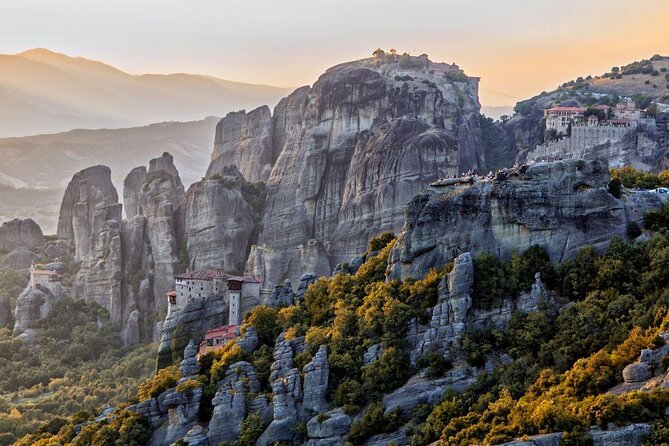
- Three monasteries inside: You visit Roussanou, Varlaam, and Great Meteoron, while seeing the remaining monasteries from outside.
- Four hours well used: A 9:00 a.m. start normally brings you back around 1:00 p.m., leaving the rest of the day free.
- Local guides add value: Guides including Apostolis and Vaggelis have been praised for strong English, humor, and personal knowledge of Kalambaka and Meteora.
- Photo stops are part of the plan: The minibus pauses at major viewpoints, not just monastery entrances.
- Transport solves the hard part: Pickup and drop-off are included from hotels and Airbnbs in Kalambaka and Kastraki.
- Budget for extra costs: The listed monastery fees are €5 for Great Meteoron per person, plus €5 each for Roussanou and Varlaam per booking.
Why a half-day is a smart way to see Meteora
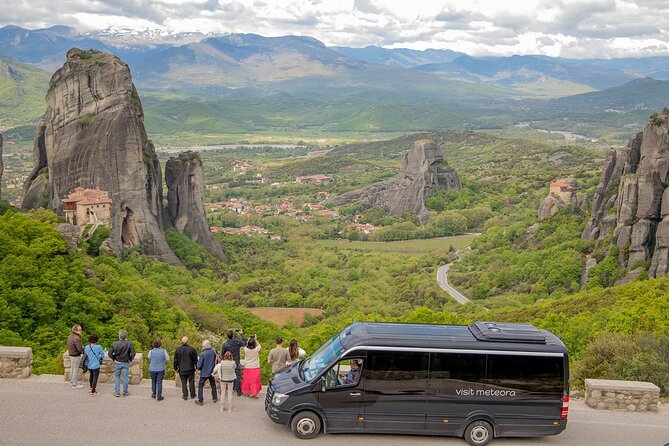
Meteora is not a place you want to experience only through a car window. The monasteries sit on tall rock pillars, and the scale is hard to understand until you stop, climb, and look back across the valley.
At the same time, walking between all six active monasteries would take far longer than most short visits allow. This tour gives you a practical middle ground: you ride between the sites, hear the story of the area on the road, enter three monasteries, and stop for wide views along the way.
The price, $36.30 per person, is particularly attractive if you are staying in Kalambaka or Kastraki and do not have a car. You are paying for transport, a driver, a guide, bottled water, onboard WiFi, and a compact route through one of Greece’s most unusual sights.
The low price does come with limits. The tour is guided in English, while the free audio guide covers Spanish, French, German, Italian, Portuguese, Chinese, Japanese, Polish, Russian, Korean, and other listed languages. Also, the guide and driver do not provide the full interior commentary inside the monasteries.
More Monastery Tours in Meteora
- Meteora Sunset with Monastery & Hermit Caves Tour in Small Group
★ 5.0 · 706 reviews - Meteora Small Group Hiking tour with Transfer and Monastery Visit
★ 5.0 · 484 reviews - Meteora: Morning Half Day Sightseeing and Monasteries Tour
★ 4.7 · 478 reviews
Pickup from Kalambaka or Kastraki
The tour begins at 9:00 a.m., with pickup offered from hotels and Airbnbs in Kalambaka and Kastraki. That is useful here because the monasteries are spread across steep roads above town, and arranging your own transport can add time and cost.
The group size is capped at 18 people. That is still a group, but it is far more workable than a large coach. Several people have specifically praised punctual pickup, friendly drivers, and careful drop-off points near the monastery entrances.
The vehicle also matters more than it might on an ordinary sightseeing ride. Meteora’s roads climb and curve around the rocks. A local driver familiar with the route can keep the morning moving while your guide explains what you are seeing.
You receive bottled water and free WiFi onboard. Food and drinks beyond the water are not included, so eat before pickup or plan for something afterward in Kalambaka or Kastraki.
The first view of Meteora’s monastery world
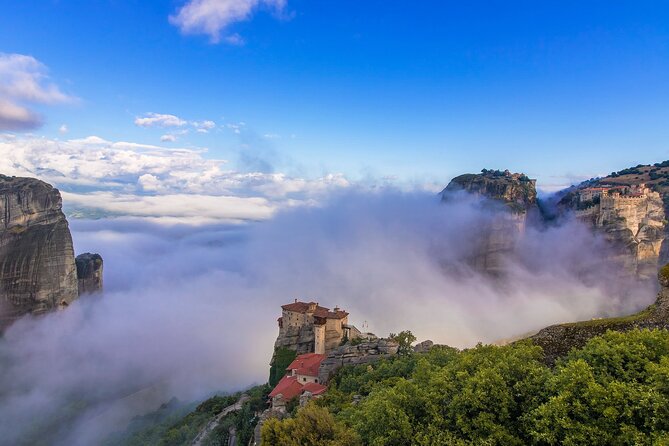
The route introduces you to a remarkable chapter of Orthodox monastic life. Twenty-four monasteries were founded on the summits of Meteora’s rocks between the 14th and 16th centuries. Six remain open and visible today.
These communities became important centers of Orthodox belief during the Byzantine era. Their churches contain religious artwork, handmade objects, manuscripts, and museum displays. The setting is protected in two ways: Meteora is a UNESCO World Heritage site, and the Meteora-Antichassia area is a Natura 2000 ecological zone because of rare birds and flowers.
Your guide’s role is most useful here. The cliffs are spectacular enough to photograph without explanation, but the story explains why people built monasteries in places that seem almost impossible to reach. Guides such as Apostolis have been praised for speaking excellent English and for sharing a personal connection to the area.
Do not expect a formal lecture from start to finish. The most successful version of this tour seems to be conversational, with explanations during the drive and before each monastery, followed by time for you to explore.
Saint Nicholas of Anapafsas, the first monastery on the road
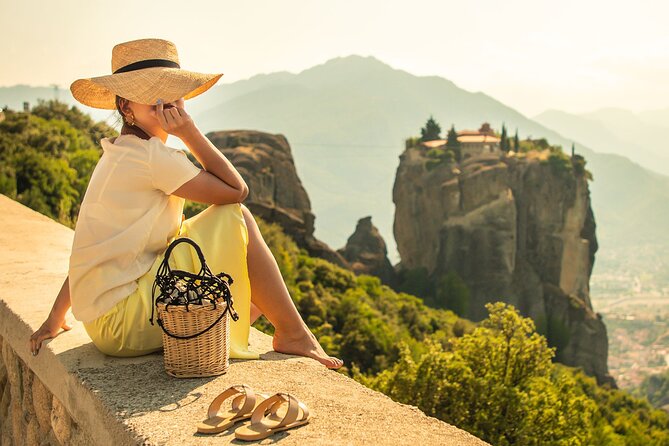
Saint Nicholas of Anapafsas is the first monastery encountered on the way up to Holy Meteora. It was founded at the end of the 14th century.
The name has several explanations. One suggests that Anapafsas came from a benefactor. Another connects it with the monastery’s position along the route, where it may have offered pilgrims a place to rest before continuing higher.
This is a good early reminder that the monasteries were not placed randomly. Their positions shaped the entire journey upward. You may see Saint Nicholas from the outside rather than entering it, since the tour’s included interior visits focus on three other monasteries.
That outside view still matters. From the road, your guide can help you understand how each complex fits onto its rock. If you want a long interior visit at every monastery, this half-day format will feel too quick. If your goal is to understand the full group of monasteries while entering the most important stops, it works better.
More Meteora monastery days:
- Meteora: Majestic Sunset Tour & Monasteries with Local Guide
★ 4.7 · 359 reviews - Meteora: Panoramic Morning Small Group Tour with Local Guide
★ 4.7 · 334 reviews - Meteora Panoramic Morning Small Group Tour with Local Guide
★ 5.0 · 311 reviews - Majestic Sunset Meteora Tour with Local Guide
★ 5.0 · 237 reviews
Roussanou Monastery and its lower, easier position
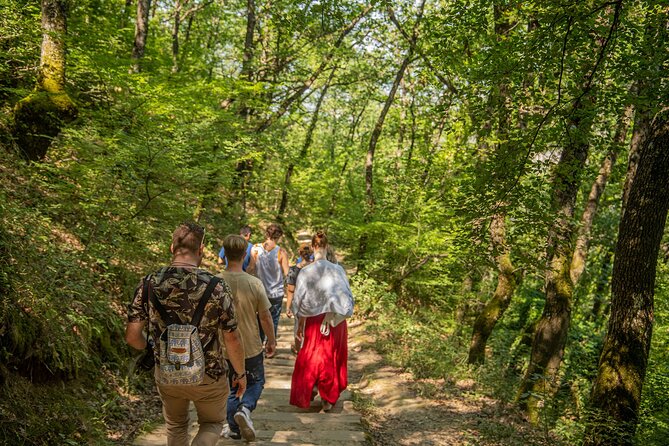
Roussanou is one of the included monastery visits, with about 45 minutes set aside for the stop. Compared with several neighboring sites, it sits at a lower elevation and is more accessible.
The main church was founded at the end of the 16th century and decorated about thirty years later. The monastery suffered serious damage during World War II and became a convent in 1988.
The lower setting changes the feel of the visit. You still get the classic Meteora experience of approaching a monastery perched on rock, but the climb may feel less demanding than at some of the higher sites. Do not read more accessible as step-free, though. The tour information specifically warns you to expect steps throughout the morning.
Inside, take time to notice the church decoration and the compact setting. The guide will explain the important points before you go in, but the guide does not enter with you as a state-licensed interior specialist. The free audio guide can help if you want information in another language.
The listed entrance cost for Roussanou is €5 per booking. Bring cash, since some monasteries do not accept cards.
Varlaam’s church and its dramatic position
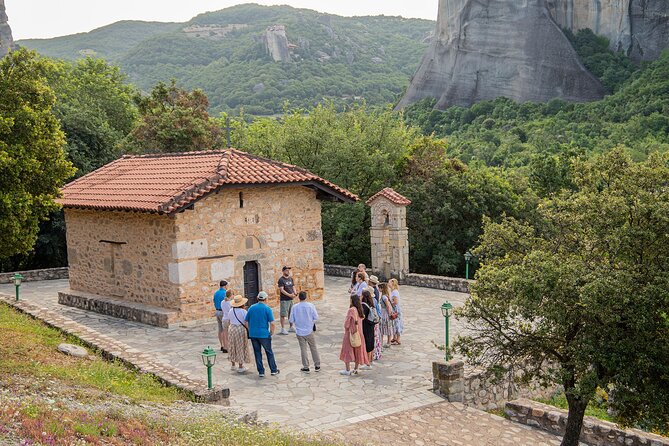
Varlaam is the second-largest monastery and sits opposite Great Meteoron. The visit lasts about 45 minutes, giving you enough time to climb, look around, and take in the views without turning the morning into a race.
The monastery was founded in the mid-14th century by Hosios Varlaam. Its main church, known as the katholikon, was built in 1541 and 1542 by two priest-monks from Ioannina, Theophanes and Nectarios Apsarades. The wall paintings were completed in 1548 and are attributed, based on artistic style, to the Theban painter Frago Catelano.
That detail gives Varlaam a different character from a simple scenic stop. You are not only looking at a building on a cliff. You are seeing a place shaped by builders, monks, painters, and centuries of religious work.
The approach includes stairs, and you should wear shoes with a firm sole. The view across to Great Meteoron is one of the reasons the route works so well: the monasteries are not isolated sights but part of a connected mountain setting.
The listed entrance fee is €5 per booking. Again, carry euros in cash.
Great Meteoron, the largest and oldest monastery
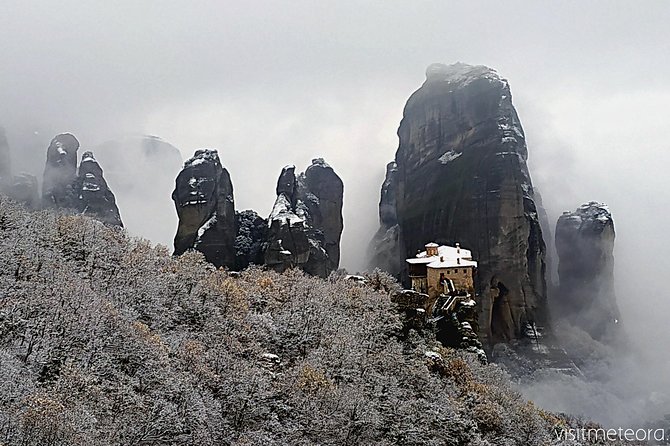
Great Meteoron receives about an hour, the longest visit on the route. That extra time makes sense. It is the biggest and oldest of the monasteries and the place most closely tied to the meaning of Meteora, often translated as suspended in the air.
Saint Athanasios the Meteorite founded the monastery and organized a systematic communal monastic life there. Its foundation is considered a turning point in the development of organized monasticism at Meteora.
For you, the practical difference is space and scale. Great Meteoron offers more to see, so an hour gives you room to move through the complex, visit its displays, and take in the views without rushing every stop.
The entrance fee is listed as €5 per person. Since this fee is separate from the tour price, your total cost will be higher than $36.30. Even so, the combined expense remains reasonable for a morning that includes transport and three monastery interiors.
The stairs here may be the most demanding part of the day for some people. The number of steps varies by route and conditions, but the tour clearly requires a fair amount of walking up and down. One useful point from the experience is that the climb may look more intimidating from below than it feels once you take it at a steady pace.
Holy Trinity and Saint Stephen from the outside
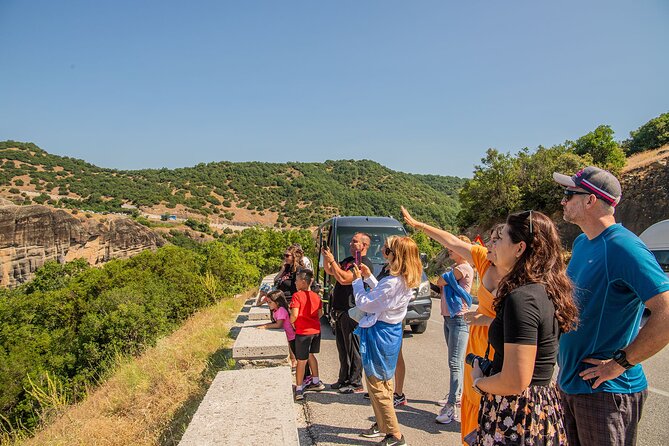
Holy Trinity, or Agia Triada, is the most difficult monastery to reach among the sites described. It sits on a steep rock near Saint Stephen’s Nunnery, and the approach includes a path to the base followed by roughly 140 steps.
The reward is a wide view over the surrounding area. You may not enter Holy Trinity on this tour, but seeing it from the road helps you appreciate the physical challenge faced by the people who built and maintained these communities.
Saint Stephen is the most accessible monastery in the group. Instead of climbing a long staircase, you cross a small bridge to reach the entrance. That makes it the best option for someone who cannot manage many steps, though you should still confirm your own needs before booking.
Monastic life on the rock of Saint Stephen reaches back to the early 12th century. Hosios Antonios and Hosios Philotheos are associated with its foundation and rebuilding, including the present church from 1545.
The tour sees the other monasteries from outside, giving you a fuller picture of Meteora than a route focused on only three interiors. This is one of the strongest parts of the design. You get variety without spending the entire morning climbing into every complex.
Photo stops are not filler
The best photo stops are often away from the monastery doors. From the viewpoints, you can see the rocks as a group, with several monasteries placed high above the valley.
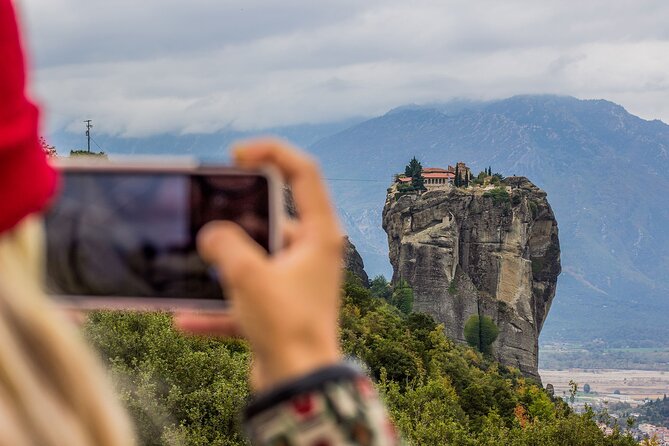
The guides and drivers have been praised for knowing where to stop and for helping with photos, including for solo visitors. That small service can make a real difference when you want a picture that includes you rather than another arm’s-length phone shot.
The stops also break up the walking. After climbing around a monastery, you return to the vehicle, hear more commentary, and then get a chance to stretch your legs at a viewpoint. The rhythm feels more comfortable than a continuous sequence of stairs.
A morning departure is a good choice. The tour begins at 9:00 a.m., and one person specifically noted that staying overnight in Meteora and taking a morning tour helps avoid heavier crowds. You cannot control every condition, but an early start generally gives you a calmer first look.
What the guide does, and what the guide does not do
The guide is the heart of this experience. Strong guides such as Apostolis and Vaggelis have been praised for clear English, humor, local knowledge, and a personal connection to Kalambaka. Jim and Lidia have also been singled out for informative, engaging explanations.
You should expect commentary on the road, at viewpoints, and before entering each monastery. The guide can point out what to notice inside and explain how the monasteries fit into the wider story.
You should not expect the guide to walk through the interior with you as a licensed specialist. That distinction matters if you care most about frescoes, manuscripts, and religious art. You will receive useful context, but the inside portion is largely self-guided.
The free smart audio guide helps fill that gap, especially if English is not your preferred language. If your main goal is detailed interior interpretation in your own language, compare this with a private or fully licensed monastery tour.
Clothing, stairs, and the real effort involved
Meteora is not a flip-flop outing. Wear comfortable shoes, since the route includes stairs, pathways, and uneven approaches.
The monasteries enforce a strict dress code. Men must wear trousers and long sleeves. Women must wear a long skirt. If you arrive in shorts, trousers, or a short skirt, clothing is provided, but it is more comfortable to arrive prepared.
The tour is suitable for most people, but the physical effort should not be brushed aside. Some people find the climbs manageable, while others may need more time. Saint Stephen is the easiest site to reach, and the company has helped people with mobility concerns, but this is not a step-free tour.
The driver’s role is valuable here. A careful driver can leave you close to the practical access point, reducing unnecessary walking before the actual climb begins.
Who gets the best value from this tour
I would choose this tour if you have one morning in Meteora and want a clear introduction without renting a car. It is also a good fit if you want the major views, three interior visits, and enough historical background to make sense of what you see.
It suits first-time visitors, solo visitors who appreciate help with photos, and people staying in Kalambaka or Kastraki. The small group limit of 18 keeps the outing more personal than a large coach trip.
You may want something else if you want to enter all six monasteries, spend a long time studying religious art, or receive detailed commentary inside every church. A private tour with a licensed guide would better match those priorities.
There is one other point to watch. If you have already taken another Meteora tour, the route may repeat a monastery or viewpoint. One person had hoped to see a different site after doing a sunset tour the previous day. If you are combining tours, ask about the planned stops in advance.
Should you book the Meteora half-day tour?
For $36.30, this is a strong-value introduction to Meteora. You get transport, a local English-speaking guide, three monastery interiors, outside views of the others, photo stops, water, WiFi, and a four-hour schedule that leaves your afternoon open.
Book it if convenience and broad coverage matter more than detailed interior guiding. Bring cash for the entrance fees, dress correctly, wear shoes suited to stairs, and choose the morning start if you can.
Skip it only if you need a fully guided visit inside every monastery or have difficulty with repeated climbs. For most people with limited time, this tour offers the right mix of scenery, history, transport, and practical help.
FAQ
How long does the Meteora monasteries tour last?
The tour lasts approximately four hours. It starts at 9:00 a.m. and commonly finishes around 1:00 p.m.
Where does pickup take place?
Pickup and drop-off are offered from hotels and Airbnbs located in Kalambaka and Kastraki village.
How many monasteries can I enter?
The tour includes interior visits to three monasteries: Roussanou, Varlaam, and Great Meteoron. The other monasteries are viewed from outside.
Are monastery entrance fees included?
No. The listed fee for Great Meteoron is €5 per person. Roussanou and Varlaam are listed at €5 per booking each. Bring cash because some monasteries do not accept credit cards.
Is the tour offered in languages besides English?
The tour itself is guided in English. A free audio guide is available in Spanish, French, German, Italian, Portuguese, Polish, Russian, Chinese, Japanese, and Korean, among the listed languages.
What should I wear to the monasteries?
Men must wear trousers and long sleeves. Women must wear a long skirt. If you arrive in unsuitable clothing, trousers and skirts are provided.
How large is the group?
The tour has a maximum of 18 people. Round-trip transportation, bottled water, and free WiFi onboard are included.
More Half-Day in Meteora
- Athens: Cape Sounion & Poseidon Temple Sunset Half-Day Trip
★ 4.8 · 8,241 reviews - Cape Sounion and Temple of Poseidon Half-Day Small-Group Tour from Athens
★ 4.5 · 3,205 reviews - Half-Day Exclusive Catamaran Cruise in Santorini with Meal and Open Bar
★ 5.0 · 2,975 reviews - From Rethymno: Half-Day Quad Bike Safari
★ 4.8 · 1,444 reviews
Just added around Meteora
- Meteora Evening Tour with Breathtaking Sunset View★ 5.0 · 44 reviews
- Sunset Meteora Tour on E-Bike★ 5.0 · 46 reviews
- Private Tour: Meteora Tour with Transport from Kalambaka★ 5.0 · 50 reviews
- Meteora Motorized or Footlaunch Flight Experience★ 5.0 · 54 reviews
- Meteora Sunset Tour on E-bikes★ 5.0 · 54 reviews
- Meteora: Sunset Hike to Secret Caves★ 4.9 · 56 reviews
- Meteora: Guided Sunset Tour with Monasteries and Caves Visit★ 5.0 · 58 reviews
- Meteora: Monasteries Tour with Lunch and Athens Transfer Option★ 5.0 · 64 reviews
Meteora Monastery Tours, compared.
Meteora Monasteries Day Trip with Caves and Lunch
Read our review →

Meteora Tour with Local Guide and Greek Lunch
Read our review →
Meteora Monasteries, Caves & Coastal Stopovers with Lunch
Read our review →
Meteora Monasteries & Caves DayTrip from Athens with Greek Lunch
Read our review →
4-Day Classical Greece Tour: Epidaurus, Mycenae, Olympia, Delphi, Meteora
Read our review →Browse the lists this tour appears in