

Reviewed · ACROPOLIS & PARTHENON TOURS
Visit of the Acropolis with an official guide in Spanish
The Acropolis rewards a closer look. This two-hour Spanish-language tour gives you the stories, myths, and building details that turn a hilltop ruin into ancient Athens. I like the official guide format, and I like that wireless audio keeps the explanations audible while the group moves around the monuments. The main catch is simple: your Acropolis admission ticket is not included, so you must arrange entry separately.
The 8:30 a.m. start is a smart choice for a site that can become hot and crowded. Guides such as Efi, Ari, Simon, and Maria have earned especially warm praise for making the material lively and easy to follow. Still, the group can reach up to 27 people, and the tour is entirely on foot over uneven ground.
In This Review
- Key points before you book
- Why a guide changes the Acropolis
- Meeting at 8:30 a.m. near Dionysiou Areopagitou
- The Propylaea: your dramatic entrance
- The Temple of Athena Nike and the memory of victory
- The Parthenon in 20 focused minutes
- The Erechtheion and its famous Caryatids
- The Odeon of Herod Atticus
- Asclepios and the ancient approach to medicine
- The Theatre of Dionysus and the birth of drama
- What the price delivers
- Physical effort, weather, and group size
- How the tour handles families and Spanish speakers
- Booking, cancellation, and the final decision
- Should you book this Acropolis tour?
- FAQ
- Is the Acropolis admission ticket included?
- What language is the tour conducted in?
- What time does the tour begin?
- How long does the experience last?
- Where does the tour end?
- Are transportation transfers included?
- What is the maximum group size?
- Can I cancel for a full refund?
Key points before you book
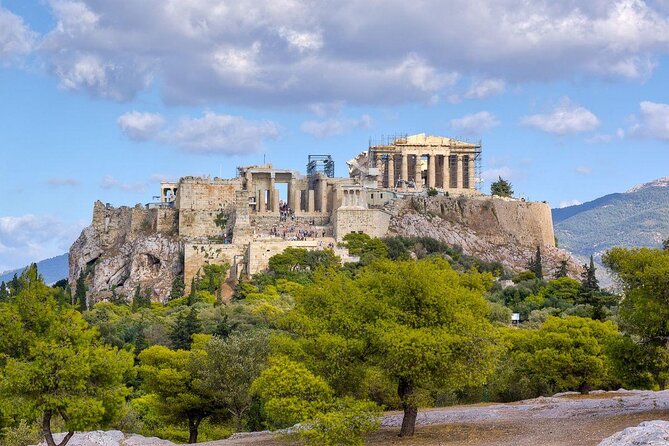
- Spanish-speaking official guide: The tour is conducted exclusively in Spanish, with historical, mythological, architectural, and social context throughout.
- Ticket not included: You pay $44.03 for the guiding service, but you must also have a valid Acropolis entry ticket.
- Early 8:30 a.m. meeting: Starting at the Greek National Tourism Organisation Information Point helps you tackle the site before the strongest heat.
- Seven major Acropolis sights: The route covers the Parthenon, Propylaea, Temple of Athena Nike, Erechtheion, Odeon of Herod Atticus, Temple of Asclepios, and Theatre of Dionysus.
- Wireless audio system: You can hear the guide more clearly than on a standard walk-and-talk tour.
- Finishes at the top: The group ends at the Acropolis summit, leaving you free to take photographs and continue exploring.
Why a guide changes the Acropolis
The Acropolis is easy to admire and surprisingly easy to misunderstand. You see marble columns, broken statues, and grand views, but without context, the hill can feel like a collection of impressive fragments rather than a connected story.
This tour supplies that missing thread. You learn how Athens linked religion, politics, war, theater, medicine, and public identity on one rocky hill. The guide explains not only what a monument is, but why it was built there and what it meant to people at the time.
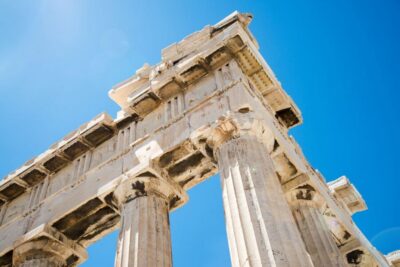
That matters most at the Parthenon. A quick photograph shows its size and surviving columns. A good explanation helps you notice the optical refinements, the changing religious uses, the damage, the looting, and the restoration work still under way.
The guiding style is also a major strength. Efi receives repeated praise for her warmth, passion, and ability to involve children and adults alike. Ari is described as equally animated, while Simon and Maria are singled out for clear, engaging explanations. Your guide may be someone else, but the experience is built around a personal, story-driven presentation rather than a dry recitation of dates.
More ways to see the Acropolis:
- Athens: Acropolis & up to 5 Archaeological Sites Combo Pass
★ 4.4 · 12,619 reviews - Athens: Acropolis Ticket with Optional Audio or Live Guide
★ 4.2 · 11,055 reviews - Athens: Acropolis, Parthenon & Acropolis Museum Guided Tour
★ 4.8 · 9,316 reviews
Meeting at 8:30 a.m. near Dionysiou Areopagitou
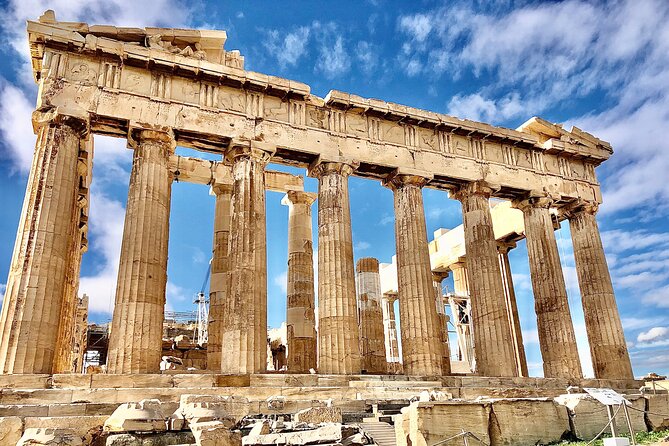
You meet at the Greek National Tourism Organisation Information Point at Dionysiou Areopagitou 18. The tour begins at 8:30 a.m., which is useful for two reasons: the Acropolis visit requires walking, and Athens can become very hot later in the day.
The meeting point is near public transportation, but transfers are not included. You make your own way there and walk for the full duration of the experience. Plan your morning around the meeting time, since the stated duration is approximately two hours and the route involves slopes, steps, and uneven historic surfaces.
The tour can include up to 27 people. That is not an intimate private visit, but the wireless audio system should make it easier to follow than a large group clustered around a guide trying to project a voice.
You also need your admission ticket before entering. The tour price of $44.03 per person covers the guide, audio equipment, and taxes, not the ticket to the archaeological site. This separation can be useful if you have already arranged entry, but it is an easy cost to overlook when comparing tour prices.
The Propylaea: your dramatic entrance
The Propylaea is the monumental gateway to the Acropolis. It was built in marble to impress people approaching the sacred hill, and it still does its job well.
Here, your guide explains the structure’s strategic role. The topography and narrow approach could act as a funnel during wartime, while the different column types reveal that the architects were working with more than one architectural language.
This is an excellent early stop because it teaches you how to look. Ancient buildings were not placed at random. Their position, scale, materials, and approach all shaped how people experienced them.
The climb also sets the physical tone for the visit. You should expect a moderate level of exertion. The site is not a flat museum, and comfortable shoes are far more useful than stylish ones.
The Temple of Athena Nike and the memory of victory
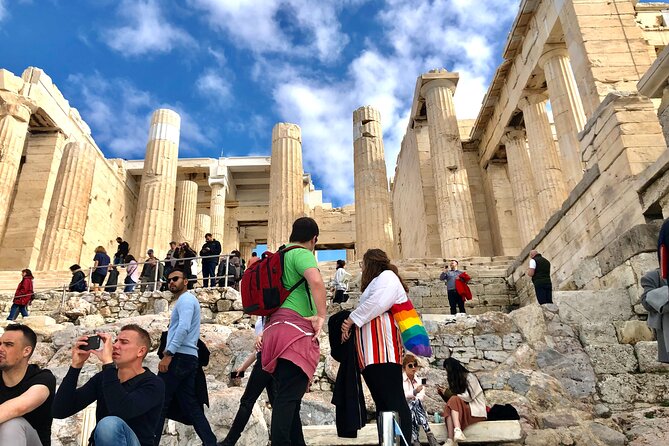
Near the monumental entrance is the small Temple of Athena Nike, dedicated to Athena as the goddess of victory. Its position is easy to miss if you are focused only on the Parthenon, so having a guide point it out adds real value.
The temple was built after Greek victories over the Persians. The guide connects the building to the pride of Athens during its golden age, when monuments were also statements about power, success, and civic identity.
This is one of the moments when a guided route beats wandering alone. You get the chance to understand why a relatively small structure mattered so much, rather than treating it as another set of marble remains beside the main attraction.
More things to do in Athens:
- Athens: Cape Sounion & Poseidon Temple Sunset Half-Day Trip
★ 4.8 · 8,241 reviews - Athens: Acropolis and Parthenon Guided Walking Tour
★ 4.6 · 5,882 reviews - All Day Cruise -3 Islands to Agistri,Moni, Aegina with lunch and drinks included
★ 5.0 · 4,958 reviews - Athens, Piraeus, and Coastline: Blue Hop-On Hop-Off Bus
★ 3.9 · 4,849 reviews
The Parthenon in 20 focused minutes
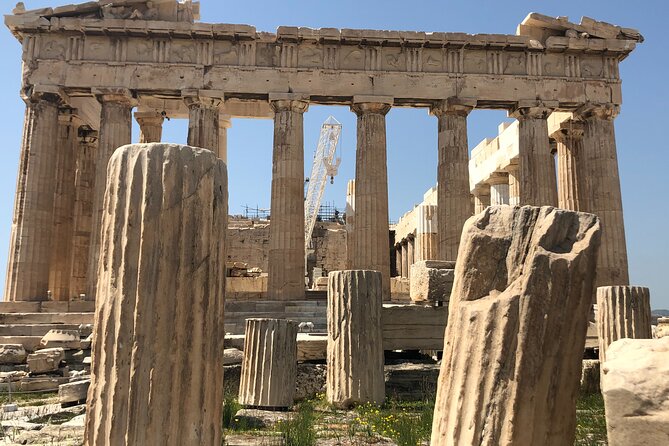
The Parthenon receives the most time on the route, with about 20 minutes devoted specifically to it. That may sound brief, but the broader Acropolis visit also places the building within its setting and connects it to nearby monuments.
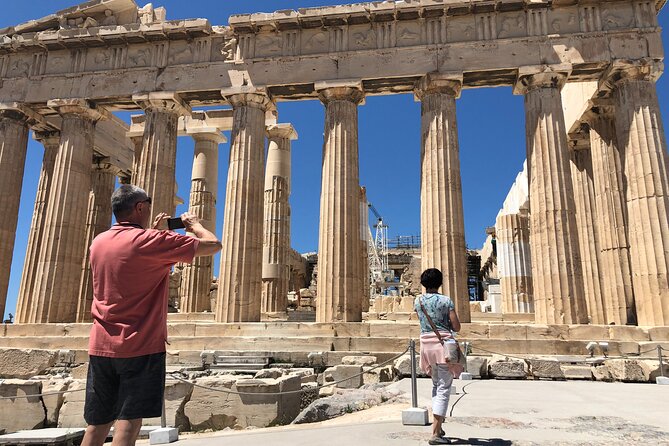
The guide covers the temple’s construction about 2,500 years ago, its carefully refined appearance, and the legends tied to it. You learn about the building’s proportions and optical adjustments, which helped create an impression of harmony despite the irregularities of the hill and the limits of human vision.
The building’s later life is just as important. The Parthenon became a church during the Byzantine period and a mosque under Ottoman rule. Its story includes damage and looting, followed by the restoration work that continues today.
Do not expect to walk inside the Parthenon or examine every detail at close range. The visit is conducted within the Acropolis complex, and the guide must keep the group moving. The benefit is a clear overview, not an architectural seminar lasting half a day.
The Erechtheion and its famous Caryatids
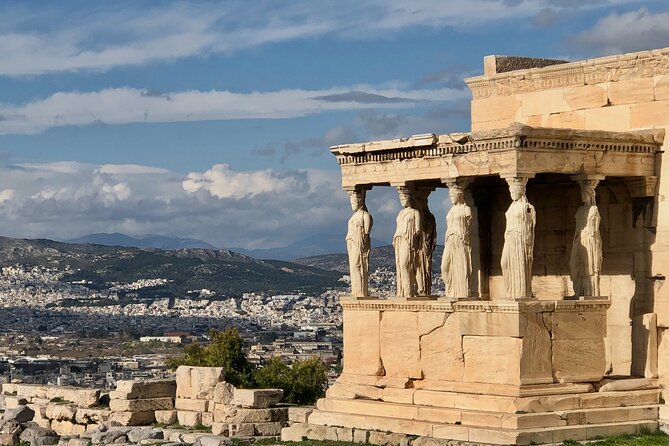
The Erechtheion is often the most photogenic stop, thanks to its Caryatids, the sculpted female figures used as columns. Their graceful appearance can make the building seem simple, but its religious role was complex.
The temple was dedicated to several figures, including Athena, Poseidon, and Erechtheus, a mythological early king of Athens. The guide uses these connections to explain how several traditions could share one sacred space.
You also hear why the olive tree associated with the temple is sacred. That detail helps connect the monument to the contest between Athena and Poseidon and to the wider identity of Athens.
The Caryatids are a favorite photograph, but the guide helps you look beyond the familiar image. The temple’s unusual design reflects the different gods and myths honored there. It is a compact lesson in how religion shaped ancient architecture.
The Odeon of Herod Atticus
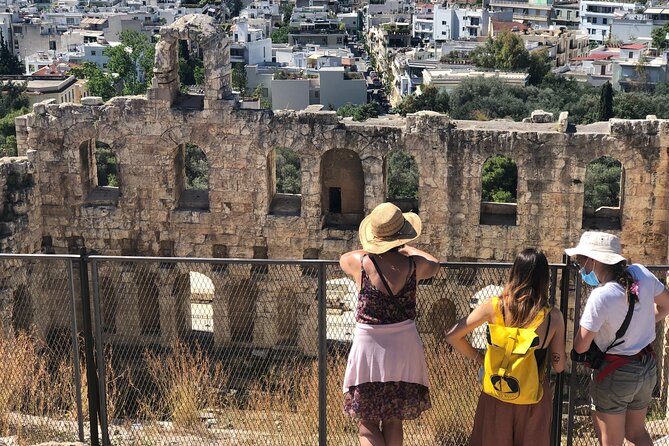
The Odeon of Herod Atticus, also called the Herod Atticus Auditorium, gives the Acropolis route a Roman-era chapter. It was built by a prominent Roman governor in Athens and dedicated to his wife, Regilla.
The theater could hold about 5,000 spectators. Unlike many ancient structures, it has been fully restored and remains in use for performances during the Athens Festival.
You view the auditorium as part of the Acropolis visit rather than attending a show. That distinction matters. The stop is short, about 10 minutes, but it shows how the hill continued to function as a cultural center long after the classical period.
It is also a good reminder that the Acropolis is not frozen in one moment. Classical Athens is the main focus, but later Roman, Byzantine, Ottoman, and modern chapters all belong to the site’s story.
Asclepios and the ancient approach to medicine
The Temple of Asclepios is a smaller stop, with about five minutes set aside for it. The temple honored Asclepius, the god of medicine.
Here, the guide explains how ancient Athenians treated patients and what types of offerings people left in thanks. These details bring a human scale to the visit. The Acropolis was not only a place of grand state monuments. It also included spaces connected with health, prayer, illness, and personal hope.
Because the stop is short, you will not receive a long medical history lecture. Instead, it works as a quick glimpse into everyday religious practice and the ways ancient people understood healing.
The Theatre of Dionysus and the birth of drama
The Theatre of Dionysus Eleuthereus sits on the slope of the Acropolis and is one of the oldest theaters in the world. It was built in marble and could hold around 17,000 spectators.
The location helped create strong acoustics, while the size made the theater suitable for major public performances. This is where works by Euripides, Aeschylus, Sophocles, and Aristophanes were first presented.
For many people, this is the stop that makes ancient Athens feel most alive. You are not only looking at stones. You are standing in a place tied to some of the foundational works of Western drama.
The tour allocates about 10 minutes here. That is enough for orientation and explanation, but not enough for an extended discussion of Greek theater. If drama is a major interest, you may want to spend extra time in the area after the guided portion.
What the price delivers
At $44.03 per person, this is not the cheapest way to enter the Acropolis, especially since admission is extra. The value depends on how much you want from the site beyond photographs.
I think the price makes sense if you want an official Spanish-speaking guide, clear historical context, and a structured route through the key monuments. You also receive a wireless audio system and state taxes in the listed cost.
The value is weaker if you already know the Acropolis well, prefer a slow independent visit, or want to spend long periods photographing one building. The tour has a fixed pace and covers many stops in about two hours.
The biggest practical advantage is efficiency. You see the main monuments in a logical order and finish at the top, where you can continue taking photographs and enjoy free time. You are not left wondering which ruined wall mattered or how the buildings fit together.
Physical effort, weather, and group size
You need moderate physical fitness for this visit. The tour is on foot, and the Acropolis includes inclines and uneven surfaces. The information provided does not promise special assistance or a flat route, so anyone with mobility concerns should assess the terrain carefully before booking.
The 8:30 a.m. start helps with heat, but it does not remove the need for preparation. The experience takes place outdoors, and one guide’s account specifically notes that the tour remained engaging despite intense heat. That is a reminder to plan for sun and warm conditions.
Service animals are allowed. The tour is also near public transportation, but no transfers are provided. You are responsible for reaching the meeting point and managing personal expenses.
The group size of up to 27 people is worth weighing. A larger group can feel less personal, but the audio system and strong guide-led structure should keep the commentary usable. If you want long one-to-one conversations, a private tour would be a better fit, but that is not what this experience offers.
How the tour handles families and Spanish speakers
This experience is especially suitable if Spanish is your preferred language. Complex subjects such as mythology, temple design, and shifting religious uses are easier to follow when explained naturally rather than through a translated recording.
It also appears well suited to families. Efi is praised for keeping children attentive, asking questions, and making the past feel tangible. That style can make a major difference on a hot hill where younger children may tire of dates and names.
The tour is also a good match for first-time visitors to Athens. You get a broad orientation to the Acropolis, then finish with time to look and photograph on your own.
I would choose a different format if you want a quiet, unhurried archaeological study. The route gives each monument a useful introduction, but some stops last only five or 10 minutes.
Booking, cancellation, and the final decision
Confirmation is provided at booking, and free cancellation is available if you cancel at least 24 hours before the start time. Changes or cancellations inside that window are not accepted for a refund, so check your plans before committing.
The experience is booked around 25 days in advance on average. That suggests you should not leave it until the last minute if you need a Spanish-language tour on a particular morning.
Should you book this Acropolis tour?
Book it if you want the Acropolis explained in Spanish by an official guide, especially if this is your first visit or you are traveling with children. The strongest reasons are the guide-led storytelling, the broad range of monuments, the wireless audio, and the early start.
You should skip it if you already have detailed Acropolis knowledge, want complete control over your pace, or have not yet secured your admission ticket. The ticket is not included, and the group may reach 27 people.
For most Spanish-speaking visitors, though, this is a sensible way to make the Acropolis more than a photo stop. The tour gives you the essential structure, mythology, architecture, and later history, then leaves you at the summit with time to look around for yourself.
FAQ
Is the Acropolis admission ticket included?
No. The tour price does not include admission to the Acropolis. You need an entry ticket to take part in the visit.
What language is the tour conducted in?
The tour is conducted exclusively in Spanish with an official tourist guide.
What time does the tour begin?
The tour starts at 8:30 a.m. at the Greek National Tourism Organisation Information Point, Dionysiou Areopagitou 18, Athens.
How long does the experience last?
The guided visit lasts approximately two hours.
Where does the tour end?
The tour ends at Theorias 21, directly at the top of the Acropolis. You can use the remaining time to photograph the monuments and explore independently.
Are transportation transfers included?
No. The visit is done on foot, and transfers are not included.
What is the maximum group size?
The tour can have a maximum of 27 participants. A wireless audio system is included.
Can I cancel for a full refund?
Yes, if you cancel at least 24 hours before the experience start time. Cancellations or changes made less than 24 hours before the start are not refunded or accepted.
Just added around Athens
- Athens Hotels to Athens Airport Private Departure Transfer★ 5.0 · 40 reviews
- Private One-way Transfer between Athens International Airport and Athens Hotels★ 4.5 · 40 reviews
- Athens: Acropolis Museum Ticket with Self-Guided Audio tour App★ 3.5 · 40 reviews
- From Athens: Meteora Train Trip with Overnight Stay★ 4.8 · 40 reviews
- Athens Photography Tour★ 5.0 · 40 reviews
- Athens: Acropolis Visit and City Night Tour★ 4.7 · 40 reviews
- Delphi Full Day Private Trip From Athens With Lunch Overlooking the Sea★ 5.0 · 40 reviews
- Acropolis & Plaka Neighbourhood Private Tour with Licensed Expert★ 5.0 · 40 reviews
Acropolis & Parthenon Tours, compared.
Acropolis & up to 5 Archaeological Sites Combo Pass
Read our review →
Acropolis, Parthenon & Acropolis Museum Guided Tour
Read our review →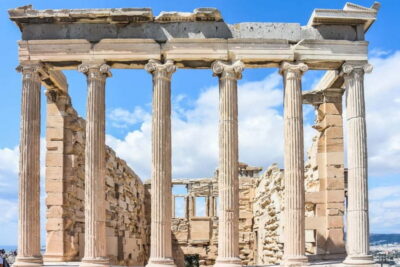
Acropolis, Parthenon & Acropolis Museum Guided Tour
Read our review →

Acropolis: Acropolis and Parthenon Guided Walking Tour
Read our review →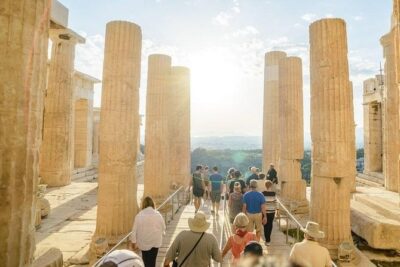
Acropolis monuments & Parthenon Walking Tour with Optional Acropolis Museum
Read our review →Browse the lists this tour appears in