
Reviewed · ACROPOLIS & PARTHENON TOURS
Private Luxury Tour: Athens Acropolis & Iconic City Highlights
Athens reveals its greatest hits in one cool ride. This private tour pairs the Acropolis and Parthenon with major ancient sites, neoclassical landmarks, and city viewpoints, making it a useful choice when you have only four or five hours. I like the door-to-door pickup and the freedom to adjust the pace with your own driver-guide. I also like the air-conditioned vehicle, bottled water, and onboard Wi-Fi, especially during Athens’ hot summer months. The main drawback is clear: entrance fees are extra, and no licensed guide accompanies you inside the archaeological sites.
The experience is best understood as a private orientation tour, not a full guided archaeological visit. Your English-speaking driver handles the route, transport, and historical commentary, while you decide how long to spend at each stop. Past bookings have included drivers named Demetrius, Dimitrios, Pericles, and Panos, with especially warm praise for their punctuality, flexibility, and friendly approach.
In This Review
- Key points to know before booking
- A private Athens tour built around flexibility
- Entering the Acropolis and meeting Pericles’ Athens
- The Parthenon
- Athena Nike and the Erechtheion
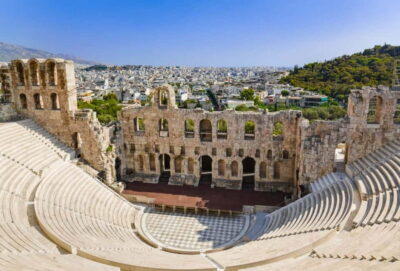
- The Odeon of Herodes Atticus
- Roman Athens and the scale of Olympian Zeus
- The Panathenaic Stadium and modern Greek ceremony
- Mount Lycabettus for the broadest city view
- The Neoclassical Trilogy on Panepistimiou Street
- Plaka, the Agora, and the final taste of old Athens
- What the guides add to the day
- Is $154.24 per person good value?
- Practical details that can make the day smoother
- Who should book this Athens tour?
- FAQ
- How long does the private Athens tour last?
- What is the price of the tour?
- Is pickup from an Athens hotel included?
- Is cruise port pickup included?
- Is airport pickup included?
- Are Acropolis and archaeological site tickets included?
- Does a licensed guide enter the archaeological sites?
- What type of vehicle is used?
- Is the tour private?
- What happens if the weather is poor?
Key points to know before booking
- The Acropolis takes center stage: You spend the most meaningful part of the visit around the Parthenon, Erechtheion, Temple of Athena Nike, and Odeon of Herodes Atticus.
- Your driver can adapt the pace: A private car lets you linger at a favorite stop or move faster when time is tight.
- The vehicle matters in Athens: Air conditioning, bottled water, and Wi-Fi make a real difference under the Greek sun.
- Admissions cost extra: Archaeological entrance fees are listed at €30 per person, and the driver does not enter the sites as a licensed guide.
- The route covers ancient and modern Athens: You see Syntagma Square, the Presidential Mansion, the neoclassical trilogy, Plaka, Mount Lycabettus, and several classical monuments.
- It works well around a cruise: Pickup and drop-off at the port can make this a practical sightseeing option before boarding.
A private Athens tour built around flexibility
This experience costs $154.24 per person and lasts about four to five hours. That price can offer solid value for a small group because the vehicle and driver are reserved for your party, rather than shared with strangers.
Groups of one to four use a luxury sedan. Groups of five to seven use a minivan. One especially useful detail is the luggage capacity noted for a Mercedes wagon taxi, which held four carry-on bags and one checked bag in addition to four passengers. If you are moving between a hotel and a cruise ship, that can simplify the day considerably.
The tour includes hotel or cruise port pickup and drop-off, private transportation, air conditioning, Wi-Fi, and bottled water. Airport pickup is available, but it costs extra. At the port, your driver meets you in the arrival area with a sign showing your name. For a hotel or apartment pickup, the driver waits outside.
The route includes travel time between stops, so you should not expect several hours inside archaeological sites. The listed stops add up to a busy schedule, with some landmarks receiving only five or 15 minutes. That is not a flaw if your goal is to get a broad view of Athens. It is a limitation if you want long museum visits or detailed site interpretation.
More City Tours in Athens
- Athens: City Sightseeing Hop-On Hop-Off Bus Tour
★ 4.3 · 4,520 reviews - City Sightseeing Athens, Piraeus & Beach Riviera Hop-On Hop-Off Bus Tours
★ 4.0 · 1,887 reviews - Athens:City Pass with Acropolis, Museums, Hop-On Hop-Off Bus
★ 3.9 · 586 reviews
Entering the Acropolis and meeting Pericles’ Athens
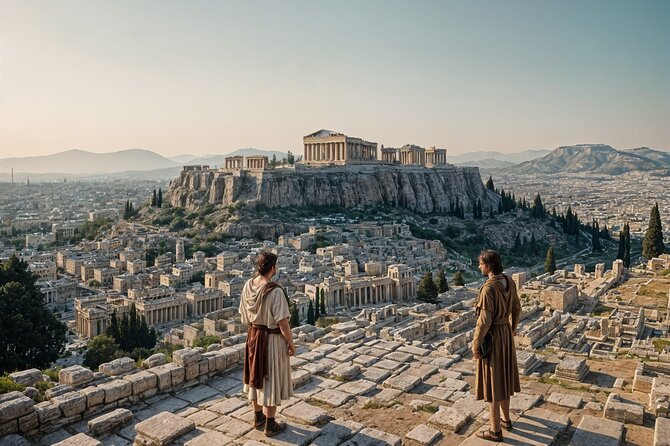
The Acropolis is the heart of the tour. The hill served as the great religious and civic center of classical Athens, and the building program associated with Pericles gave the city many of the monuments you recognize today.
The planned Acropolis visit lasts about 40 minutes, followed by separate time at the Parthenon, Temple of Athena Nike, and Erechtheion. Since the admission ticket is not included, you need to pay the archaeological entrance fee separately. The listed fee is €30 per person.
The Acropolis is not a quick roadside photo stop. You should wear comfortable shoes and expect walking over uneven ancient surfaces. A hat and sunscreen are sensible, since much of the visit takes place in open sun.
The driver-guide can explain the broad story of the hill and point out the main structures. However, the driver is not a licensed guide who accompanies you into the archaeological sites. That distinction matters. You get private transport and commentary, but not the sustained, inside-the-monument explanation that a specialist guide would provide.
The Parthenon
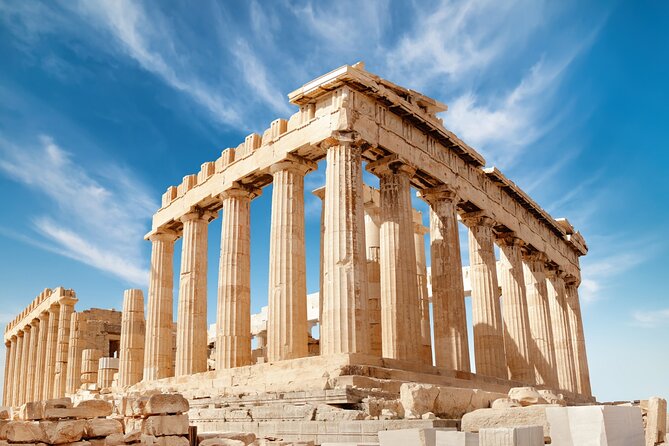
The Parthenon receives about 20 minutes in the schedule. Dedicated to Athena, the city’s patron goddess, it was built in the fifth century BC during Athens’ golden age. Its carefully planned proportions, sculptural decoration, and unusual architectural refinements made it a model of classical design.
You will not see a complete temple. Centuries of war, reuse, weather, and removal of sculpture changed the building dramatically. Even so, its surviving columns and commanding position make it the visual center of the Acropolis.
The short time allocation means you should focus on the building itself, its setting, and the views across Athens. If the Acropolis is your main reason for booking, ask to spend as much of the available site time here as possible.
Athena Nike and the Erechtheion
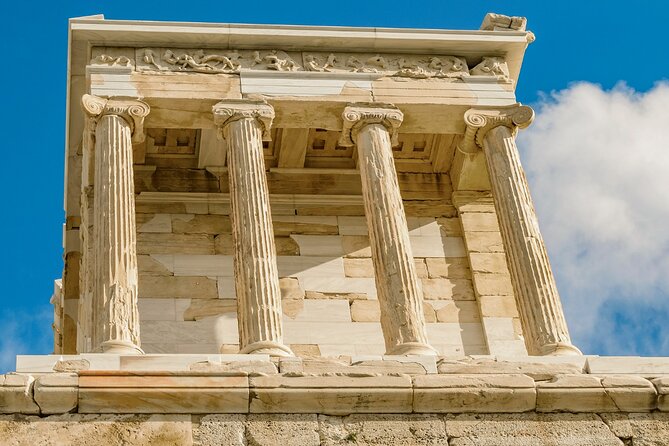
The Temple of Athena Nike receives about 10 minutes. This small Ionic temple sits near the southwest edge of the Acropolis and honored Athena in her role as bringer of victory. Its size makes it easy to miss beside the Parthenon, but its position near the entrance gives it an elegant profile.
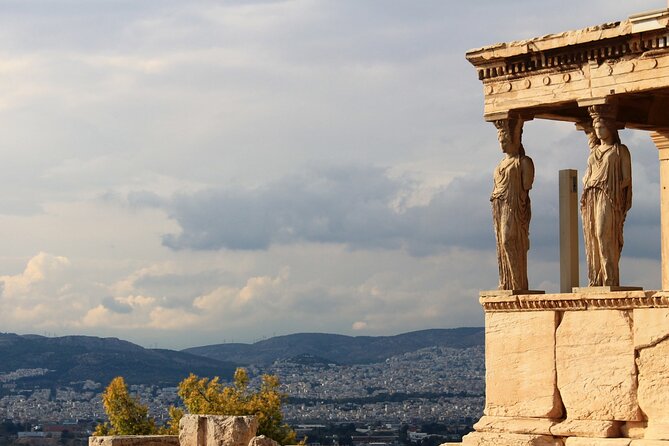
The Erechtheion receives about 15 minutes. This temple has an unusual, uneven plan because it honored both Athena and Poseidon. Its best-known feature is the Porch of the Caryatids, where sculpted female figures serve as architectural supports.
These stops reward close looking more than quick photographs. The Erechtheion in particular feels less forceful than the Parthenon, but its design tells you more about the many myths and sacred traditions attached to the Acropolis.
More ways to see the Acropolis:
- Athens: Acropolis & up to 5 Archaeological Sites Combo Pass
★ 4.4 · 12,619 reviews - Athens: Acropolis Ticket with Optional Audio or Live Guide
★ 4.2 · 11,055 reviews - Athens: Acropolis, Parthenon & Acropolis Museum Guided Tour
★ 4.8 · 9,316 reviews - Athens: Acropolis and Parthenon Guided Walking Tour
★ 4.6 · 5,882 reviews
The Odeon of Herodes Atticus
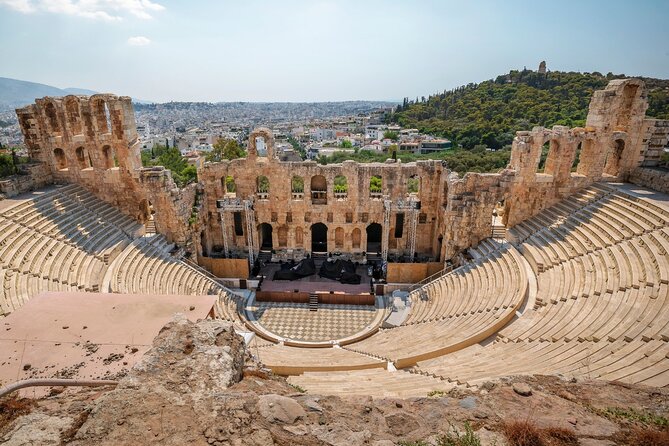
The Odeon receives about 15 minutes and sits on the southern slope of the Acropolis. Herodes Atticus built this theater in AD 161, and it remains connected with performances today.
You generally view the theater from outside rather than settle in for a show. Its restored stone seating and curved form make a strong contrast with the temples above it. This is a good example of how the tour connects ancient buildings with modern Athens without requiring a separate theater visit.
Roman Athens and the scale of Olympian Zeus
After the Acropolis, the route shifts to monuments that show how Athens changed under Roman rule.
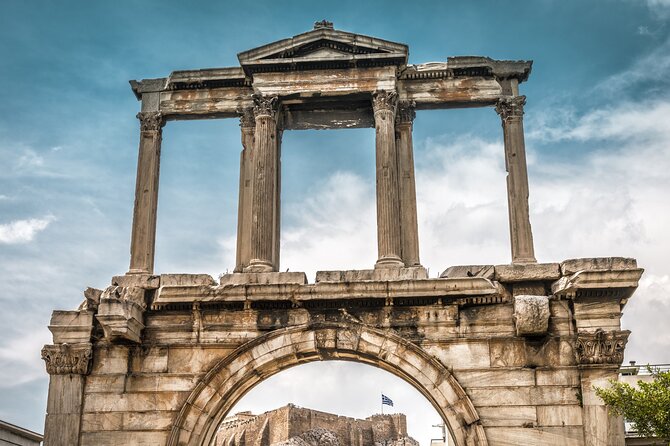
Hadrian’s Arch marks the old Greek city and the newer Roman area associated with Emperor Hadrian. Built in AD 131 from Pentelic marble, the gateway carries inscriptions honoring both Theseus and Hadrian. The stop is treated as a pass-by, so you may have only a brief look from the vehicle.
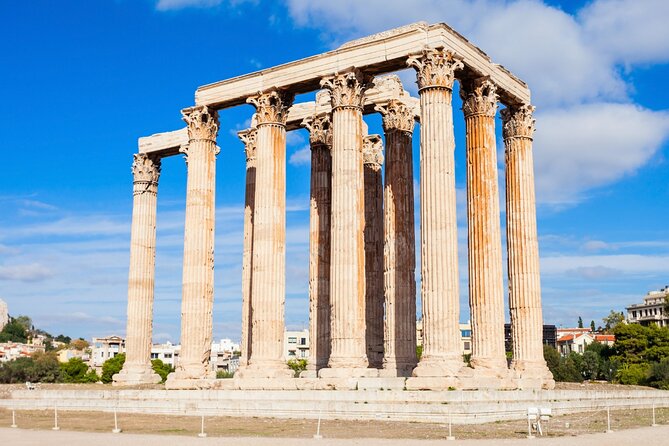
The nearby Temple of Olympian Zeus receives about 20 minutes. Construction began in the sixth century BC and ended under Hadrian in the second century AD. The surviving columns give you a useful sense of the temple’s original scale, even though the structure is now largely open sky.
The admission fee is not included at either archaeological stop. If you want to enter the grounds, allow for that cost within the stated €30 per person site fee. Ask your driver how the timing works on the day, since the route contains more stops than most people can explore at length.
The Panathenaic Stadium and modern Greek ceremony
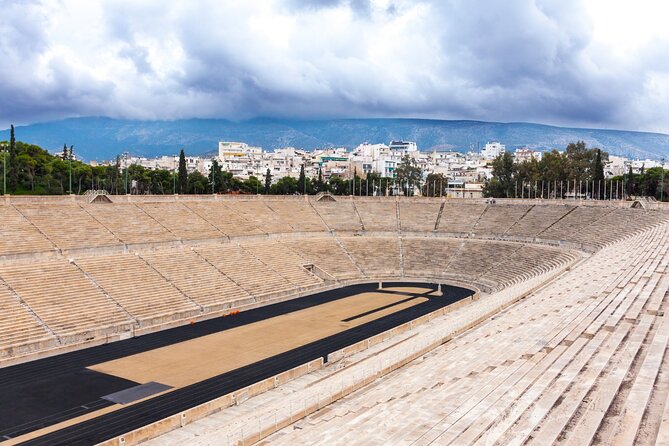
The Panathenaic Stadium receives about 15 minutes. Built in 330 BC for the Panathenaic Games, it was later reconstructed in marble by Herodes Atticus and used for the first modern Olympic Games in 1896.
The stadium is one of the easiest places in Athens to connect ancient customs with modern national identity. Its long white marble seating makes the venue instantly recognizable, even during a short stop.
The Presidential Mansion follows, with about 15 minutes and no admission charge. The building began as a royal palace and now serves as the residence of Greece’s president. Depending on timing, you may see the Evzones, the ceremonial guards known for their traditional uniforms.
The route also passes the Hellenic Parliament and Constitution Square, usually called Syntagma Square. The Parliament building began as a royal residence and now houses Greece’s elected legislature. Syntagma is the city’s central public square, surrounded by hotels, cafes, and important civic buildings.
These stops are useful because they give you more than ancient stones. You see how Athens functions as a present-day capital, with government, ceremony, and daily city life sharing the same central district.
Mount Lycabettus for the broadest city view
Mount Lycabettus receives about 20 minutes and offers a different view of Athens. From the city’s highest point, you can look across the urban spread toward the Acropolis and the Aegean Sea.
This is one of the tour’s most valuable pauses if you want to understand Athens geographically. From the Acropolis, you look outward across the city. From Lycabettus, you can look back toward the Acropolis and see how the ancient hill fits into modern Athens.
The stop is listed as free, but the overall schedule is tight. The tour does not specify a cable car ride or a particular walking route, so do not assume you will have time for an extended hilltop visit. Treat it as a viewpoint stop rather than a separate excursion.
The Neoclassical Trilogy on Panepistimiou Street
The Academy of Athens, University of Athens, and National Library form Athens’ famous neoclassical trilogy. Each receives about five minutes, making these quick exterior visits.
The Academy features sculptural references to Plato and Socrates and reflects the nineteenth-century effort to link modern Greek institutions with classical ideals. The University of Athens has Ionic columns and murals connected with learning and education.
The National Library, at Panepistimiou 32, completes the group with its marble columns and grand staircase. Its collection includes rare manuscripts, historical documents, and literary material, but this tour only provides an outside look.
Five minutes per building is enough to appreciate the façades and take photographs. It is not enough for an interior visit or a serious architectural study. Still, these stops help explain why Athens is more than an ancient-site destination. The city’s nineteenth-century planners deliberately used classical forms to express national identity and intellectual ambition.
Plaka, the Agora, and the final taste of old Athens

The route passes through Plaka, the old neighborhood below the Acropolis. Its narrow streets, neoclassical buildings, small squares, shops, tavernas, and Byzantine churches give you a change of scale after the large monuments.
Plaka is listed as a pass-through rather than a long walking stop. If you want lunch, shopping, or a slow wander through its lanes, you will probably need to arrange that separately or ask whether the schedule can be adjusted. The private format gives you a better chance of negotiating such changes than a fixed group excursion.
The Ancient Agora receives about 30 minutes. This was the center of public life in classical Athens, where civic, political, social, and religious activity came together. The Temple of Hephaestus is the major surviving structure and one of the best-preserved ancient Greek temples.
Thirty minutes lets you get a useful first look, but the Agora deserves more time if you care about how democracy and everyday public life worked in ancient Athens. You may need to choose between exploring it properly and keeping the later stops on schedule.
The Roman Agora receives about 15 minutes. Located in Plaka, it once served as a marketplace during the Roman period. Its columns and remaining structures provide a compact final stop, showing how the city continued to function after classical Athens had passed its peak.
Both Agoras require separate admission. The driver can bring you to the entrances and explain the setting, but you should not expect a guided walk through every building.
What the guides add to the day
The strongest part of this experience is the driver-guide relationship. Demetrius received praise for answering questions, adding a few extra activities when time allowed, and never rushing the sightseeing. Dimitrios was described as punctual, familiar with the major sights, and especially helpful for a port-to-cruise transfer.
Pericles was praised as a friendly host, careful driver, and strong source of historical information. Panos was singled out for keeping the van comfortable and cool during an August tour.
Those details point to the real advantage of a private tour: you can work with the driver’s local judgment. If you are spending too long at one place, the route can move on. If you have extra time, you might be able to add a short stop. This flexibility is more useful than a long list of monuments when your schedule is tied to a cruise departure.
At the same time, expectations should be precise. The included person is an English-speaking driver with historical knowledge, not a licensed guide inside the archaeological areas. If you want formal archaeological interpretation, book a licensed guide separately if that option is available to you.
Is $154.24 per person good value?
The price makes the most sense for a small group that values comfort and control. Four people sharing a private sedan receive door-to-door transport, a dedicated driver, air conditioning, Wi-Fi, and a custom pace. For a port day, avoiding a separate taxi between every major sight can make the cost easier to justify.
The value is weaker if you are alone or mainly want time inside the Acropolis. You still pay the per-person tour price, then add the €30 archaeological admission fee. You also receive limited time at many places because the route covers a large section of Athens in one half-day.
I would compare the cost with your priorities:
- Book it if you want a broad Athens overview with private transport.
- Book it if you are arriving or departing by cruise ship.
- Book it if heat, mobility between sites, or luggage makes taxis and public transport less appealing.
- Think twice if you want a slow archaeological study with a licensed guide inside each site.
- Think twice if you plan to spend most of your day in museums or walking through Plaka.
The 100 percent recommendation rate and five-star score across 48 ratings support the tour’s main strengths: friendly drivers, punctual pickup, comfort, and flexibility. They do not remove the need to budget for admissions or account for the short stops.
Practical details that can make the day smoother
Wear shoes suited to walking and uneven ground. Bring a hat, sunscreen, and water, although bottled water is supplied.
Tell the operator your exact pickup location, especially if you are staying in an apartment or arriving at a cruise port. At the port, look for the driver holding a sign with your name. The tour ends at the original meeting point unless your selected arrangements specify otherwise.
The experience is offered in English and is private, with only your group participating. Most people can take part, and the route is near public transportation, but the supplied details do not provide a specific accessibility plan for the Acropolis or other sites. If that is important for you, ask before booking.
Free cancellation is available up to 24 hours before the start time for a full refund. Changes or cancellations inside that window are not accepted for a refund. The tour also requires good weather, with a different date or full refund offered if poor weather causes cancellation.
Who should book this Athens tour?
I would choose this tour for a first visit, a short cruise stop, or a group of up to seven people that wants to see a lot without wrestling with Athens traffic and heat. The combination of Acropolis monuments, Roman remains, government buildings, neoclassical façades, and city views gives you a useful introduction in a single outing.
I would not choose it as my only Athens experience if I wanted a detailed lesson inside the archaeological sites. In that case, add a licensed guide or plan a separate day for the Acropolis and Agora.
For the best result, tell your driver which three places matter most. If the Parthenon and Acropolis are your priority, protect that time first. If you are transferring to a ship, protect the return schedule. If you want a taste of modern Athens, keep Syntagma, the Presidential Mansion, and Mount Lycabettus in the plan.
FAQ
How long does the private Athens tour last?
The tour lasts approximately four to five hours, including the time spent traveling between stops.
What is the price of the tour?
The listed price is $154.24 per person.
Is pickup from an Athens hotel included?
Yes. Pickup and drop-off are offered at hotels and apartments in Athens. The driver waits outside the location.
Is cruise port pickup included?
Yes. Port pickup options are available during checkout, and the driver meets you in the arrival area with a sign showing your name.
Is airport pickup included?
Airport pickup is available at an additional cost. It is not included in the listed tour price.
Are Acropolis and archaeological site tickets included?
No. Entrance fees are not included. The listed archaeological admission cost is €30 per person.
Does a licensed guide enter the archaeological sites?
No. The tour includes an English-speaking driver with historical knowledge, but not a licensed guide accompanying you inside the sites.
What type of vehicle is used?
Groups of one to four people use a luxury sedan. Groups of five to seven use a comfortable minivan.
Is the tour private?
Yes. Only your group participates in the activity.
What happens if the weather is poor?
The experience requires good weather. If it is canceled because of poor weather, you are offered a different date or a full refund.
Just added around Athens
- Athens Hotels to Athens Airport Private Departure Transfer★ 5.0 · 40 reviews
- Private One-way Transfer between Athens International Airport and Athens Hotels★ 4.5 · 40 reviews
- Athens: Acropolis Museum Ticket with Self-Guided Audio tour App★ 3.5 · 40 reviews
- From Athens: Meteora Train Trip with Overnight Stay★ 4.8 · 40 reviews
- Athens Photography Tour★ 5.0 · 40 reviews
- Athens: Acropolis Visit and City Night Tour★ 4.7 · 40 reviews
- Delphi Full Day Private Trip From Athens With Lunch Overlooking the Sea★ 5.0 · 40 reviews
- Acropolis & Plaka Neighbourhood Private Tour with Licensed Expert★ 5.0 · 40 reviews
Acropolis & Parthenon Tours, compared.
Acropolis & up to 5 Archaeological Sites Combo Pass
Read our review →

Acropolis, Parthenon & Acropolis Museum Guided Tour
Read our review →
Acropolis, Parthenon & Acropolis Museum Guided Tour
Read our review →

Acropolis: Acropolis and Parthenon Guided Walking Tour
Read our review →
Acropolis monuments & Parthenon Walking Tour with Optional Acropolis Museum
Read our review →Browse the lists this tour appears in