
Reviewed · ACROPOLIS & PARTHENON TOURS
Parthenon & Acropolis Guided Tour in Spanish -Option Tickets
Ancient Athens rewards a slow look. This two-hour Spanish tour takes you from the Theatre of Dionysus to the Parthenon and Erechtheion with an official guide, giving the stones a clear human story. I especially like the early start for cooler air and fewer people, and the fact that the route covers nearly every major monument inside the Acropolis. The main consideration is the brisk schedule: two hours is enough for a strong introduction, but not for lingering at every ruin.
I also like the practical setup. The meeting point is near the Acropolis metro stop, headphones help you hear the guide, and you can remain on the hill after the guided portion to take pictures. Spanish is the only tour language, so this is a focused choice for Spanish speakers rather than a multilingual group.
In This Review
- Key points at a glance
- Why this Spanish Acropolis tour works well
- Meeting near the southern entrance
- Theatre of Dionysus: where public drama began
- Asclepieion: ancient ideas about healing
- Odeon of Herodes Atticus: an ancient concert hall still in use
- Propylaea: the grand entrance uphill
- Temple of Athena Nike: a compact monument with a big role
- Parthenon: the main event, with twenty minutes
- Erechtheion and the famous Caryatids
- Views from the top and time after the guide
- Is $33 a fair price?
- Who should book this tour?
- Practical details before you go
- Should you book it?
- FAQ
- Is the tour conducted in Spanish?
- How long does the Acropolis tour last?
- Does the price include the Acropolis entrance ticket?
- Where is the meeting point?
- Does the tour include headphones?
- Is the tour suitable for wheelchair users?
- Can I cancel and receive a refund?
Key points at a glance
- The route begins on the southern slope: You see the Theatre of Dionysus, Asclepieion, Odeon of Herodes Atticus, Propylaea, Temple of Athena Nike, Parthenon, and Erechtheion.
- Early entry matters: A morning visit can mean less heat and a better chance of enjoying the monuments before the busiest part of the day.
- The Caryatids get proper attention: The feminine-shaped columns of the Erechtheion are one of the tour’s most memorable sights.
- The guide brings myth and politics together: Expect stories about Athena and Poseidon, along with explanations of art, religion, medicine, theater, and civic life.
- The tour ends at the summit: After the guided walk, you may stay to photograph the Acropolis and its 360-degree views.
- The $33 price needs one check: Confirm that your booking includes the entrance ticket, since admission is included only with the ticket option.
Why this Spanish Acropolis tour works well
The Acropolis is not one building. It is a hilltop collection of temples, theaters, gateways, sanctuaries, and monuments tied to the public life of ancient Athens. Without context, you can admire the marble and still miss what made the place important.
This tour gives you that context in Spanish and keeps the walking route moving at a moderate pace. You are not simply taken straight to the Parthenon, photographed, and sent away. The approach begins on the southern side, where theater, healing, music, religion, and political power all appear before you reach the famous temple.
The guide is a major part of the value. Several guides receive especially warm praise, including Efi and Simon. Efi is repeatedly described as energetic, kind, and able to turn difficult subjects into clear stories. Simon is praised for his friendly manner and command of the site. One particularly useful detail is the guide’s attention to shade and timing during hot weather.
That matters in Athens. The Acropolis is exposed, and the pale stone reflects the sun. An early start does not remove the heat, but it can make the climb and stops more pleasant.
The tour has a 4.9 rating from 804 reviews, with strong praise for guide enthusiasm, historical explanation, pacing, and organization. I would treat that as a sign that the human side of the tour is dependable, while still remembering that the quality of any live tour depends on the particular guide leading your group.
More ways to see the Acropolis:
- Athens: Acropolis & up to 5 Archaeological Sites Combo Pass
★ 4.4 · 12,619 reviews - Athens: Acropolis Ticket with Optional Audio or Live Guide
★ 4.2 · 11,055 reviews - Athens: Acropolis, Parthenon & Acropolis Museum Guided Tour
★ 4.8 · 9,316 reviews
Meeting near the southern entrance
The meeting point is at the Tourist Information Center Athens, next to the southern entrance of the Acropolis and across from the Acropolis Museum. It is only a few meters from the Acropolis metro stop, which makes the start fairly easy to reach without a taxi.
Look for the guide holding the TOP TOURS GREECE office sign. Arrive ready to walk. The route goes uphill over ancient and uneven surfaces, and the tour is not designed for sitting down at every stop.
The supplied information says bags, food, and drinks are not allowed. Baby strollers, non-folding wheelchairs, and electric wheelchairs are also not permitted, and the tour is not suitable for wheelchair users. These restrictions are important enough to check before you book, particularly if you are visiting with a small child or anyone with limited mobility.
The tour includes headphones, which is a small but valuable detail. At a major site, guides often need to speak over wind, foot traffic, and nearby groups. Clear audio lets you look at the monument instead of standing shoulder to shoulder with the guide.
Theatre of Dionysus: where public drama began
Your first guided stop is the Theatre of Dionysus, with about ten minutes devoted to it. Built in the fifth century BC and dedicated to Dionysus, the god associated with wine and theater, it could hold about 17,000 spectators.
This is a smart opening stop because it sets up ancient Athens as a public culture, not just a collection of temples. Theater was tied to religion, civic identity, and public debate. As you look across the seating, you can picture the scale of an audience gathering on the southern slope of the Acropolis.
Ten minutes is enough to understand the theater’s role and see its shape, but not enough for an extended architectural study. If you are especially interested in Greek drama, you may want to return later or give yourself extra time nearby after the tour.
Asclepieion: ancient ideas about healing
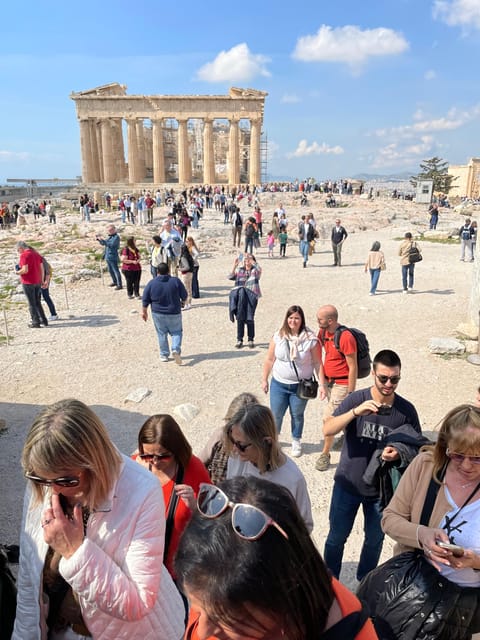
The next stop is the Asclepieion of Athens, also known as the sanctuary of Asclepius, with another ten-minute explanation. This building was dedicated to the god of medicine, and important findings connected with health were discovered here.
The stop adds welcome range to the tour. The Acropolis is often reduced to gods, temples, and heroic myths, but this sanctuary shows another side of ancient life: illness, treatment, prayer, and the hope of recovery.
The remains may not have the instant visual impact of the Parthenon. That is exactly why a guide helps. A short explanation can turn a set of foundations into a place with a clear purpose.
More things to do in Athens:
- Athens: Cape Sounion & Poseidon Temple Sunset Half-Day Trip
★ 4.8 · 8,241 reviews - Athens: Acropolis and Parthenon Guided Walking Tour
★ 4.6 · 5,882 reviews - All Day Cruise -3 Islands to Agistri,Moni, Aegina with lunch and drinks included
★ 5.0 · 4,958 reviews - Athens, Piraeus, and Coastline: Blue Hop-On Hop-Off Bus
★ 3.9 · 4,849 reviews
Odeon of Herodes Atticus: an ancient concert hall still in use
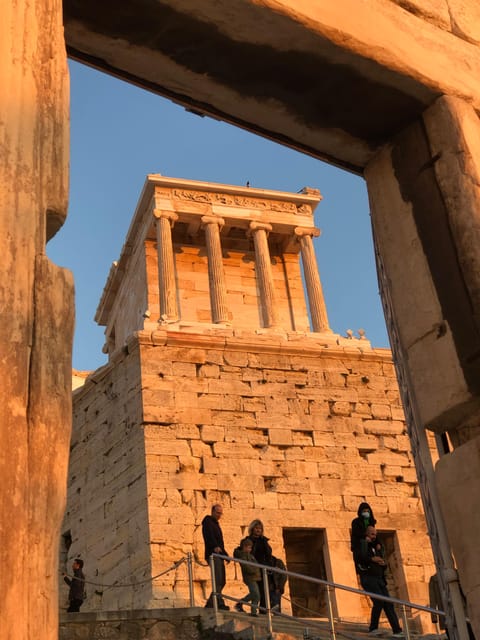
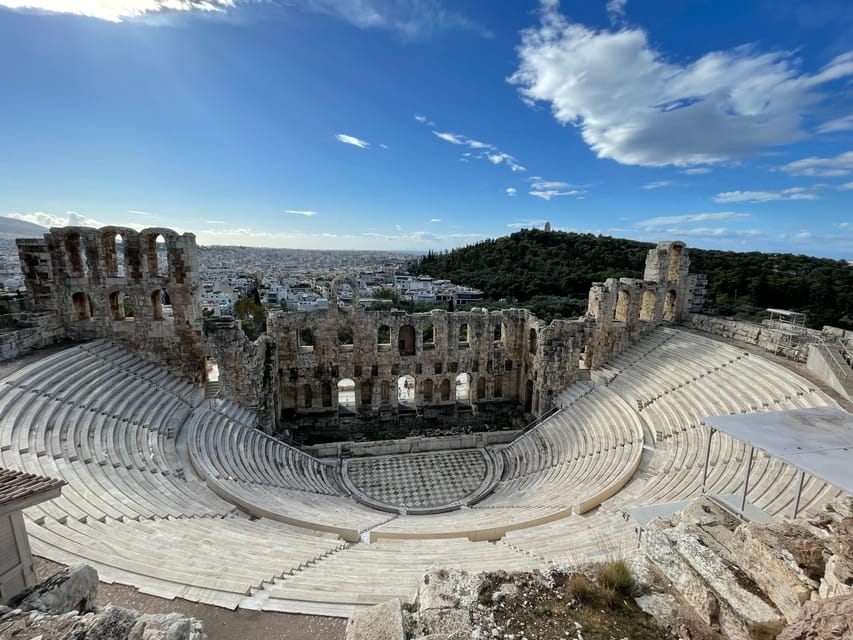
The Odeon of Herodes Atticus receives about ten minutes. This grand theater once had a roof and is still used for concerts today.
Its continuing role gives the Acropolis a direct link with modern Athens. You are not looking only at a dead ruin. You are seeing a building that still serves as a performance venue, even though its ancient setting and original use belong to another age.
The Odeon is also one of the easiest monuments to appreciate quickly. Its sweeping stone structure is dramatic from the outside, and the guide’s explanation helps you understand how it fitted into the cultural life of the city.
Propylaea: the grand entrance uphill
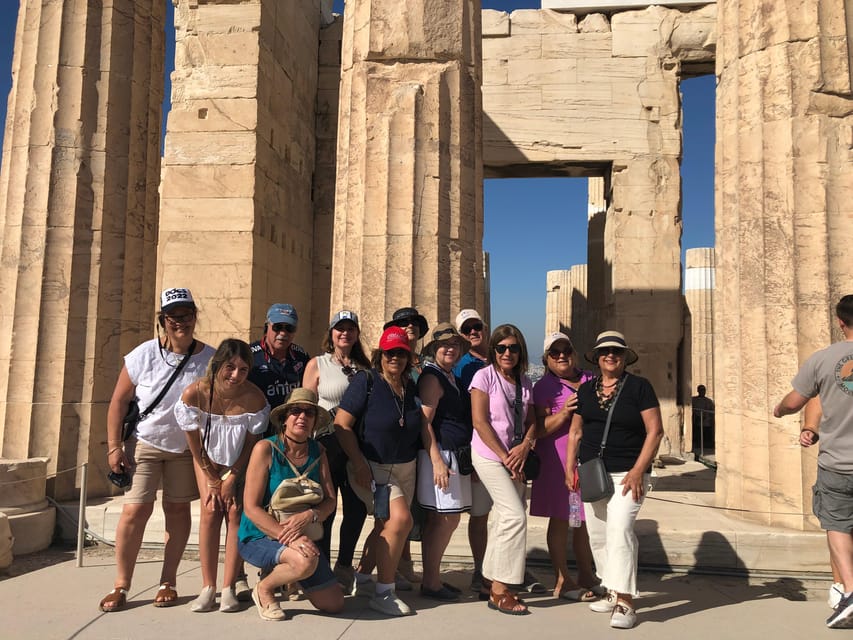
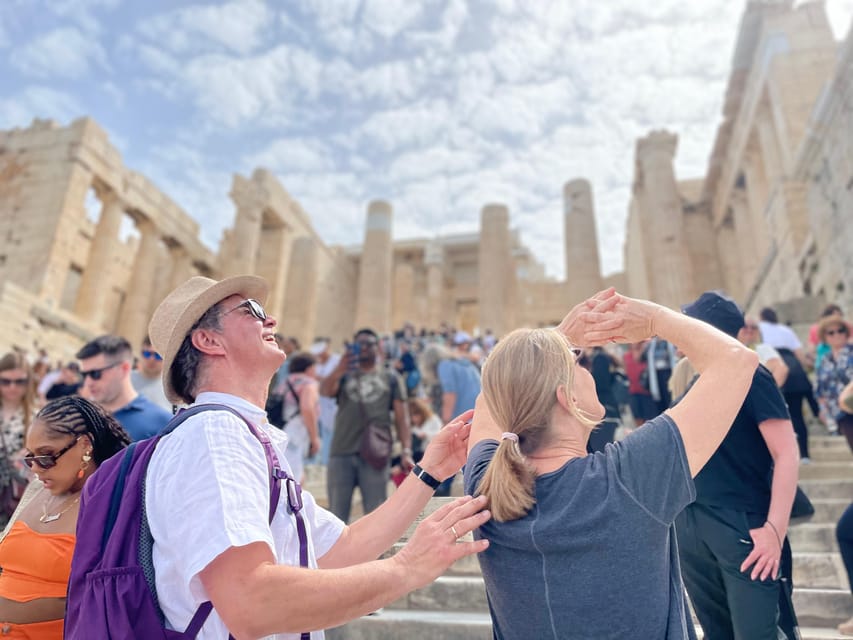
The route then reaches the Propylaea, the monumental gateway to the Acropolis. You have about ten minutes here to examine its scale and the mix of Doric and Ionic architectural styles.
The Propylaea was meant to shape your arrival. It is not a plain doorway but a formal passage from the ordinary city into a sacred and political center. The uphill approach adds effort, ceremony, and anticipation.
This is one point where the early timing helps. The gateway can become a crowded bottleneck, so a calmer morning visit makes it easier to pause and look up without feeling pushed along.
Temple of Athena Nike: a compact monument with a big role
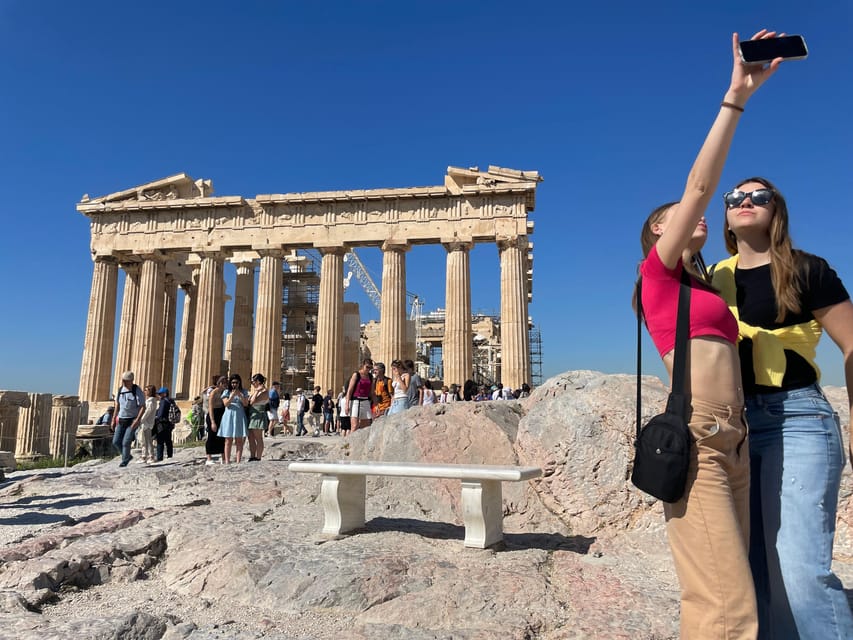
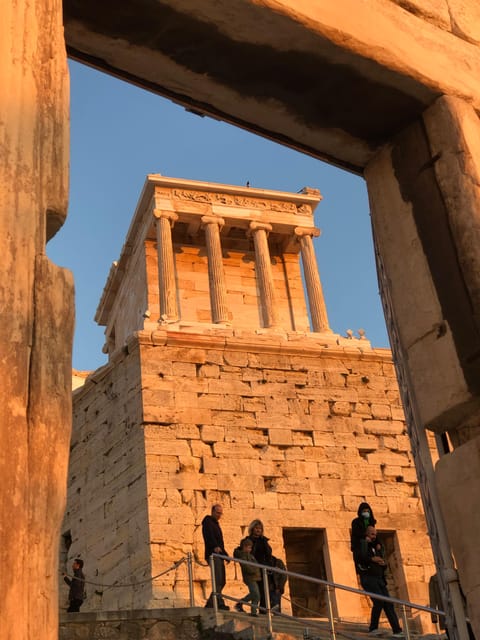
The Temple of Athena Nike gets a shorter explanation of about five minutes. It honors Athena Nike, the goddess associated with victory, and sits near the entrance area.
Because this stop is brief, you will receive a concise explanation rather than a full lesson in the temple’s design. Still, it fits neatly into the route. The monument helps explain how different parts of the Acropolis honored different aspects of the gods and the city’s ambitions.
I appreciate that the itinerary includes smaller monuments as well as the famous ones. The Parthenon gets the headlines, but the smaller temples help you see the hill as a planned sacred center rather than a single isolated building.
Parthenon: the main event, with twenty minutes
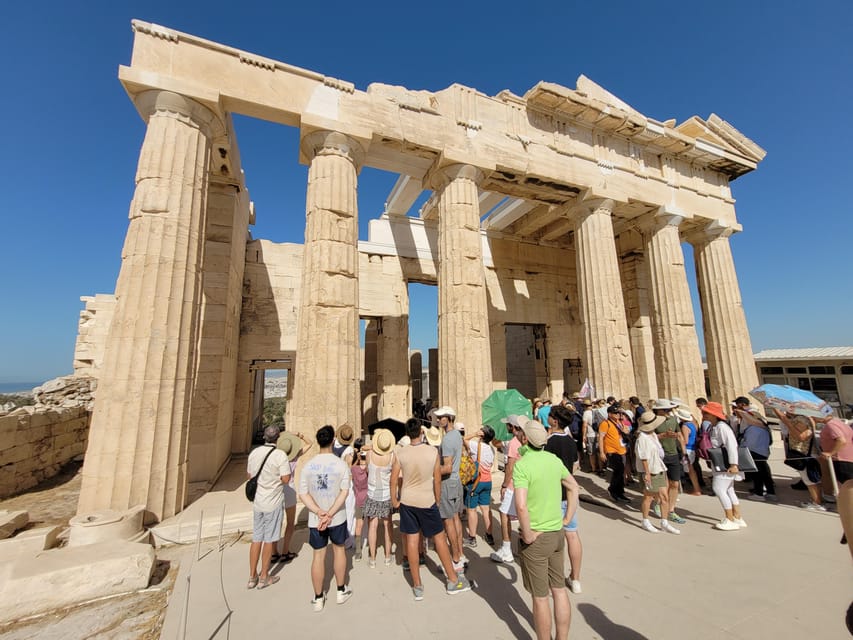
The tour gives the Parthenon about twenty minutes, the longest single stop. Built in honor of Athena, the city’s protective goddess, it is presented as one of the most harmonious temples of the ancient world.
The guide’s job here is more than pointing out columns. You want help reading the building’s purpose, design, damage, and place in Athenian identity. The supplied tour promises both historical and mythological explanations, including the contest between Athena and Poseidon for the city’s protection.
That story is useful because it connects the temple to the city around it. Athens was not simply named after Athena by accident. Its identity was expressed through myth, ritual, architecture, and public memory.
Twenty minutes is a reasonable compromise. You get time to hear the main explanation and take in the structure, but you will not study every column or sculptural detail. After the guided part ends, you can stay on the hill, so you have a chance to return your attention to photographs and views without trying to listen and frame a picture at the same time.
Remember that the Parthenon is viewed from the exterior. The value lies in understanding its role and seeing its proportions, location, and surviving architectural elements in person.
Erechtheion and the famous Caryatids
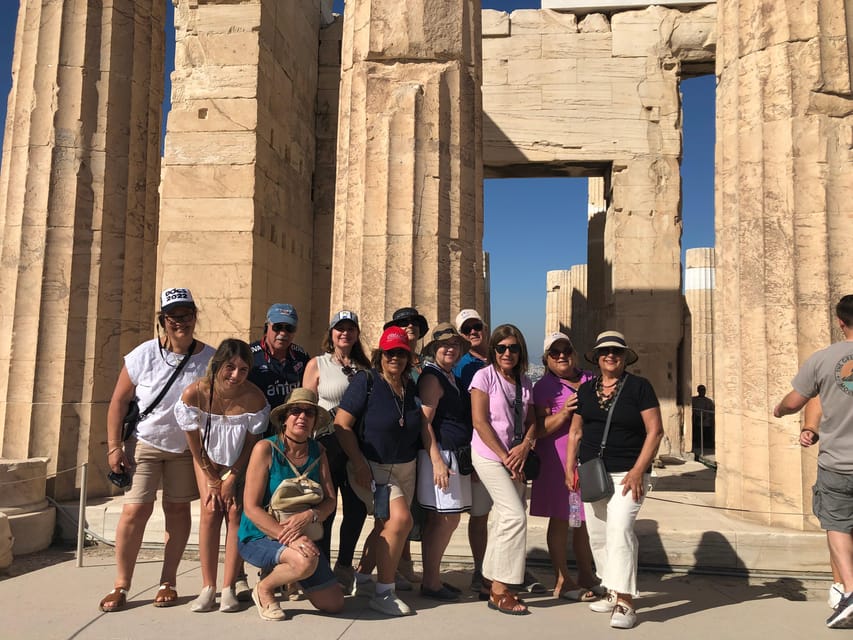
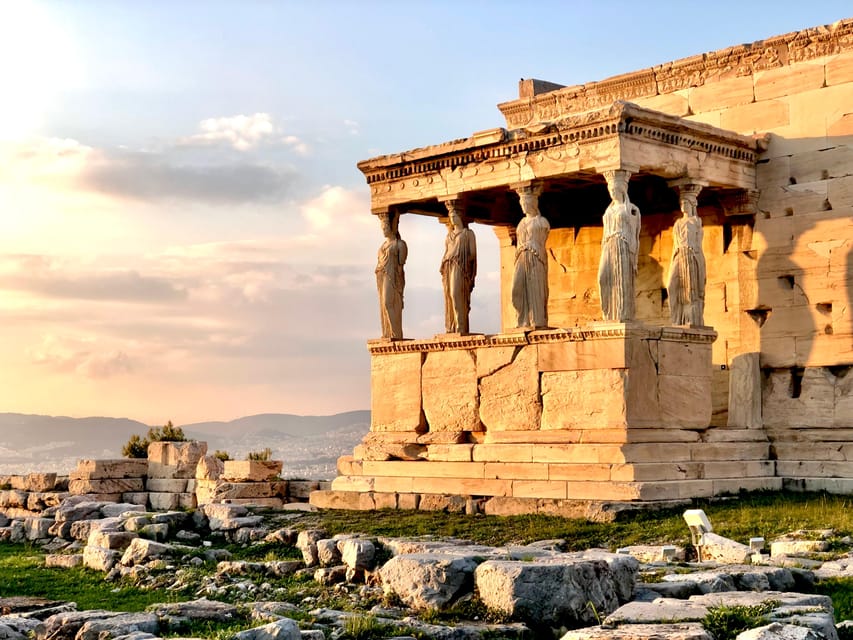
The final major stop is the Erechtheion, followed by about ten minutes at the Porch of the Caryatids. This is often the most immediately charming part of the visit.
The Caryatids are columns carved in the form of women. Their human shape makes them easy to remember, but the guide can give you more than the basic fact. The porch belongs to the Erechtheion, a building connected with the rival claims of Athena and Poseidon.
According to the myth explained on the tour, the gods competed to give Athens its most useful gift. Poseidon offered a water source, while Athena gave the olive tree. The story helps you understand why the Erechtheion feels less uniform than the Parthenon. It is tied to several sacred traditions and divine claims.
The tour presents the Caryatids as part of the building rather than as isolated decorative figures. You will also need to remember that what you see on site is part of a preserved monument, while original pieces and replicas may be handled differently by conservation authorities. The supplied information does not specify which figures are originals, so do not expect the guide to treat every visible detail as untouched ancient material.
Views from the top and time after the guide
The guided walk concludes at the top of the Acropolis. You may remain there as long as you like to photograph the monuments and enjoy the 360-degree views.
This free time is essential. Two hours can feel packed when every stop includes an explanation, and photography is often rushed if you try to do it while the group is moving. Ending at the summit gives you permission to slow down.
Use the final minutes to look beyond the Parthenon. The hilltop position gives you a broad view over Athens, and the setting explains why the Acropolis held such power for the city. You can also take a few quiet photographs after the guide has finished speaking.
The information provided does not include a fixed amount of post-tour time, so plan your day with some flexibility. The tour itself lasts two hours, but your visit to the site can continue after the guided portion.
Is $33 a fair price?
At $33 per person, this is a reasonable price for a Spanish-language guided visit if your ticket option includes admission. You are paying for a qualified guide, early entry, headphones, and a route that covers the major monuments rather than only the Parthenon.
The key phrase is if your ticket option includes admission. Entrance is listed as included only when that option is selected. Check the exact booking choice before paying, then compare the total with the price of entering independently and arranging your own guide.
The value is strongest for you if you want explanations in Spanish and prefer a structured visit. A self-guided visit may cost less if you already know the site well or want to spend several hours sketching, photographing, or reading every inscription.
The tour is also a good fit for a short stay in Athens. In two hours, you see the main religious, artistic, theatrical, and medical sites on the hill, then continue with your day.
Who should book this tour?
I would recommend it to Spanish-speaking adults, couples, families with older children, and first-time visitors who want the Acropolis to make sense. The guides have a strong record for storytelling and keeping people engaged, including children.
It suits you particularly well if you like myths connected to physical places. The stories of Athena and Poseidon are not treated as detached fairy tales. They are used to explain why the buildings were placed there and what they meant to Athenians.
You should think twice if you need step-free access, use a wheelchair, want to bring a stroller, or expect to carry a large bag. The restrictions are firm. I would also choose another option if you want a long, leisurely archaeological study, since the pace is designed to cover many points in two hours.
The early start is best for anyone sensitive to heat or crowds. One guide is specifically praised for finding shade and choosing good timing in summer, but weather and crowd levels can still vary.
Practical details before you go
The tour is conducted entirely in Spanish, with a live certified guide. Food and drinks are not included, and hotel pickup or transfer is not provided.
You can cancel up to 24 hours in advance for a full refund, and the reserve-now, pay-later option keeps your plans flexible. Starting times vary, so check availability when choosing your date.
Wear shoes suitable for an uphill walk over uneven ancient surfaces. Bring only what the site rules permit, since bags and food are not allowed according to the supplied information. If you plan to take many pictures, keep your camera ready but listen first. The best value here comes from understanding what you are seeing.
Should you book it?
Book this tour if you want a clear, lively introduction to the Acropolis in Spanish and value a guide who can connect temples with myths, theater, medicine, and civic life. The early timing, included headphones, broad route, and free time at the summit make $33 a solid deal when the entrance-ticket option is selected.
Skip it if you prefer to wander alone, need accessible facilities, or want to spend half a day on detailed photography. For most Spanish-speaking first-time visitors, though, this is a practical way to meet the Parthenon without missing the smaller monuments that give the hill its meaning.
FAQ
Is the tour conducted in Spanish?
Yes. The live tour guide speaks Spanish, and Spanish is the listed language for the activity.
How long does the Acropolis tour last?
The guided tour lasts two hours. Afterward, you may remain at the top of the hill to take photographs and enjoy the views.
Does the price include the Acropolis entrance ticket?
The entrance ticket is included only if you choose the ticket option when booking. Check the selected option before completing your reservation.
Where is the meeting point?
The meeting point is at the Tourist Information Center Athens, next to the southern Acropolis entrance and across from the Acropolis Museum. It is a few meters from the Acropolis metro stop. Look for the TOP TOURS GREECE office sign.
Does the tour include headphones?
Yes. Headphones are provided so you can hear the guide clearly during the walking tour.
Is the tour suitable for wheelchair users?
No. The activity is not suitable for wheelchair users, and non-folding and electric wheelchairs are not allowed. Baby strollers are also not permitted.
Can I cancel and receive a refund?
Yes. You can cancel up to 24 hours in advance for a full refund. A reserve-now, pay-later option is also available.
Just added around Athens
- Athens Hotels to Athens Airport Private Departure Transfer★ 5.0 · 40 reviews
- Private One-way Transfer between Athens International Airport and Athens Hotels★ 4.5 · 40 reviews
- Athens: Acropolis Museum Ticket with Self-Guided Audio tour App★ 3.5 · 40 reviews
- From Athens: Meteora Train Trip with Overnight Stay★ 4.8 · 40 reviews
- Athens Photography Tour★ 5.0 · 40 reviews
- Athens: Acropolis Visit and City Night Tour★ 4.7 · 40 reviews
- Delphi Full Day Private Trip From Athens With Lunch Overlooking the Sea★ 5.0 · 40 reviews
- Acropolis & Plaka Neighbourhood Private Tour with Licensed Expert★ 5.0 · 40 reviews
Acropolis & Parthenon Tours, compared.
Acropolis & up to 5 Archaeological Sites Combo Pass
Read our review →
Acropolis, Parthenon & Acropolis Museum Guided Tour
Read our review →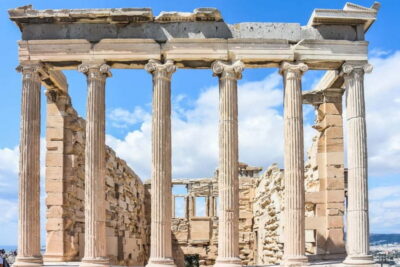
Acropolis, Parthenon & Acropolis Museum Guided Tour
Read our review →

Acropolis: Acropolis and Parthenon Guided Walking Tour
Read our review →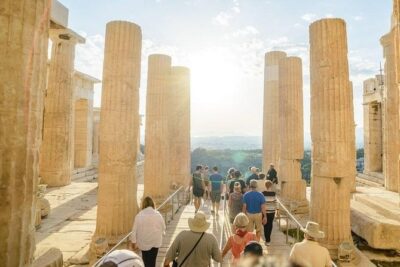
Acropolis monuments & Parthenon Walking Tour with Optional Acropolis Museum
Read our review →Browse the lists this tour appears in