
Reviewed · WALKING TOURS
Guided Walking Tour in Chania
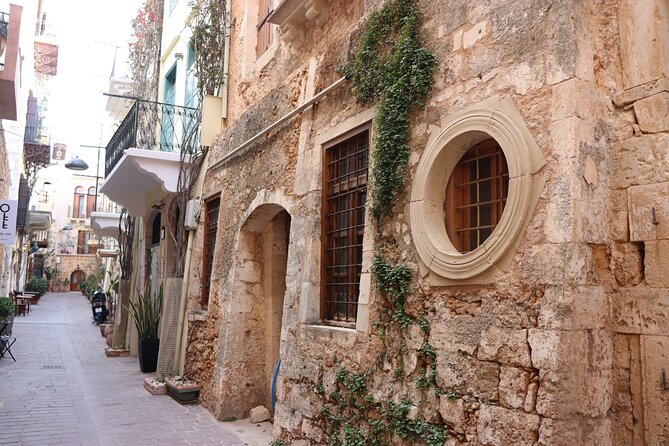
Chania rewards a slow look. This $32 walking tour links its knife-makers, leather shops, churches, harbor, and Ottoman-era landmarks in one English-language outing. I like the clear two-hour format, and I like the small maximum of 15 people, which should make questions easier than on a large coach tour. The main concern is that the advertised meeting point is at Venizelos Graves, while the listed sights are in central Chania, so you should confirm the exact route and meeting instructions before paying.
I also like the free cancellation available up to 24 hours before departure. The 5:00 pm start can work well for a cooler walk and evening views around the harbor. Still, the 3.6 rating from 39 reviews shows an uneven record, including one report of a last-minute time change and a tour that lasted only one hour.
In This Review
- Key points to know before booking
- What this Chania walk is trying to show you
- Starting at Venizelos Graves at 5:00 pm
- Skalidakis Cretan Knives: a quick look at a living craft
- Skridlof Street and Chania’s leather trade
- The Catholic Cathedral of Saint Mary of the Assumption
- The Old Venetian Harbor in the late afternoon
- Kucuk Hasan Mosque and the Ottoman chapter
- Agios Nikolaos and the extra surprise stops
- Guide quality is the real value at $32
- Who will get the most from this experience
- Cancellation and practical planning
- Should you book the Chania guided walking tour?
- FAQ
- How long is the Guided Walking Tour in Chania?
- What time does the tour start?
- Where does the tour begin?
- Where does the tour finish?
- How many people can join the tour?
- Is free cancellation available?
Key points to know before booking
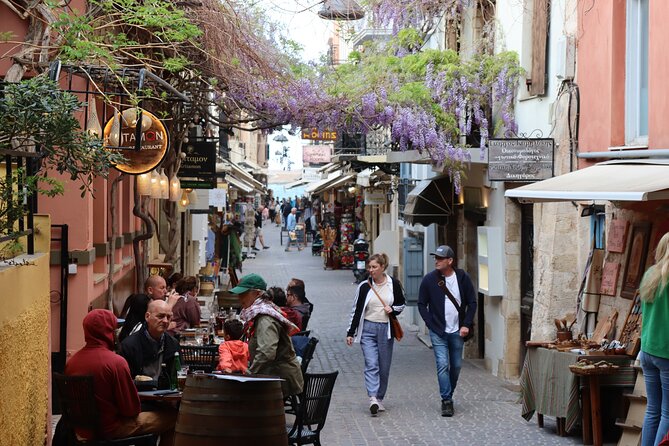
- Six named stops in about two hours: Expect roughly 20 minutes at each listed location, plus a few additional surprise stops.
- A useful look at local crafts: The knife district and Skridlof Street give you practical shopping context, not just postcard views.
- Chania’s mixed past is the main theme: The route includes Catholic, Orthodox, Venetian, and Ottoman landmarks.
- Small-group limit: A maximum of 15 people should keep the walk more manageable and personal.
- Guide quality matters: The experience depends heavily on how well the guide adds stories and local context beyond basic facts.
- Check the start point carefully: The tour begins at Venizelos Graves, Agorastaki 4, at 5:00 pm, and returns there.
What this Chania walk is trying to show you
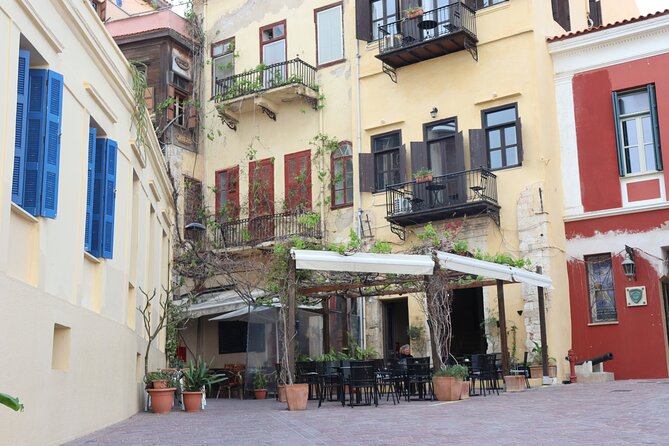
This is not simply a harbor stroll. The route brings together working crafts, religious buildings, waterfront landmarks, and traces of different rulers who shaped Chania. In a short period, you move from handmade knives and leather goods to Catholic and Orthodox worship, Venetian power, and Ottoman influence.
That range is the tour’s strongest idea. Chania makes more sense when you see its past as a series of layers rather than one single Greek story. A good guide can connect those layers and explain how the city changed over time.
The tour is conducted in English and lasts about two hours. Each of the six listed stops is allocated around 20 minutes, though that timing is approximate and the route also includes a few extra stops. You should expect an overview rather than a detailed museum tour or a long shopping session.
The $32 price is fair if the guide brings the city to life and keeps the walk well organized. It is less attractive if the commentary stays at the level of facts you could pick up from a basic guidebook. One poor assessment made exactly that complaint, saying the experience felt too dull and predictable. That is a useful warning: this tour’s value rests more on the guide’s storytelling than on admission savings, since the listed stops are free.
More Walking Tours in Crete
- Knossos: Knossos Palace Skip-the-Line Guided Walking Tour
★ 4.8 · 1,380 reviews - Walking “Food tasting tour” in the town of Chania
★ 5.0 · 297 reviews - Heraklion: Food Tastings Walking Tour
★ 5.0 · 136 reviews
Starting at Venizelos Graves at 5:00 pm
The meeting point is Venizelos Graves, Agorastaki 4, Chania 731 33. The walk begins at 5:00 pm and ends back at the same meeting point.
Pay close attention here. The named sights include the Old Venetian Harbor, Skridlof Street, the Kucuk Hasan Mosque, and other central landmarks, so the stated start and finish deserve confirmation before your tour day. The supplied details do not explain how the group moves between Venizelos Graves and the central sights. Do not assume that every part of the outing is a continuous walk from the meeting point.
The late afternoon departure has some practical appeal. The light should be more pleasant than at midday, and the temperature may be easier for walking. On the other hand, a two-hour tour beginning at 5:00 pm can run into the evening, especially if the group stops for questions or shopping.
You receive confirmation at booking. I would save the meeting-point address, check the confirmation for any update, and arrive with enough time to sort out the start location. The maximum group size is 15, and that is a sensible size for narrow streets and small shops.
Skalidakis Cretan Knives: a quick look at a living craft
The first listed stop is Skalidakis Cretan Knives, in Chania’s knife district. You get about 20 minutes here, with no admission charge.
This is one of the more distinctive parts of the route. Many city walks show churches and waterfronts, but fewer explain the local tradition of knife-making. The shops carry traditional Greek designs as well as modern styles, so the stop can appeal to both shoppers and people who simply want to understand the craft.
I would treat this as a short introduction, not a full workshop visit. The information provided describes specialized shops and artisans making and selling knives, but it does not promise a demonstration, a hands-on activity, or time set aside for buying. If you are interested in a purchase, ask the guide about local designs, practical use, care, and how to pack a knife for your journey.
The stop also gives the guide a chance to explain why handmade objects matter in a place shaped by trade and changing cultures. If the commentary only points out shop windows, you may find the visit thin. If the guide explains the symbols, materials, and place of knife-making in Cretan life, those 20 minutes could be memorable.
Skridlof Street and Chania’s leather trade
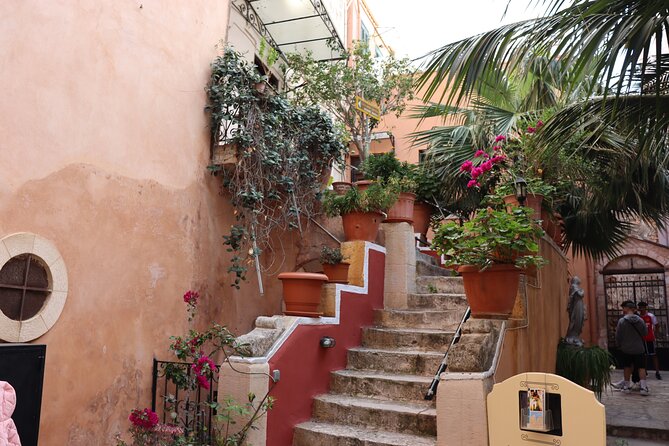
Skridlof Street is known as the Street of Leather. The tour allows another 20-minute stop, and admission is free.
You will find shops selling bags, shoes, belts, jackets, and other leather goods. This is useful if you want a practical souvenir rather than a mass-produced trinket. The range also makes the stop easy to tailor to your interests. You can browse, compare prices, or simply watch how the street’s shops fit into the old city.
Keep your expectations realistic. The tour does not include a purchase, discount, or leather-making demonstration. Twenty minutes is enough for an introduction, but not much time for serious comparison shopping. If you hope to buy a jacket or a larger item, you may need to return on your own after the walk.
This stop pairs well with the knife district. Both places show Chania through its crafts and commercial life, not only through monuments. I like that balance. A city becomes more understandable when you see what people make and sell, not just what rulers built centuries ago.
More things to do in Crete:
- From Kissamos Port: Boat Cruise to Balos Lagoon & Gramvousa
★ 4.2 · 6,755 reviews - Crete: Day Trip to Agios Nikolaos and Spinalonga Island
★ 4.6 · 4,416 reviews - From Chania: Full-Day Samaria Gorge Trek Excursion & Guide
★ 4.6 · 3,191 reviews - Agios Nikolaos: Boat Trip to Spinalonga with Swim Stop
★ 4.4 · 3,031 reviews
The Catholic Cathedral of Saint Mary of the Assumption
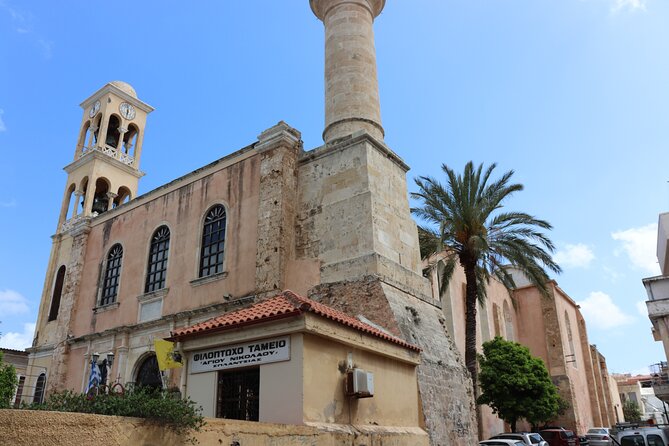
The Holy Catholic Church of the Assumption of the Blessed Virgin Mary offers a change of pace. After two shopping areas, the route turns toward a quiet religious site, with about 20 minutes allocated here.
The cathedral is described as an elegant place for reflection and prayer. Its importance is both religious and cultural. It reminds you that Chania has served communities with different faiths and traditions, and that the city’s identity cannot be reduced to its Venetian waterfront or modern Greek character.
Because this is an active place of worship, keep your visit respectful. The supplied details do not specify a formal interior tour, special access, or a guided architectural lecture. Your experience may depend on whether the church is open in the usual way at the time of the visit and on how the guide handles the stop.
This is also one of the places where a guide can add real value. A short explanation of the cathedral’s role, architecture, and place in Chania would help you see it as more than a quick photo stop. Without that context, 20 minutes may feel long for visitors who are not especially interested in religious buildings.
The Old Venetian Harbor in the late afternoon
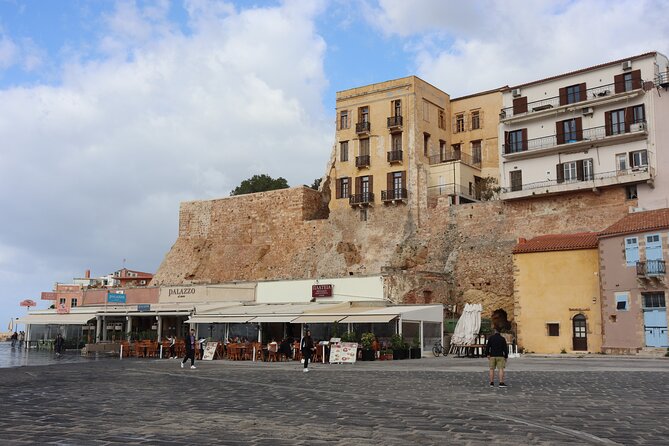
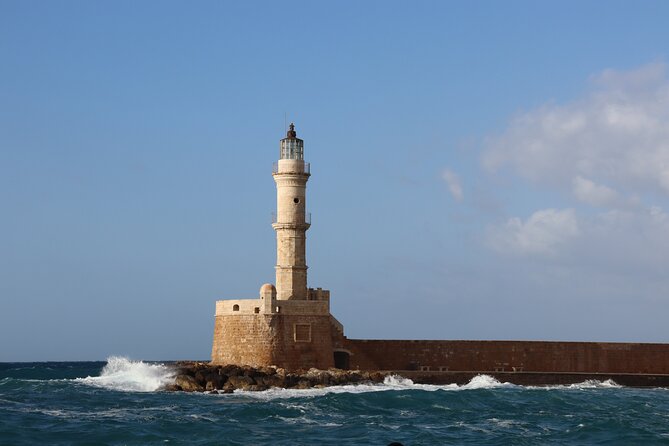
The Old Venetian Harbor is likely the visual centerpiece of the outing. You walk along cobblestone paths beside the water, with cafes and colorful buildings around the harbor. The listed stop lasts about 20 minutes and is free.
The harbor connects several periods of Chania’s past. The ancient lighthouse and Venetian fortress point to the city’s maritime and trading importance, while the waterfront remains a popular place to stroll and pause. This is the sort of stop where a guide can help you read the scene: which structures served practical purposes, how ships and trade shaped the city, and why the harbor remains Chania’s main gathering point.
A short stop is enough to orient yourself, but it will not cover every corner of the waterfront. You will probably want to return later for a longer walk, especially if you enjoy photographs or want time at a cafe. The harbor is also a place where the group may feel most crowded, depending on the time and season.
I like the timing here. A 5:00 pm start may bring you to the waterfront as the light softens, though the precise timing depends on the route and the guide. Do not count on a sunset visit unless the guide confirms it. The tour is scheduled for about two hours, not around a guaranteed sunset event.
Kucuk Hasan Mosque and the Ottoman chapter
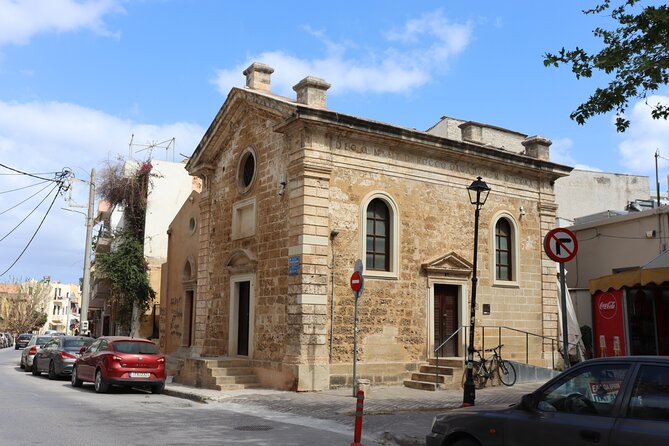
The Kucuk Hasan Mosque adds another important layer to Chania. Its architecture and location offer a reminder of the city’s Ottoman past and of the different powers and communities that shaped it.
The mosque is described as a place of worship and a cultural landmark. The route gives it about 20 minutes, with no entrance fee listed. The key value here is context. Seen beside Venetian buildings and Christian churches, the mosque helps you understand Chania as a city with overlapping traditions rather than a single-period monument.
The available information does not promise entry inside the mosque. Plan on viewing and discussing the site from the accessible areas unless your guide tells you otherwise. That distinction matters, especially if you expect an interior visit.
This stop should suit you if you enjoy history presented through streets and buildings. It may feel brief if you want detailed Ottoman history, architectural analysis, or a long visit. The tour format favors breadth, so you get several viewpoints rather than one subject in depth.
Agios Nikolaos and the extra surprise stops
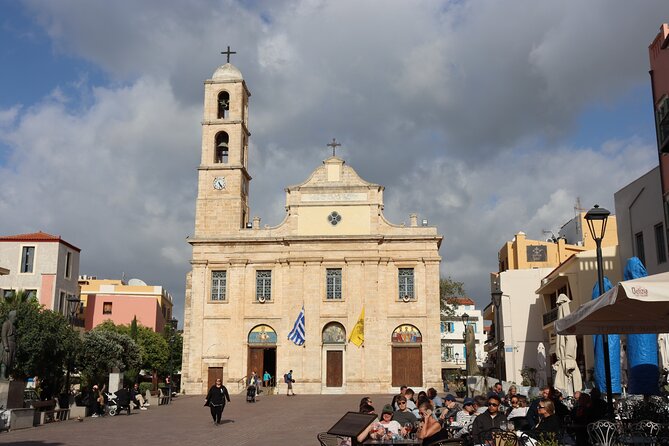
The sixth named stop is the Church of Agios Nikolaos. The supplied details give it about 20 minutes but do not explain its specific role in the route. The tour also includes a few additional stops kept as surprises.
That lack of detail is both appealing and limiting. You may enjoy discovering places not fully described in advance, and the extra stops give the guide room to respond to the group or point out features along the way. But you cannot plan around them or judge their importance before booking.
For this part of the walk, I would listen for connections between the church and the other religious sites. The Catholic cathedral, Agios Nikolaos, and Kucuk Hasan Mosque create a useful framework for understanding Chania’s religious variety. The guide’s ability to explain those links will determine how much you take away.
The surprise element should not be the main reason you book. Think of it as a bonus within a compact city orientation. You are paying for a guided overview, not a guaranteed list of six in-depth visits.
Guide quality is the real value at $32
At $32 per person, the tour is priced above a casual self-guided walk but well below a private guide. The maximum of 15 people makes the comparison more favorable, especially if the guide welcomes questions and keeps everyone together.
There is no admission fee listed for the stops, and gratuities are optional. That means most of your payment covers the guide’s time, planning, explanations, and route management. You should book only if you want interpretation and company. If you prefer to read at your own pace and browse shops for as long as you like, a self-guided walk may offer better value.
Guide performance appears to be uneven. One poor experience described the tour as boring and too close to information found in a short tourist book. Another complaint reported a last-minute change in time and a tour lasting only one hour instead of the expected two and a half hours.
At the same time, praise for guide Stavros on a separate Elafonisi day trip highlights a warm manner, strong information about Cretan history, careful driving, and good care of the group. That feedback concerns a different excursion, so I would not treat it as proof of what your Chania guide will be like. It does show that the provider has received strong praise when a guide adds personality and useful local explanation.
Who will get the most from this experience
I would recommend this tour to a first-time visitor who wants a quick orientation before exploring Chania alone. The route covers shopping streets, faith buildings, the harbor, and Ottoman and Venetian landmarks, giving you several ideas for later walks.
It also suits you if you prefer a small group, need an English-language guide, or enjoy learning through a city’s everyday details. The knife and leather stops are especially useful if you want to understand local crafts or shop for a Cretan item.
I would hesitate if you have only one day and need guaranteed precision. The mixed feedback about timing makes it important to confirm the start details. I would also hesitate if you want a highly detailed history tour, since the schedule allows only about 20 minutes per named stop.
Most participants can take part, and service animals are allowed. The tour is near public transportation, though the supplied information does not give a specific transit route. Since the activity ends back at the meeting point, plan your onward arrangements with that return in mind.
Cancellation and practical planning
You can cancel for a full refund up to 24 hours before the 5:00 pm start time. Cancellations or changes made less than 24 hours before departure are not accepted for a refund, and the cut-off follows local time.
I would bring comfortable walking shoes because the route includes cobblestone paths and old-city streets. The tour information does not list food, drinks, transport, shopping credit, or entry fees as included, so budget separately for anything you buy on Skridlof Street or in the knife district.
Arrive prepared to walk for two hours, even though the stops break up the route. Ask at the beginning how the group will move between the Venizelos Graves meeting point and the central sights. That one question could prevent confusion.
Should you book the Chania guided walking tour?
Book it if you want a compact introduction to Chania’s crafts, religious buildings, waterfront, and layered past, and if you value having an English-speaking guide explain what you are seeing. The $32 fee is reasonable for a well-run small group, especially when the guide adds stories that a book cannot provide.
Skip it if you mainly want shopping time, a guaranteed sunset, or a detailed visit inside every landmark. Before booking, confirm the route from Venizelos Graves, the exact departure time, and the expected duration. With those points clear, this can be a useful first look at Chania, but its success will depend heavily on the individual guide.
FAQ
How long is the Guided Walking Tour in Chania?
The tour lasts approximately two hours.
What time does the tour start?
The scheduled start time is 5:00 pm.
Where does the tour begin?
The meeting point is Venizelos Graves, Agorastaki 4, Chania 731 33, Greece.
Where does the tour finish?
The activity ends back at the meeting point.
How many people can join the tour?
The maximum group size is 15 people.
Is free cancellation available?
Yes. You can cancel for a full refund at least 24 hours before the experience start time. Changes or cancellations made less than 24 hours before departure are not accepted for a refund.
Just added around Crete
- Kournas Lake Argiroupolis and olive oil factory from Rethymno★ 4.5 · 39 reviews
- Rethymno: Old Town Segway Tour★ 4.9 · 39 reviews
- Island Spinalonga, Milatos Cave,private Speedboat,OliveOilTasting★ 4.5 · 39 reviews
- South Crete: Sarakinas Gorge Hike, Swim & Jeep Safari★ 4.6 · 39 reviews
- Chania – Knossos Palace Guided Tour★ 4.4 · 39 reviews
- Panormo: Luxury Sunset Catamaran Cruise Sushi & Open Bar★ 5.0 · 39 reviews
- Lasithi –Plateau Traditional Vilages★ 5.0 · 40 reviews
- The Palace of Knossos with Skip-the-Line Ticket★ 5.0 · 40 reviews
Walking Tours, compared.

Acropolis: Acropolis and Parthenon Guided Walking Tour
Read our review →
Acropolis monuments & Parthenon Walking Tour with Optional Acropolis Museum
Read our review →
Knossos: Knossos Palace Skip-the-Line Guided Walking Tour
Read our review →

Athens Authentic Greek Food Walking Tour (Small Group)
Read our review →
Early Morning Acropolis & Old Athens Guided Walking Tour
Read our review →Browse the lists this tour appears in