
Reviewed · ANCIENT CORINTH TOURS
Biblical Corinth: St. Paul and His Letters to the Corinthians
Paul’s Corinth still feels close. This private Athens day trip links Mars Hill, the Corinth Canal, Ancient Corinth, and Cenchreae with the places tied to Paul’s ministry and letters. I like the personal pickup and flexible schedule, and I like having a driver who can connect the scattered sites with clear historical context. The main catch is important: your driver does not enter the archaeological sites, so a licensed guide must be added if you want an expert-led walk through the ruins.
The day covers a lot of ground, from Athens to the Peloponnese and back, in roughly eight to nine hours. You get private transport, bottled water, onboard Wi-Fi, and hotel or port pickup. The pace can be adjusted, but Akrokorinthos requires a serious uphill walk, and the day works best for people who value freedom more than a standard guided group tour.
In This Review
- Key points to know before booking
- Starting at Mars Hill in Athens
- Crossing the Isthmus at the Corinth Canal
- Seeing the ancient Diolkos
- Isthmia, the games, and Paul’s working life
- Inside the Archaeological Museum of Isthmia
- Ancient Corinth and the Bema
- The Temple of Apollo and the old city center
- The ports at Kechries and Paul’s next journey
- Churches and local reminders of Paul
- Lunch at a seaside Greek taverna
- Climbing Akrokorinthos for the view
- What the private format really gives you
- Is $218.43 per person good value?
- Who should book this Corinth day trip?
- FAQ
- How long does the tour last?
- Is hotel or port pickup included?
- Is the tour private?
- Is a licensed tour guide included?
- Are entrance fees included?
- Is lunch included?
- Is the tour offered in English?
- Should you book it?
Key points to know before booking
- Mars Hill connects the day to Athens: You begin at Areopagus Hill, where Paul addressed the council of Athens.
- The private car makes the scattered sites practical: Corinth’s canal, ports, ruins, churches, and fortress are spread across a wide area.
- The driver is not a licensed site guide: Expect commentary in the vehicle and independent visits inside the archaeological sites.
- Ancient Corinth and Akrokorinthos are the big moments: One gives you Paul’s Roman-era setting, while the other offers wide views and a demanding climb.
- The Greek lunch adds real value: Choose the traditional food option if you want the meal included, or ask the driver to suggest a taverna.
- The price is easier to justify for a group: At $218.43 per person, the cost makes more sense when divided among several people sharing the private vehicle.
Starting at Mars Hill in Athens
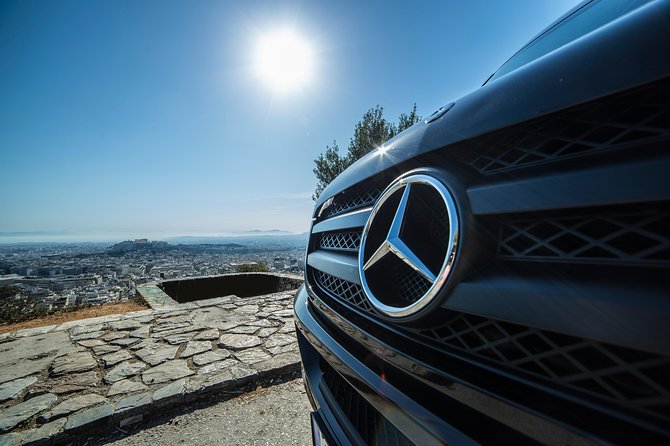
The day begins in Athens with a short stop at Areopagus Hill, also called Mars Hill. Paul is associated with the famous speech delivered here to the Athenian council, where he spoke about the city’s altar to an unknown god and introduced Christianity to a philosophical audience.
You have about 20 minutes, and there is no admission charge. That is enough time to pause, take in the view, and connect the Athens portion of the day with the Corinth journey ahead. The rock can be uneven, so wear shoes with a secure grip.
This is not a full Acropolis tour. The experience places the emphasis on Paul’s connection to Athens, not on a detailed tour of every monument on the Acropolis. If you have already visited central Athens, this brief opening stop may be exactly right. If the Acropolis is still high on your list, you will need a separate visit.
More Ancient Corinth trips:
- From Athens: Ancient Corinth Day Trip with Canal & VR Guide
★ 4.6 · 1,073 reviews - Private Biblical Tour Ancient Corinth & Isthmus Canal from Athens
★ 5.0 · 762 reviews - Athens: Ancient Corinth & Nafplio Full Day Trip with Swim
★ 4.8 · 523 reviews
Crossing the Isthmus at the Corinth Canal
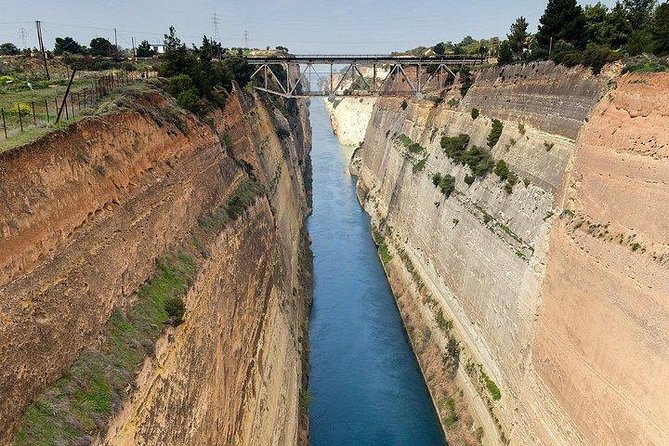
Once you leave Athens, the Corinth Canal gives you a quick lesson in geography and engineering. It cuts through the Isthmus of Corinth, connecting the Gulf of Corinth with the Saronic Gulf and separating the Peloponnese from mainland Greece.
The canal is about 6.4 kilometers long and only 21.4 meters wide at its base. Its steep limestone walls make the view especially striking from above. You may see vessels moving below, though the narrow channel cannot handle many modern ships.
The stop lasts about 30 minutes and costs nothing to enter. I consider it one of the day’s best orientation points because it explains why Corinth mattered so much. This narrow strip of land controlled movement between two seas, making it a natural route for trade, armies, sailors, and missionaries.
The driver can explain what you are seeing, and the private format lets you spend a little more or less time here if the conditions allow. Wi-Fi in the vehicle is useful during the longer stretches between stops, though the real pleasure is looking out the window and watching the scenery change.
Seeing the ancient Diolkos

Near the canal, the remains of the Diolkos show how people solved the same transport problem centuries earlier. Before the modern canal, ships and cargo could be moved overland across the isthmus along this ancient roadway.
You get about 20 minutes here, with no admission fee. The surviving remains are not a grand monument, so this stop rewards curiosity more than spectacle. Look for the practical side of ancient life: Corinth was not simply a city with temples. It was also a working transport hub where goods, ships, and people crossed between seas.
This is a useful stop for understanding Paul’s world. Corinth’s importance came from its position and connections. The Diolkos helps you picture the commercial traffic that brought merchants and sailors into the same region where Paul preached.
Isthmia, the games, and Paul’s working life

Isthmia adds a different side of ancient Corinth. The sanctuary was dedicated to Poseidon and hosted the Isthmian Games, which ranked below the Olympic Games in prestige but attracted people from across the Greek world.
The tour connects Paul with this setting through his work as a tentmaker. The idea is that he may have encountered athletes, visitors, and merchants in the area, using ordinary work and daily contact as part of his Christian mission. Treat this as historical interpretation rather than a precisely documented scene from Paul’s life.
You have about an hour at Isthmia, followed by time at its archaeological museum and site. The subject is especially interesting if you want to understand how athletic gatherings influenced Paul’s writing. His letters use images of running, training, discipline, and competition, and Isthmia gives those images a physical setting.
The museum visit lasts about 30 minutes, but admission is not included. Ancient Corinth and the Archaeological Museum of Isthmia together cost €15 per person according to the tour information. Bring cash or a payment method suitable for on-site purchase, since the fees are paid separately.
More things to do in Athens:
- Athens: Acropolis & up to 5 Archaeological Sites Combo Pass
★ 4.4 · 12,619 reviews - Athens: Acropolis Ticket with Optional Audio or Live Guide
★ 4.2 · 11,055 reviews - Athens: Acropolis, Parthenon & Acropolis Museum Guided Tour
★ 4.8 · 9,316 reviews - Athens: Cape Sounion & Poseidon Temple Sunset Half-Day Trip
★ 4.8 · 8,241 reviews
Inside the Archaeological Museum of Isthmia
The museum helps fill in details that ruins alone cannot provide. Its displays come from the Sanctuary of Poseidon and include statues, votive offerings, burial material, and glass panels from Kenchreai, the port from which Paul traveled toward Syria.
The Kenchreai glass is a particularly useful link between the religious center, the port, and Paul’s journeys. It reminds you that the area was connected by sea as well as by roads and overland routes.
Because the driver does not enter archaeological sites, you explore the museum independently unless you arrange a licensed guide. You will receive background information in the car, but you should not expect a guide standing beside each display to explain its meaning.
That arrangement suits you if you enjoy setting your own pace and reading signs. It may disappoint you if you want a formal lesson at every stop. Ask about adding a licensed guide before the day if close interpretation of the museum matters to you.
Ancient Corinth and the Bema
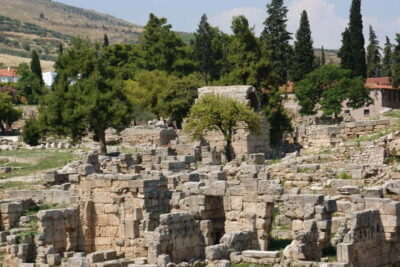
Ancient Corinth is the heart of the experience. Paul spent more than 18 months in Corinth around AD 51 to 52, building a Christian community that later received the letters known as First and Second Corinthians.
The site gives you the Roman setting behind those letters. Corinth was a major commercial city with an international population, multiple religious traditions, public buildings, and sharp social divisions. Paul’s correspondence addresses arguments, moral questions, worship, leadership, and practical problems within the early church. Standing among the ruins makes those letters feel less abstract.
The Bema, or judgment seat, is the key Paul location. According to Acts, Paul was brought before the Roman proconsul Gallio after accusations from members of the Jewish community. Gallio declined to treat the dispute as a Roman legal matter, allowing Paul to continue his work.
You have about an hour at Ancient Corinth, and the entrance fee is separate. The driver gives you information before you go in, but he is not permitted to accompany you through the site. This is the point where the difference between a private driver and a licensed guide matters most.
Several people have praised the freedom to explore Ancient Corinth at their own pace. One traveler specifically appreciated being able to spend time at the ruins and the fortress without being hurried. Another found the site larger and more impressive than expected. Plan your energy well, because there is still more walking later at Akrokorinthos.
The Temple of Apollo and the old city center
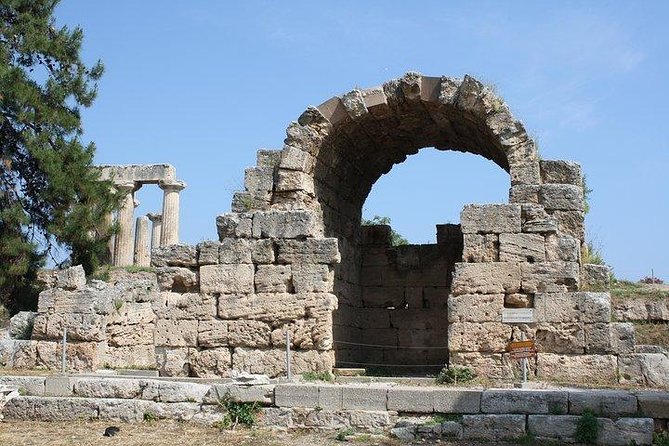
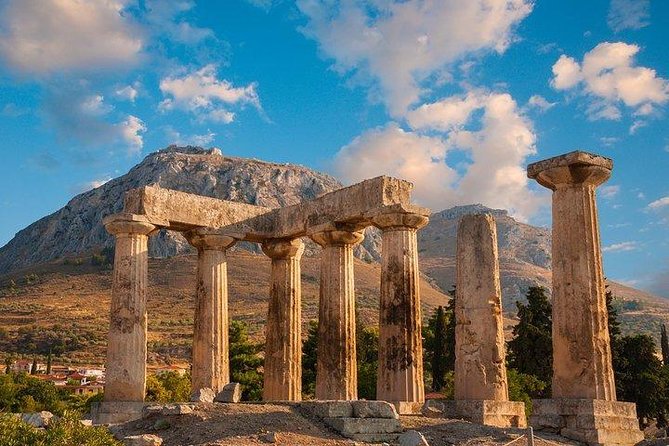
The Temple of Apollo is one of the most recognizable sights at Ancient Corinth. Built around 560 BC, it preserves massive Doric columns from a much older city.
When Paul arrived, a temple like this would have helped define the city’s religious character. The ruins offer a clear visual contrast between the older pagan world and the Christian message Paul preached. You do not need to force a spiritual conclusion, but the setting naturally invites reflection.
The stop is listed at about 30 minutes, with no separate admission charge beyond the Ancient Corinth site ticket. It is close to the Bema and the Roman Forum, so you can fit it into your independent walk through the ruins.
The ports at Kechries and Paul’s next journey
Kechries, ancient Cenchreae, was Corinth’s eastern port. Acts 18:18 places Paul here before he sailed for Syria with Priscilla and Aquila. The passage also records Paul cutting his hair in connection with a vow.
The coastal setting is quieter than Ancient Corinth and gives the day a sense of movement. Paul’s mission was not fixed in one city. From this port, his work continued across the eastern Mediterranean.
Paul’s letter to the Romans also mentions Phoebe, associated with the church at Cenchreae. The reference gives the port an additional connection to the early Christian community and to the important role of women in that community.
You have about 30 minutes here. There is no admission fee, and the visit is more about place and connection than large ruins. If you are hoping for a major archaeological site, keep your expectations modest. If you value following the route of Paul’s journeys, Kechries is well worth the stop.
Churches and local reminders of Paul
The Apostolou Pavlou church honors Paul’s time in Corinth and the Christian community he helped establish. It is a short 20-minute stop and offers a modern religious connection to the ancient sites.
The church is not a substitute for Ancient Corinth, but it adds a living element to the day. You are moving between archaeological remains and a place where Paul’s memory still has an active role in local worship.
The second stop at the Bema reinforces the same connection. The platform’s later Christian use adds another layer to a place already associated with Paul’s encounter with Roman authority.
Lunch at a seaside Greek taverna
Lunch is scheduled for about an hour in Corinth. If you choose the traditional Greek food option, the meal is included in the price. If you choose another option, lunch is not necessarily included, so check the exact selection when booking.
The meal is one of the tour’s practical pleasures. Drivers have suggested local tavernas with good views, and one particularly praised meal included a generous meat platter near the Ancient Corinth exit. Another driver helped with the menu, which is useful if you are unfamiliar with Greek dishes.
You can also choose to pack a lunch. One group did this to protect more time for sightseeing. That is a sensible choice if you want to climb Akrokorinthos or spend longer at the ruins, though a traditional meal gives the day a stronger local flavor.
Climbing Akrokorinthos for the view
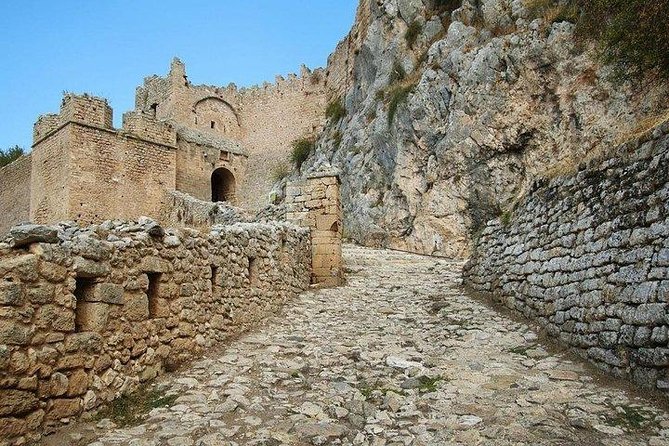
Akrokorinthos is the day’s physical challenge. The fortress rises above Ancient Corinth, and the route includes an uphill walk through old paths and walls.
The views are the reward. From above, you can look toward the city, the surrounding mountains, and the routes that made Corinth important. The site also carries a strong personal association with Paul, though the claim that he climbed and viewed the city from this exact point is presented as a possibility rather than firm documentation.
Allow about an hour, but do not treat that as a promise that the climb will feel easy. Several people enjoyed having enough time to reach the upper areas, while one person found the hike more demanding than expected. Wear sturdy shoes, carry water, and tell the driver if your group needs a slower pace.
This is not the best stop for anyone with limited mobility or little interest in uphill walking. It is one of the best stops for you if views, fortifications, and a sense of place matter as much as inscriptions and ruins.
What the private format really gives you
Pickup and drop-off are available from hotels, apartments, and the port. For a port pickup, the driver waits at the gate with a sign bearing your name. The start time can be adjusted, and the return point can be changed by arrangement.
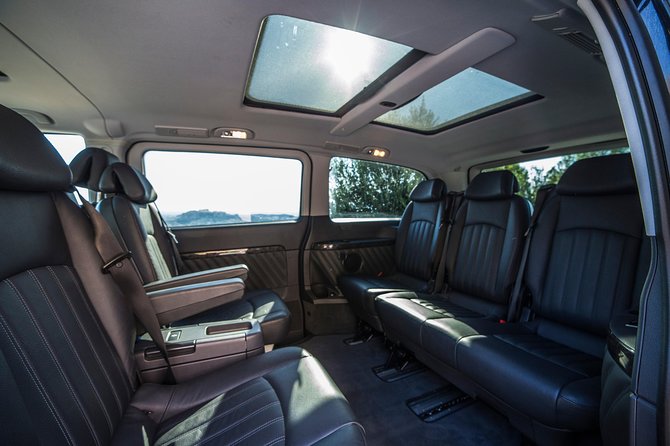
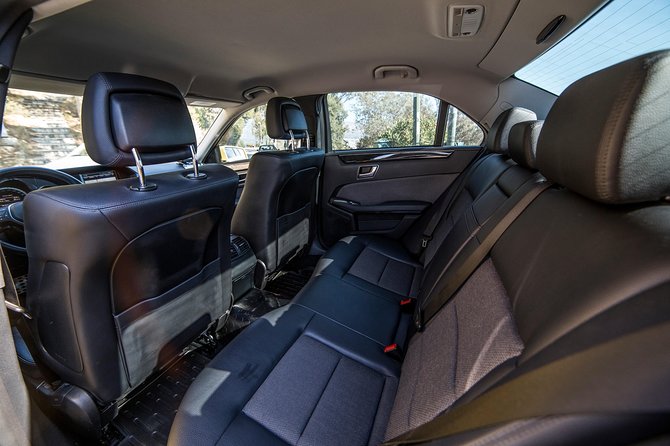
The vehicle is air-conditioned and private to your group. That matters on an eight to nine-hour day with several separate sites. You can ask for quiet stretches, stop for a bathroom or coffee break, or spend longer at a place that interests you, subject to the day’s timing.
Drivers such as Alex, George, Spiros, Stefanos, Panos, Vasilis, and Kostas have received especially warm praise for safe driving, patience, clear English, and historical commentary. The strongest pattern is not a formal lecture, but helpful conversation during the road sections. Drivers have also helped with photos, menus, timing, and last-minute changes.
Still, be precise about the service. The driver is not a licensed tour guide and does not enter the archaeological sites. If you need detailed explanations beside the monuments, request a licensed guide in advance, subject to availability and an additional fee.
Is $218.43 per person good value?
The price is $218.43 per person, and the value depends heavily on group size. For one or two people, it is a substantial cost for a private vehicle and driver. For a family or small group, the private arrangement becomes more reasonable because you are sharing transport across a full day.
The price includes pickup and drop-off, private air-conditioned transportation, Wi-Fi, bottled water, and a driver with historical knowledge. It does not include the €15 entrance cost for Ancient Corinth and the Archaeological Museum of Isthmia, nor does it include a licensed guide.
I think the cost is justified if you want a custom day from Athens that combines biblical sites with the canal, ports, museums, churches, and fortress. It is less attractive if you only want Ancient Corinth. In that case, a simpler excursion or a site visit with a licensed guide may better match your priorities.
Free cancellation is available until 24 hours before the scheduled start time. Changes made inside that period are not accepted, so keep your plans firm once the deadline approaches.
Who should book this Corinth day trip?
This suits you if Paul’s ministry gives your visit a clear purpose, especially if you want to connect Acts and the Corinthian letters with real places. It also works for history fans who want Ancient Corinth, Isthmia, the canal, and Akrokorinthos in one private day.
Families and small groups will appreciate the adjustable schedule. Cruise passengers may also find the port pickup and return useful, but you should give the operator your exact ship timing and allow a safe margin.
You should think twice if you want a guide inside every ruin, dislike long drives, or are not comfortable with the climb at Akrokorinthos. The tour covers a great deal, and the independent site visits require you to take an active role.
FAQ
How long does the tour last?
The experience lasts approximately eight to nine hours.
Is hotel or port pickup included?
Yes. Pickup and drop-off are offered from hotels, apartments, and the port. The return can be made to the same location or another preferred point by arrangement.
Is the tour private?
Yes. Only your group participates in the private activity.
Is a licensed tour guide included?
No. The professional driver provides historical commentary but is not licensed to accompany you inside the archaeological sites. A licensed guide may be requested, depending on availability, for an additional cost.
Are entrance fees included?
No. Entrance to Ancient Corinth and the Archaeological Museum of Isthmia costs €15 per person and can be paid on-site.
Is lunch included?
Lunch is included only with the With Greek Traditional Food option. The tour information also indicates that you may pack a lunch.
Is the tour offered in English?
Yes. It is offered in English, and the drivers provide commentary in fluent English.
Should you book it?
Book this tour if you want a flexible, faith-focused day that follows Paul from Athens to Corinth and onward to the ports and sites linked with his work. The private car, patient drivers, strong road commentary, and traditional lunch option make the long day comfortable and personal.
Before paying, decide how much guided interpretation you need. If you are happy to explore Ancient Corinth and Isthmia on your own after an introduction from the driver, this is a rewarding way to cover a wide area. If you want a guide beside you at the Bema, Temple of Apollo, museum, and other ruins, arrange the licensed guide in advance. That one detail will determine whether this feels like excellent value or an expensive drop-off service.
Just added around Athens
- Athens Hotels to Athens Airport Private Departure Transfer★ 5.0 · 40 reviews
- Private One-way Transfer between Athens International Airport and Athens Hotels★ 4.5 · 40 reviews
- Athens: Acropolis Museum Ticket with Self-Guided Audio tour App★ 3.5 · 40 reviews
- From Athens: Meteora Train Trip with Overnight Stay★ 4.8 · 40 reviews
- Athens Photography Tour★ 5.0 · 40 reviews
- Athens: Acropolis Visit and City Night Tour★ 4.7 · 40 reviews
- Delphi Full Day Private Trip From Athens With Lunch Overlooking the Sea★ 5.0 · 40 reviews
- Acropolis & Plaka Neighbourhood Private Tour with Licensed Expert★ 5.0 · 40 reviews
Ancient Corinth Tours, compared.
Ancient Corinth Day Trip with Canal & VR Guide
Read our review →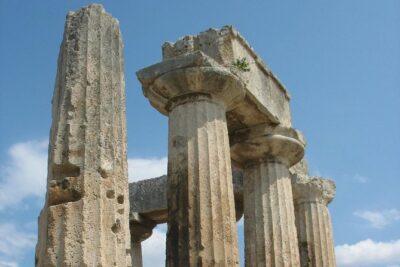
Private Biblical Tour Ancient Corinth & Isthmus Canal from Athens
Read our review →
Ancient Corinth & Nafplio Full Day Trip with Swim
Read our review →
Private Tour of Apostle Paul’s Footsteps in Ancient Corinth
Read our review →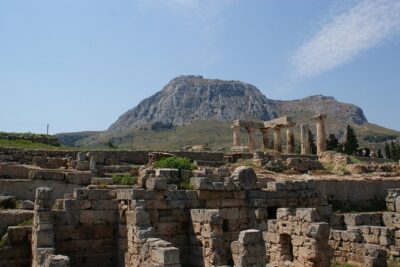
Corinth Half-Day Trip from Athens with Entrance Tickets
Read our review →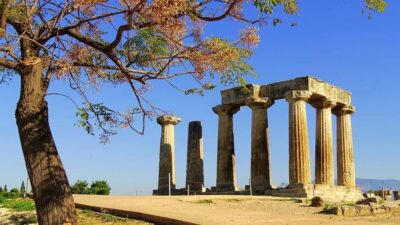
Browse the lists this tour appears in