
Reviewed · ANCIENT CORINTH TOURS
Private Tour of Apostle Paul’s Footsteps in Ancient Corinth
Ancient Corinth connects Scripture with stone. This private trip from Athens follows Apostle Paul’s time in Corinth through ports, ruins, museums, and churches, while an English-speaking driver handles the roads and timing. I especially like the easy hotel or port pickup, and I like that a private group can move at its own pace. The main catch is that the driver is not a licensed guide inside the archaeological sites, and entrance fees cost extra.
The tour is strongest for people who want biblical context without giving up broader Greek history. You will see the place where Paul faced Roman authority, the old marketplace where he worked and preached, and the fortress high above Corinth. If you expect a Bible study at every stop, this may feel too general. If you want history, scenery, and Paul’s story woven together, it offers good value.
In This Review
- Key points to know before booking
- Why Corinth makes a strong day trip from Athens
- The Corinth Canal and the ancient shortcut
- Kenchreai, where Paul reached Corinth by sea
- Ancient Corinth, the heart of the experience
- The museum fills in what the ruins cannot show
- Acrocorinth brings the biggest views
- A modern church closes the historical circle
- What the guides do well, and what they do not replace
- Is $169.03 per person a fair price?
- Practical advice for a smooth Corinth day
- Who should book this private Corinth tour?
- Should you book it?
- FAQ
- How long does the private Apostle Paul tour from Athens last?
- What is included in the tour price?
- Are entrance fees included?
- Is a licensed guide included inside the archaeological sites?
- Can the tour pick me up at the airport?
- Is the tour private?
Key points to know before booking
- Paul’s Corinth is more than one ruin: The tour links Kenchreai, the Agora, the Bema, Acrocorinth, and the modern Church of Saint Paul.
- Acrocorinth is the visual high point: The fortress offers wide views and layers of Greek, Byzantine, Frankish, Venetian, and Ottoman history.
- The private format keeps things flexible: Your group alone participates, and guides such as Giannis, Ruslan, Nick, George, and Fotis have adjusted stops and pace to suit families.
- The driver-guide setup matters: You receive historical explanation during the drive and at stops, but a licensed guide is not included inside the sites.
- Budget around €15 extra: Archaeological site and museum entrance fees are not included in the $169.03 price.
- Plan for heat and uneven ground: Comfortable shoes, a hat, and sunscreen will make the ruins much easier.
Why Corinth makes a strong day trip from Athens
Athens has enough ancient monuments to fill several days, but Corinth gives you a different kind of historical setting. The route leaves the capital and heads west toward the Isthmus of Corinth, the narrow strip linking mainland Greece with the Peloponnese.
That location explains Corinth’s importance. Before modern roads and canals, this was a key crossing point between two parts of Greece. Ancient Corinth gained power from trade, shipping, and its control of movement across the isthmus.
The drive is part of the experience, not dead time. Travel time is included in the five- to six-hour schedule, and the air-conditioned vehicle gives you a comfortable base between stops. You also get WiFi and bottled water, useful touches on a warm Greek day.
For one to four people, the company uses sedan vehicles. Larger groups receive a different vehicle, though the exact model is not specified. Several guides have used clean, comfortable cars or roomy Mercedes SUVs, and their driving has been praised for being careful on narrow roads and tight corners.
More Ancient Corinth trips:
- From Athens: Ancient Corinth Day Trip with Canal & VR Guide
★ 4.6 · 1,073 reviews - Private Biblical Tour Ancient Corinth & Isthmus Canal from Athens
★ 5.0 · 762 reviews - Athens: Ancient Corinth & Nafplio Full Day Trip with Swim
★ 4.8 · 523 reviews
The Corinth Canal and the ancient shortcut
Your first stop is the Corinth Canal, cut through the 6.3-kilometer-wide isthmus in 1893. You have about 20 minutes here, enough to see the steep limestone walls and the narrow strip of blue water below.
The canal is not an ancient monument, but it quickly explains the geography that shaped Corinth. The modern cut turned the Peloponnese into an island and made the old crossing point easy to understand. Bring your camera, but also take a moment to look straight down into the channel. The scale is more impressive than a quick roadside glance suggests.
Next comes the Diolkos, a short ten-minute stop. This ancient stone-paved trackway let ships move overland across the isthmus rather than sail around the Peloponnese. The idea sounds startling today, and the surviving remains help you picture the practical work involved.
This is a brief stop, so do not expect a long walk or a fully preserved transportation system. Its value comes from the concept: Corinth was important because people kept solving the problem of moving ships, goods, and armies through this narrow point.
Kenchreai, where Paul reached Corinth by sea
At ancient Kenchreai, on the Saronic Gulf side of Corinth, the tour turns directly toward Paul’s story. The port is linked with his arrival in Corinth around 51 A.D. during his first visit to the city.
The remains are modest, so this stop depends more on historical imagination than on grand ruins. You will not find a huge harbor complex waiting intact. Instead, you get a coastal setting tied to Paul’s movements and to the early Christian community.
Kenchreai also connects with Phoebe, a prominent Christian woman and deaconess associated with the local church. Paul later sailed from this port toward Ephesus, and the port is linked with his letter to the Romans being entrusted to Phoebe.
You have about 20 minutes here. That is enough for the setting and photographs, but it may feel short if you want to study every remaining stone. I would listen closely to the guide at this stop, since the spoken context does more work than the physical remains.
Ancient Corinth, the heart of the experience
The main archaeological site at Ancient Corinth receives about 40 minutes, followed by 45 minutes in the museum. Together, these are the most important stops for understanding the city Paul knew.
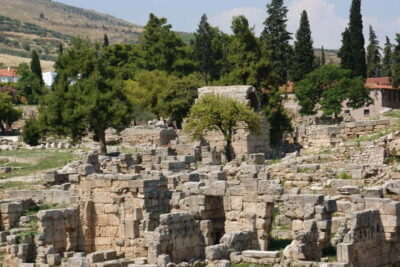
The Agora was the center of public and commercial life. Paul’s work and preaching took place within a city shaped by trade, civic politics, and many competing religious beliefs. Walking through the marketplace gives you a clearer picture of daily life than reading Paul’s letters in isolation.
The Bema, or raised platform, is especially important. Paul is traditionally associated with this spot, where he addressed the local community and faced trial before the Roman proconsul. The site helps connect the account in Acts with a real civic setting, though the ruins cannot recreate the event in a literal way.
You can also look for the area associated with shops where Paul, Aquila, and Priscilla made and sold tents. The street connected with Erastus adds another personal detail. Erastus was a civic official who later became associated with Paul’s circle.
The Temple of Apollo gives the site its most recognizable ancient outline. Its surviving columns recall the religious world Paul entered, a world that did not disappear simply because Christianity arrived. The tour’s attention to pagan beliefs is useful here. It shows the contrast between older cults, civic religion, and the Christian message without reducing Corinth to a simple Bible backdrop.
Entrance to Ancient Corinth is not included. The listed cost for the archaeological sites and museum is €15 per person, so include that in your budget. The driver can explain the site, but a licensed guide to accompany you inside is specifically excluded. That distinction is important if you want formal archaeological interpretation at every ruin.
More things to do in Athens:
- Athens: Acropolis & up to 5 Archaeological Sites Combo Pass
★ 4.4 · 12,619 reviews - Athens: Acropolis Ticket with Optional Audio or Live Guide
★ 4.2 · 11,055 reviews - Athens: Acropolis, Parthenon & Acropolis Museum Guided Tour
★ 4.8 · 9,316 reviews - Athens: Cape Sounion & Poseidon Temple Sunset Half-Day Trip
★ 4.8 · 8,241 reviews
The museum fills in what the ruins cannot show
The Archaeological Museum of Corinth was built in 1932 to protect objects found during excavation. Its galleries add human detail to the broad stones outside.
You can expect material from different periods, including prehistoric finds and objects connected with the Sanctuary of Asklepios. The collection helps explain how people lived, worshipped, worked, and made art in Corinth across the centuries.
I like the museum’s place in the schedule. Seeing the Agora, Temple of Apollo, and Bema first gives the objects a physical setting. Then the museum supplies the smaller details that ruins cannot preserve.
The 45-minute visit is enough for an organized overview, but not for a slow study of every gallery. If ancient art and archaeology are your main interest, you may wish for more time. On a five- to six-hour private outing, though, the balance is sensible.
Acrocorinth brings the biggest views
Acrocorinth sits high above the ancient city and is the tour’s most dramatic stop. You have about 40 minutes to explore the fortified acropolis, with its walls, towers, and bastions built or reinforced across Greek, Byzantine, Frankish, Venetian, and Ottoman periods.
This is where the tour broadens beyond Paul. The fortress tells the story of Corinth as a strategic stronghold long after the apostolic period. You can see how each ruling power adapted the same commanding site for defense.
Acrocorinth is also linked with the Temple of Aphrodite, a sanctuary associated with up to 1,000 priestesses. That claim is part of the site’s traditional historical account and gives you another way to consider the religious culture surrounding early Christianity.
The climb and ground conditions deserve attention. The tour information recommends comfortable shoes, and that is not a throwaway tip. Stone paths, slopes, and fortress terrain can be demanding, especially in heat or for anyone with limited mobility.
Several guides have helped older relatives in and out of the vehicle, offered cold water, and adjusted the pace. That personal care can make a real difference, but the tour should not be treated as effortless sightseeing. Ask about your group’s needs when booking, and bring a hat and sunscreen.
A modern church closes the historical circle
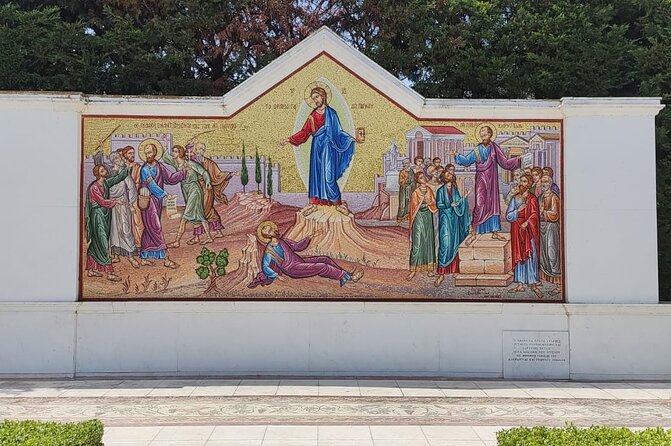
The final stop is the Church of Saint Paul, or Apostolos Pavlos Church, in the center of Ancient Corinth. It is a modern place of worship, but its large mosaic links Paul’s journey and mission with the present day.
The mosaic, created by artists Pastorutti and Tsotsonis, provides a reflective ending after the ruins and fortress. You move from pagan temples and Roman civic life to a church honoring the apostle’s lasting role in Corinth.
This stop will mean most to Christian visitors, especially those who have read Acts or Paul’s letters. It can also work for anyone interested in how modern Greece remembers its ancient Christian past.
The church is not an archaeological monument in the same sense as the Agora or Temple of Apollo. That is precisely its role in the itinerary. It gives the day a present-day conclusion rather than leaving you with only broken columns and defensive walls.
What the guides do well, and what they do not replace
The strongest part of this experience is the human service. Guides named Giannis, Ruslan, Nick, George, Fotis, Dennis, and Johnny have been praised for being punctual, courteous, safe, and flexible.
Giannis has been especially effective for people seeking a connection between Scripture and place. He has explained Paul’s movements, connected stories with Bible passages, and added humor and patience. Nick has helped with restroom stops, water refills, general questions about Greece, and local restaurant suggestions. George has been attentive to older family members and has even recommended locally prepared meals.
These details matter because the tour covers several sites in a short time. A good driver-guide keeps the day from feeling rushed and helps you understand why each stop belongs on the route.
Still, you should set the right expectation. The included staff are professional English-speaking tour drivers with strong history knowledge, not licensed site guides. A licensed guide is not included inside the archaeological areas. One person described the experience as more of a drive to Corinth than a strictly biblical tour, and that is a fair warning for anyone hoping for an intensive theological program.
The best approach is to read some of Acts and the relevant letters before you go. Then you can ask focused questions and make better use of the time at the Bema, Kenchreai, and the Agora.
Is $169.03 per person a fair price?
At $169.03 per person, this is not the cheapest way to reach Corinth. It becomes better value when you consider what is included: hotel or port pickup and drop-off, an air-conditioned private vehicle, an English-speaking driver, WiFi, bottled water, and a five- to six-hour route covering several separated places.
The private format is the key value. You are not waiting for a large group, and the schedule can respond to your pace. That has been particularly helpful for families, cruise passengers, older relatives, and people carrying luggage between the airport, port, and hotel.
Entrance fees add €15 per person. Airport pickup or drop-off costs an additional €50 per booking, so confirm that cost before you finalize your plans. Airport service can still be useful if you are connecting a flight, hotel stay, and cruise, but it changes the final price.
Group discounts are offered, which may improve the cost for a larger party. For one or two people, the price is easier to justify if you value privacy, door-to-door transport, and personal attention more than the lowest possible fare.
Practical advice for a smooth Corinth day
Pickup is offered from hotels and apartments, with the driver waiting at the entrance. At the port, the driver waits at the gate holding a sign with your name. Airport pickup is optional and costs extra.
Wear shoes suited to uneven archaeological ground. Carry sunscreen and a hat, since much of the day takes place outdoors and Greek sun can be strong.
Child seats are available on request. Most people can participate, but Acrocorinth’s terrain may be harder for anyone who struggles with slopes or rough paths. Tell the company about mobility concerns before the day begins.
The tour is offered in English and is private, meaning only your group participates. It generally receives a 4.9 rating from 275 reviews, with 99 percent of customers recommending it. Cancellation is free up to 24 hours before the start time. Poor weather can also lead to a different date or full refund.
Who should book this private Corinth tour?
I would choose this tour if you want to combine Paul’s story with the wider history of Corinth. It suits couples, families, cruise passengers, and small groups that prefer a private car over a large coach.
It is also a good choice if you want help with practical details. Guides have handled port pickups, airport drop-offs, luggage, restroom breaks, older relatives, and local meal suggestions. Those small acts can turn a demanding half-day into an easy one.
I would hesitate if you want a formal religious pilgrimage led by a biblical scholar. The tour has clear Christian connections, but it also covers ancient engineering, pagan worship, Roman civic life, fortifications, and Greek history. The driver explains the sites, but a licensed guide is not included inside them.
Should you book it?
Book this experience if the idea of standing at the Bema, walking through Paul’s marketplace, seeing Kenchreai, and looking down from Acrocorinth appeals to you. The route gives you more than a single ruin, and the private vehicle makes the spread-out sites practical from Athens.
Before booking, budget for the €15 entrance fee, confirm airport charges if needed, and ask for a guide who fits your interests. If you prepare with Acts and Paul’s letters, you will get more from the visit. For a comfortable, personal introduction to Ancient Corinth and Paul’s connection to it, this is a strong choice.
FAQ
How long does the private Apostle Paul tour from Athens last?
The tour lasts approximately five to six hours, including travel time between Athens and the Corinth sites.
What is included in the tour price?
The price includes an air-conditioned vehicle, WiFi on board, bottled water, hotel or port pickup and drop-off, and an English-speaking professional tour driver with historical knowledge.
Are entrance fees included?
No. Entrance fees for the archaeological sites and museum cost €15 per person and are not included.
Is a licensed guide included inside the archaeological sites?
No. A licensed guide to accompany you into the archaeological sites is not included. The included staff are English-speaking tour drivers who provide historical information.
Can the tour pick me up at the airport?
Airport pickup and drop-off are optional and cost an additional €50 per booking. Hotel and port pickup and drop-off are included.
Is the tour private?
Yes. Only your group participates in the activity. For groups of one to four people, the tour uses a sedan vehicle.
Just added around Athens
- Athens Hotels to Athens Airport Private Departure Transfer★ 5.0 · 40 reviews
- Private One-way Transfer between Athens International Airport and Athens Hotels★ 4.5 · 40 reviews
- Athens: Acropolis Museum Ticket with Self-Guided Audio tour App★ 3.5 · 40 reviews
- From Athens: Meteora Train Trip with Overnight Stay★ 4.8 · 40 reviews
- Athens Photography Tour★ 5.0 · 40 reviews
- Athens: Acropolis Visit and City Night Tour★ 4.7 · 40 reviews
- Delphi Full Day Private Trip From Athens With Lunch Overlooking the Sea★ 5.0 · 40 reviews
- Acropolis & Plaka Neighbourhood Private Tour with Licensed Expert★ 5.0 · 40 reviews
Ancient Corinth Tours, compared.
Ancient Corinth Day Trip with Canal & VR Guide
Read our review →
Private Biblical Tour Ancient Corinth & Isthmus Canal from Athens
Read our review →
Ancient Corinth & Nafplio Full Day Trip with Swim
Read our review →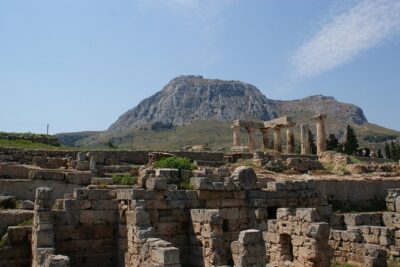
Corinth Half-Day Trip from Athens with Entrance Tickets
Read our review →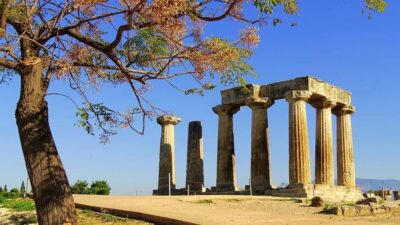
Ancient Corinth, Epidaurus, Nafplio full day private tour from Athens
Read our review →Browse the lists this tour appears in