
Reviewed · WALKING TOURS
Athens: Women in Ancient Greece Guided Walking Tour
Women shaped Athens, too. This two-hour walking tour brings their stories into view at places usually explained through politics, war, and famous men. I especially like the focus on daily life, not just celebrated figures, and the way mythology links goddesses such as Athena and Demeter to real social rules. The main drawback is that archaeological sites are viewed from outside, so you will not enter the Agora or other monuments.
The route also gives you familiar Athens from a fresh angle. I like the conversational style praised by many guests, especially with guide Maelle, who asks questions and welcomes side discussions. Plan for steps, sun, and uneven walking, though, because this is not a good fit for wheelchair users or anyone with serious mobility or heart concerns.
In This Review
- Key points to know before you book
- Why this women’s-history walk feels different
- Starting at Monastiraki Square
- Hadrian’s Library and the city’s public life
- Plaka, the Gate of Athena, and myth in the streets
- The Ancient Agora from a woman’s point of view
- The Pnyx and the missing voices of democracy
- The Acropolis and Filopappou Hill views
- The guide makes the difference
- What the $44.04 price gets you
- Timing, walking effort, and practical comfort
- Who will enjoy this most
- Should you book the Women in Ancient Greece walk?
- FAQ
- Where does the tour start?
- How long does the walking tour last?
- Where does the tour finish?
- What languages are available?
- Does the tour enter the Acropolis or Ancient Agora?
- Are archaeological-site tickets included?
- Is this a private tour?
- What should I bring?
- Is the tour suitable for wheelchair users?
- Can I cancel for a refund?
Key points to know before you book
- Women’s stories at famous Athenian sites: Hear about women at Hadrian’s Library, the Ancient Agora, the Pnyx, and the Acropolis viewpoints.
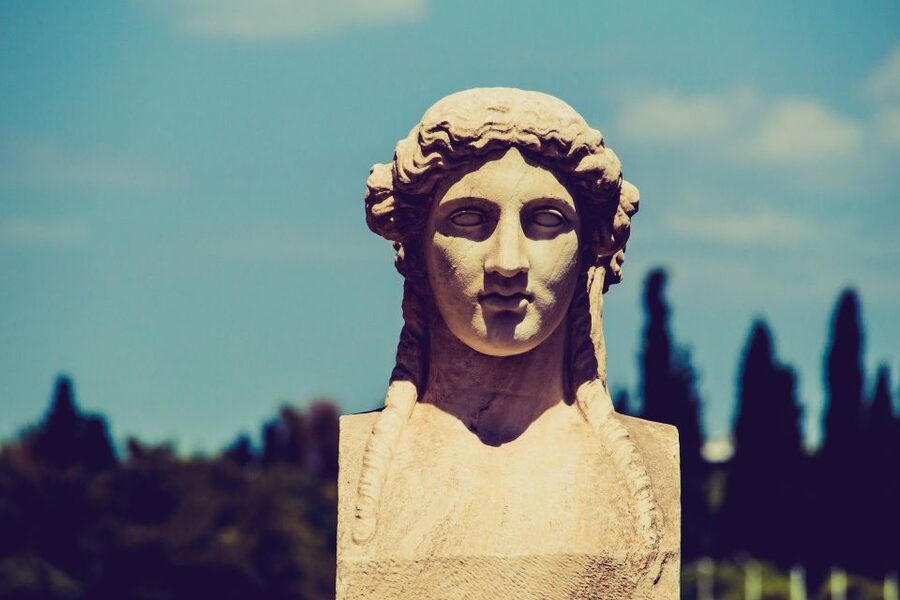
- Mythology meets daily life: Athena, Penelope, Demeter, and Pandora help explain how Greek ideas shaped women’s roles.
- A route through central Athens: Begin at Monastiraki Square, pass through Plaka, and finish near Filopappou Hill.
- Maelle is a major strength: Her warm, conversational approach and broad command of Greek history have earned repeated praise.
- Exterior sightseeing only: Entrance tickets are not included, and the tour does not enter the archaeological sites.
- Bring protection from the sun: A hat, sunscreen, and water matter on this mostly outdoor walk.
Why this women’s-history walk feels different
Athens has no shortage of tours about temples, democracy, and heroic men. This one asks a more useful question: what did the city look like to women who could not vote, hold the same public rights, or move through society in the same way as men?
That change in viewpoint is the tour’s real value. You are not simply given a list of famous women. You hear about marriage, household duties, social expectations, mythology, education, work, and the narrow paths open to women in different parts of society.
The walk also avoids treating ancient Greek women as one uniform group. A wealthy Athenian woman, a poor worker, a foreign resident, a priestess, and an enslaved woman did not have the same life. The experience is strongest when it connects those different positions to the streets and monuments around you.
The tour also includes women who pushed beyond the usual boundaries. Sappho appears as a poet, Aspasia as an influential thinker and public figure, and Agnodice as a woman linked with medicine. Their stories give the tour energy, but the focus remains on ordinary life as well as exceptional individuals.
More Walking Tours in Athens
- Athens: Acropolis and Parthenon Guided Walking Tour
★ 4.6 · 5,882 reviews - Greek Food Walking Tour in Athens
★ 5.0 · 4,740 reviews - Acropolis: Acropolis and Parthenon Guided Walking Tour
★ 4.7 · 3,442 reviews
Starting at Monastiraki Square
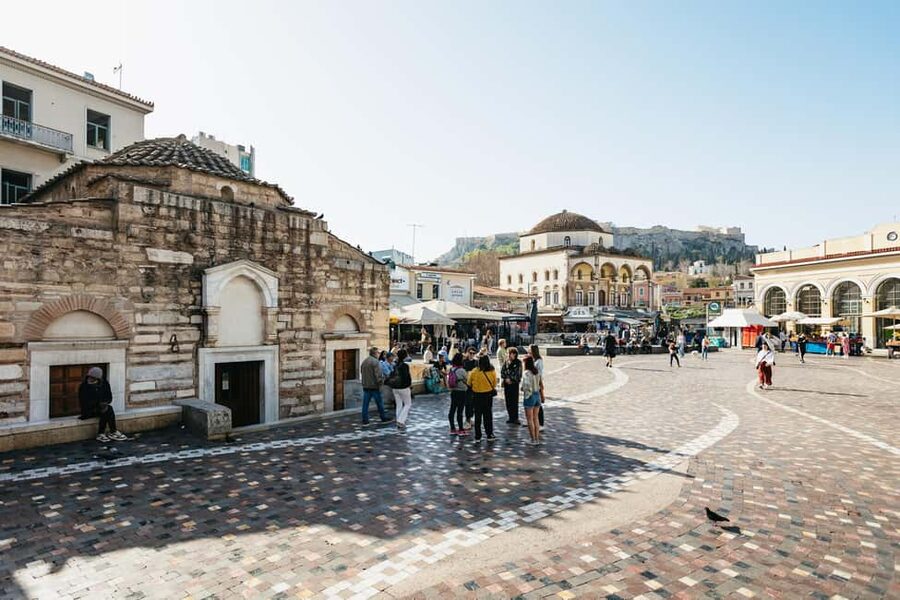
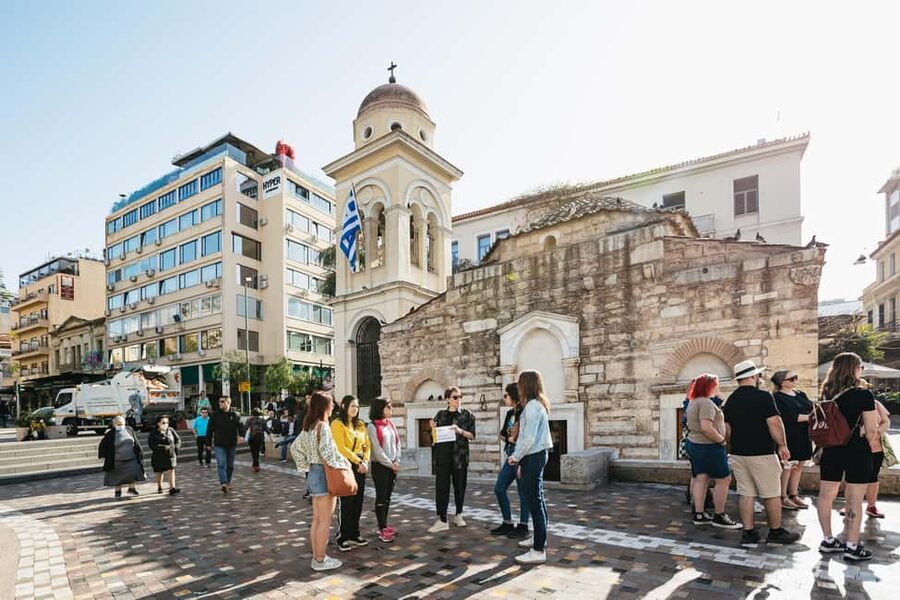
Meet your guide in Monastiraki Square, in front of the Church of the Virgin Mary Pantanassa. Look for the guide holding a sign marked Women in Ancient Greece. This is a useful meeting point in central Athens, but give yourself enough time to find the church among the square’s shops, cafés, and passing crowds.
The opening stretch around Monastiraki helps set the tone. You are in one of Athens’ most active public areas, yet the guide turns your attention away from the modern scene and toward the people who lived here in antiquity.
Expect a short guided look at Monastiraki before continuing to Hadrian’s Library. These early stops are brief, so do not expect a long architectural lecture at each one. Their purpose is to build the setting and introduce the main theme.
Hadrian’s Library and the city’s public life

Hadrian’s Library is a good early stop because it raises questions about who had access to learning and public culture. The building is easy to admire from the outside, but the tour’s real interest is the social world around such institutions.
Ancient Athens is often presented as the birthplace of democracy and philosophy. This walk asks you to notice who was left out of that story. Women’s lack of formal political power becomes more striking when you are standing near places connected with education, public debate, and civic life.
The stop is listed as about five minutes, so the guide will likely keep the explanation focused. That is helpful on a two-hour route, though people who want a detailed architectural study will need a separate visit.
Plaka, the Gate of Athena, and myth in the streets
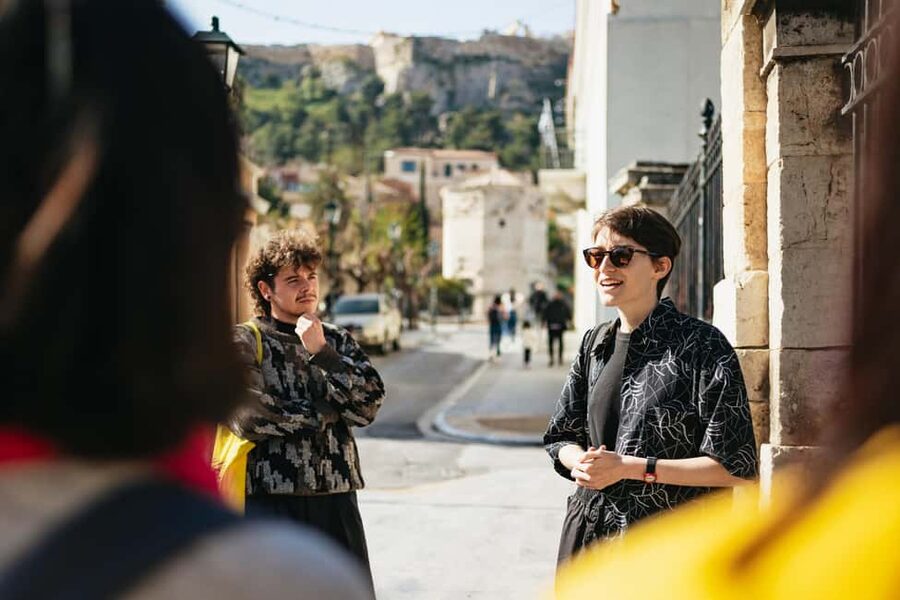
The route continues through Plaka, one of the most atmospheric parts of central Athens. Here, the tour brings ancient stories into a modern neighborhood rather than keeping them locked inside a museum.
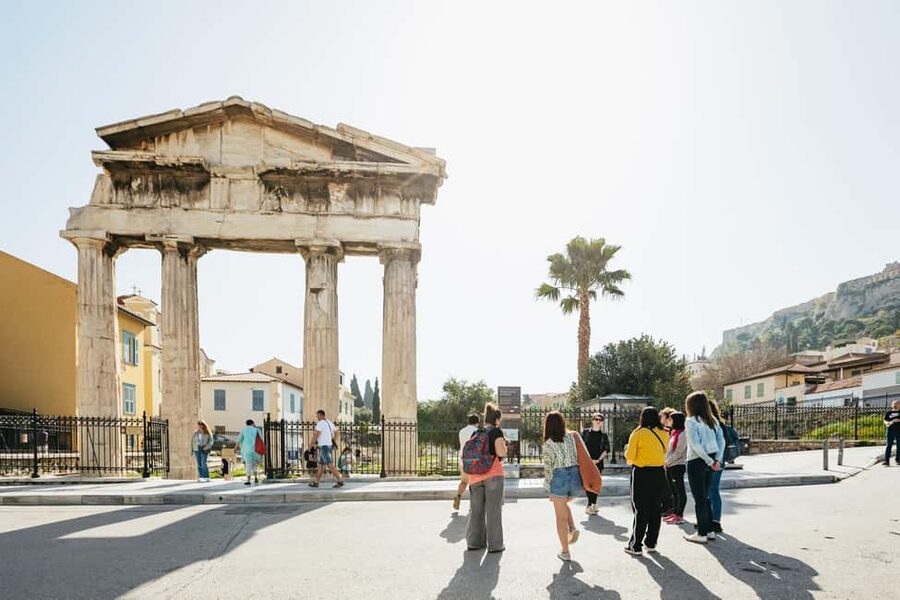
At the Gate of Athena Archegetis, you get another exterior view and a chance to connect mythology with civic identity. Athena was not simply a goddess in a storybook. Her image and character helped shape ideas about wisdom, protection, war, citizenship, and women’s place in society.
The guide also discusses Pandora, Penelope, and Demeter. These figures offer different models of womanhood. Pandora is tied to a cautionary myth, Penelope to loyalty and household endurance, and Demeter to motherhood, agriculture, and religious power. The point is not to present mythology as a direct record of daily life, but to show how stories can reveal the values a society promoted.
A short secret stop is included along the way. No exact location is provided, which is part of the fun, but you should understand it as a brief sightseeing point rather than a major monument visit.
More things to do in Athens:
- Athens: Acropolis & up to 5 Archaeological Sites Combo Pass
★ 4.4 · 12,619 reviews - Athens: Acropolis Ticket with Optional Audio or Live Guide
★ 4.2 · 11,055 reviews - Athens: Acropolis, Parthenon & Acropolis Museum Guided Tour
★ 4.8 · 9,316 reviews - Athens: Cape Sounion & Poseidon Temple Sunset Half-Day Trip
★ 4.8 · 8,241 reviews
The Ancient Agora from a woman’s point of view

The Ancient Agora is one of the most important stops on the route. It was the center of public life in classical Athens, a place associated with trade, political activity, legal matters, and social exchange.
You will view the site from outside because admission is not included. That keeps the tour price lower, but it also means you will not see the interior monuments during this experience. If the Agora is high on your list, plan a separate paid visit.
Even from the exterior, the location helps explain the limits placed on Athenian women. The Agora’s public role makes the contrast clear: men could take part in civic life in ways women generally could not. The guide uses the site to move beyond a simple statement that women had fewer rights, showing how those limits affected everyday movement and decision-making.
This is also where stories such as the kidnapped Spartan girls and the mysterious women’s festival in Athens add texture. These tales are not just colorful interruptions. They help show how women’s bodies, marriages, religious duties, and relationships were treated as matters tied to the wider community.
The Pnyx and the missing voices of democracy
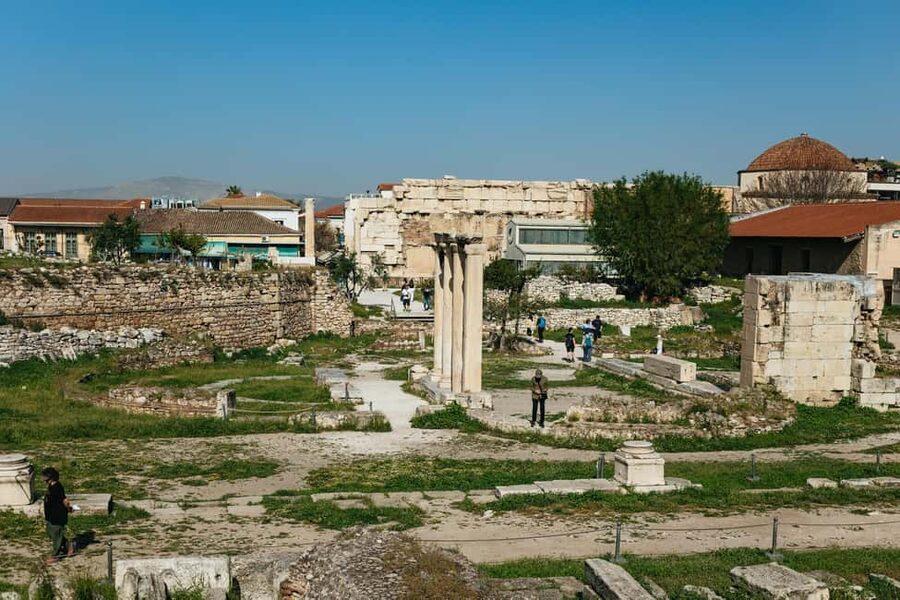
The walk then reaches the Pnyx, a powerful stop for anyone interested in politics. This is where the first democratic votes were cast, making it an obvious place to examine the famous Athenian system more closely.
From the perspective of women, democracy looks incomplete. The Pnyx represents public participation, but the women whose work supported households and families were excluded from the voting body. The guide uses this tension to make ancient democracy easier to understand and harder to romanticize.
The Pnyx stop lasts about 15 minutes, one of the longer pauses on the route. That gives you time to listen, ask questions, and consider how citizenship worked in practice. Several guests particularly valued Maelle’s habit of asking questions rather than giving a nonstop speech. That conversational approach should suit you if you enjoy discussing ideas instead of only taking photographs.
The Pnyx also offers views toward the Acropolis. You may find this one of the best points for seeing the famous monument while thinking about the people who had limited access to political power around it.
The Acropolis and Filopappou Hill views
The route includes a viewpoint on the way to Filopappou Hill, followed by a guided stop at the hill itself. You will not tour the Acropolis interior, but you will gaze up at it from the route.
That distinction matters. If you want temple interiors, excavation details, or a full explanation of the Acropolis buildings, book an Acropolis-focused visit as well. This tour uses the monument as a visual anchor for stories about society, religion, myth, and women’s lives.
Filopappou Hill provides a fitting finish. The walk ends with scenery rather than another dense block of facts, and the hill lets you look back across Athens. The final guided stop lasts about 10 minutes.
The advertised information says the activity ends back at the meeting point, while the route also lists a drop-off point near the kiosk at Rovertou Galli 69. Confirm the exact ending arrangement when you reserve, especially if you have a tight schedule afterward.
The guide makes the difference
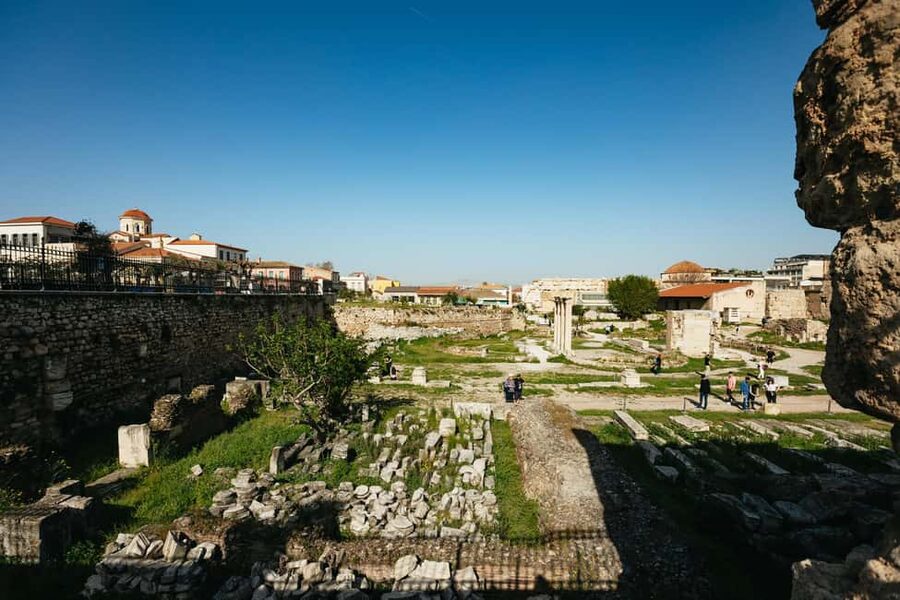
The strongest praise centers on the guide, especially Maelle. She is described as warm, funny, patient, and able to handle questions well beyond the narrow tour theme.
That matters here because women’s history can be reduced to a few famous names or presented as a modern argument placed on top of ancient evidence. Maelle’s approach appears more careful. She connects literature, mythology, social customs, politics, and everyday life while also weighing difficult ideas instead of presenting every ancient claim as simple fact.
Her style is interactive. She asks questions, checks the group’s level of understanding, and encourages people to follow their curiosity. One person who joined on a quiet February morning ended up with a private experience because no one else had booked. Private groups are also available as an option, though the price and exact arrangement should be checked for your date.
The tour is offered in English and French. If language choice matters to you, confirm which guide and language are scheduled before booking.
What the $44.04 price gets you
At $44.04 per person, this is not the cheapest way to walk around Athens. You are paying for a specialized subject, a live guide, a planned route, and interpretation that connects separate places into one story.
I think the price is fair if you value context and discussion. A self-guided walk can take you past the Gate of Athena or the Pnyx, but it is less likely to explain why those places matter to women, or how mythology helped define social expectations.
The price does not include food, drink, or archaeological admission. Since the route only views the sites from outside, you should include separate entrance costs in your Athens budget if you want to visit the Agora or Acropolis afterward.
The tour also includes a small gift. It is a pleasant extra, but the guide’s teaching is the main reason to book, not the souvenir.
Timing, walking effort, and practical comfort
The walk lasts two hours, with stops ranging from about five to 15 minutes. That is long enough to cover a lot of ground without taking up an entire morning or afternoon.
You will encounter steps, slopes, and uneven surfaces. The experience is not suitable for wheelchair users or people with mobility impairments, and the information also advises against it for people with heart problems. If you have doubts, choose a flatter activity or ask the provider before reserving.
Athens can be hot, even when the walking distance looks manageable. Bring water, sunscreen, and a sun hat. One guest noted that Maelle looked for shady places to stop on a hot day, but shade cannot be guaranteed along every part of the route.
Wear comfortable shoes. You are moving through several neighborhoods and hills, not simply standing in one square. Food and drink are not included, so carry water and plan a snack before or after the walk.
Free cancellation is available up to 24 hours before the activity for a full refund. You can also reserve now and pay later, which helps if your Athens plans are still shifting.
Who will enjoy this most
I would recommend this tour to anyone who has already seen the standard Athens highlights and wants a more focused question to guide the visit. It also works well as an introduction to the city because you still see major locations while learning how social life operated behind the monuments.
It is a particularly good choice for:
- People interested in women’s history, mythology, literature, or ancient politics
- Visitors who prefer stories and discussion to a long architectural lecture
- Families or friends who want a shared topic to talk about after the walk
- Repeat visitors looking for a different route through central Athens
- Anyone who wants to connect ancient ideas with questions still present in society today
It may not suit you if your main goal is to enter archaeological sites, cover every Acropolis structure, or walk at a very gentle pace. It is also not ideal if you dislike discussion or want a purely visual sightseeing tour.
Should you book the Women in Ancient Greece walk?
Book it if you want Athens to feel less like a collection of famous stones and more like a society shaped by people with unequal rights and very different daily lives. The route is compact, the subject is unusual, and the guide’s thoughtful, friendly delivery appears to be the experience’s greatest strength.
I would pair it with a separate Acropolis or Ancient Agora visit. This tour explains what the monuments mean from a female point of view, while an archaeological-site visit lets you see the buildings properly.
At $44.04, it offers good value for a specialist walking tour, especially if you enjoy asking questions and thinking beyond the usual heroic version of ancient Greece. Bring water, accept the steps, and book it for a morning or cooler part of the day when possible.
FAQ
Where does the tour start?
Meet your guide in Monastiraki Square, in front of the Church of the Virgin Mary Pantanassa. The guide will hold a sign marked Women in Ancient Greece.
How long does the walking tour last?
The tour lasts two hours. Starting times vary, so check availability for your chosen date.
Where does the tour finish?
The activity information says it ends back at the meeting point. A listed drop-off location is the kiosk at Rovertou Galli 69, so confirm the exact ending point when booking.
What languages are available?
The tour is offered with a live guide in English or French. Check the available language for your selected time.
Does the tour enter the Acropolis or Ancient Agora?
No. Archaeological entrance tickets are not included, and the experience provides exterior views of the sites.
Are archaeological-site tickets included?
No. Tickets to archaeological sites are not included in the tour price.
Is this a private tour?
A private group option is available. The standard booking details do not state that every departure is private.
What should I bring?
Bring water, sunscreen, and a sun hat. Comfortable walking shoes are also sensible because the route includes steps and hill walking.
Is the tour suitable for wheelchair users?
No. The activity is listed as unsuitable for wheelchair users and people with mobility impairments.
Can I cancel for a refund?
You can cancel up to 24 hours in advance for a full refund. A reserve-now, pay-later option is also available.
Just added around Athens
- Athens Hotels to Athens Airport Private Departure Transfer★ 5.0 · 40 reviews
- Private One-way Transfer between Athens International Airport and Athens Hotels★ 4.5 · 40 reviews
- Athens: Acropolis Museum Ticket with Self-Guided Audio tour App★ 3.5 · 40 reviews
- From Athens: Meteora Train Trip with Overnight Stay★ 4.8 · 40 reviews
- Athens Photography Tour★ 5.0 · 40 reviews
- Athens: Acropolis Visit and City Night Tour★ 4.7 · 40 reviews
- Delphi Full Day Private Trip From Athens With Lunch Overlooking the Sea★ 5.0 · 40 reviews
- Acropolis & Plaka Neighbourhood Private Tour with Licensed Expert★ 5.0 · 40 reviews
Walking Tours, compared.



Acropolis: Acropolis and Parthenon Guided Walking Tour
Read our review →
Acropolis monuments & Parthenon Walking Tour with Optional Acropolis Museum
Read our review →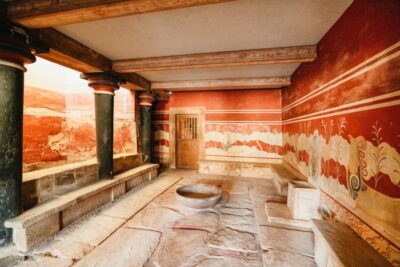
Knossos: Knossos Palace Skip-the-Line Guided Walking Tour
Read our review →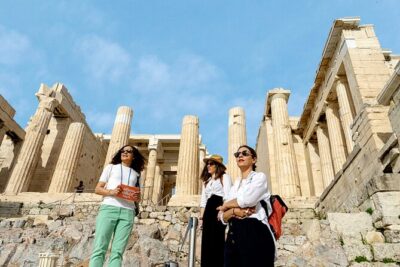

Athens Authentic Greek Food Walking Tour (Small Group)
Read our review →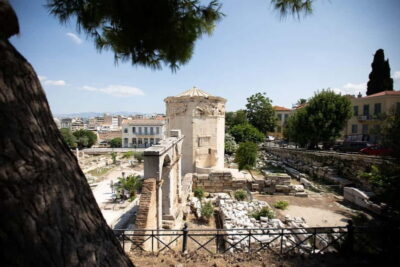
Early Morning Acropolis & Old Athens Guided Walking Tour
Read our review →Browse the lists this tour appears in