Reviewed · GUIDED
Athens: the Great Greek Philosophers Guided Tour in Spanish
Philosophy still walks Athens. This 150-minute Spanish tour follows the places linked with Socrates, Plato, and other Greek thinkers, turning familiar city streets into a lesson in ideas, politics, and moral courage. I especially like the thought-provoking questions used along the way and the chance to visit places such as the Areopagus and Socrates Prison. The main drawback is simple: you will be on your feet for two and a half hours, often outdoors, so Athens heat can make comfortable shoes and water essential.
I also like the personal feel created by guides such as Gregory, who has been praised for clear explanations, humor, and adapting discussions to the group. This is not a tour for anyone seeking a fast checklist of monuments. It works best if you enjoy conversation, stories, and asking why the ancient Greeks cared so much about how people should live.
In This Review
- Key points to know before booking
- Why this Athens tour feels different
- Meeting Plato at the starting point
- The Greek Agora and the public life of ideas
- The Areopagus and the cost of speaking freely
- Walking toward Socrates Prison
- The Pnyx and the birth of public debate
- How the Spanish guide shapes the walk
- What the $34 price really covers
- Who will enjoy this tour most
- Practical advice for a better experience
- Should you book the Great Greek Philosophers tour?
- FAQ
- How long does the Great Greek Philosophers tour last?
- What language is the tour in?
- How much does the tour cost?
- Where does the tour meet?
- How early should I arrive?
- What places are included in the route?
- What is included in the price?
- Are food and drinks included?
- Can I cancel for a full refund?
Key points to know before booking
- A philosophy walk, not a standard ancient-sites tour: The route connects Athens landmarks with the birth of Western philosophy.
- The Areopagus adds a strong setting: You discuss law, public life, and civic debate in a place tied to ancient Athens.
- Socrates Prison gives the tour an emotional center: The story of a thinker paying dearly for his beliefs brings the subject down to earth.
- The guide shapes the experience: Gregory is praised for storytelling, humor, patience, and answering questions in detail.
- Spanish is the stated tour language: Book this experience if you are comfortable following a sustained discussion in Spanish.
- $34 is fair for 150 minutes: You are paying for an expert-led theme walk, not admission to a major archaeological site or a meal.
Why this Athens tour feels different
Athens offers no shortage of ancient monuments. You can see the Acropolis, walk through the Ancient Agora, and photograph marble ruins in a single morning. This tour takes a narrower path. Its subject is not simply what happened in Athens, but how Athenians began asking difficult questions about truth, justice, knowledge, and the good life.
I like that focus. A general city tour may tell you that Socrates, Plato, and Aristotle mattered. This walk tries to show where their world took shape and how public spaces helped ideas spread. You are encouraged to picture people talking, arguing, teaching, and challenging one another in the same broad parts of the city.
The experience also avoids treating philosophy like a school lecture. The strongest feedback points to an active style, with questions and small mind games that invite you to examine your own beliefs. That matters because ancient philosophy can become dry very quickly if it is reduced to names and dates.
You do not need a university background. Several comments describe difficult ideas being explained through ordinary examples and daily situations. At the same time, the tour can still suit someone who already reads philosophy, since Gregory has been praised for welcoming detailed questions and adjusting the conversation to the group.
More things to do in Athens:
- Athens: Acropolis & up to 5 Archaeological Sites Combo Pass
★ 4.4 · 12,619 reviews - Athens: Acropolis Ticket with Optional Audio or Live Guide
★ 4.2 · 11,055 reviews - Athens: Acropolis, Parthenon & Acropolis Museum Guided Tour
★ 4.8 · 9,316 reviews
Meeting Plato at the starting point
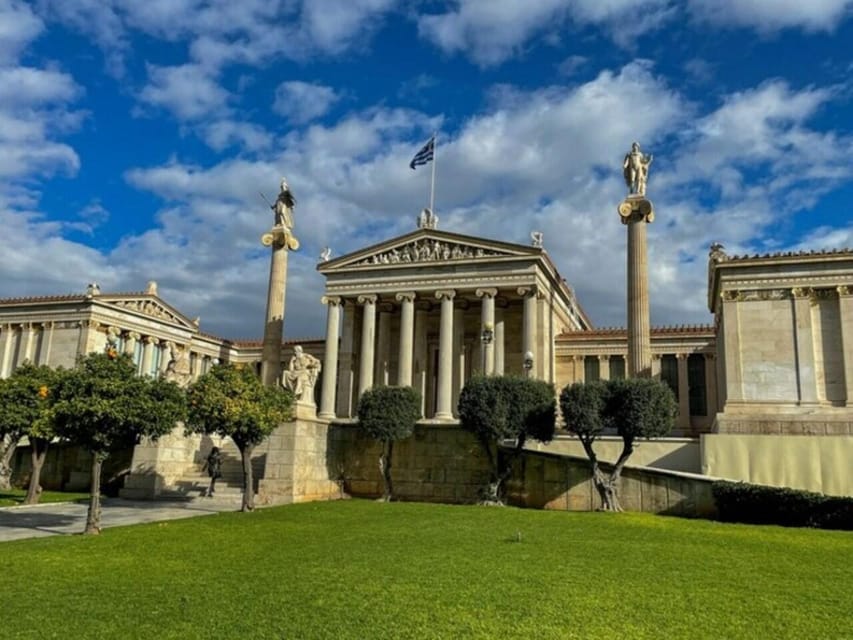
The meeting point is in front of the Statue of Plato, and you are asked to arrive 10 minutes before the start. That is a sensible arrangement. You begin beside one of the central figures of Greek thought rather than at a random street corner, so the theme is clear from the first minute.
Plato is more than a famous name here. His work preserved and developed many of the conversations associated with Socrates, while his own ideas shaped later thinking about politics, education, reality, and justice. The statue gives the guide an easy way to introduce the shift from myth-based explanations toward reasoned debate.
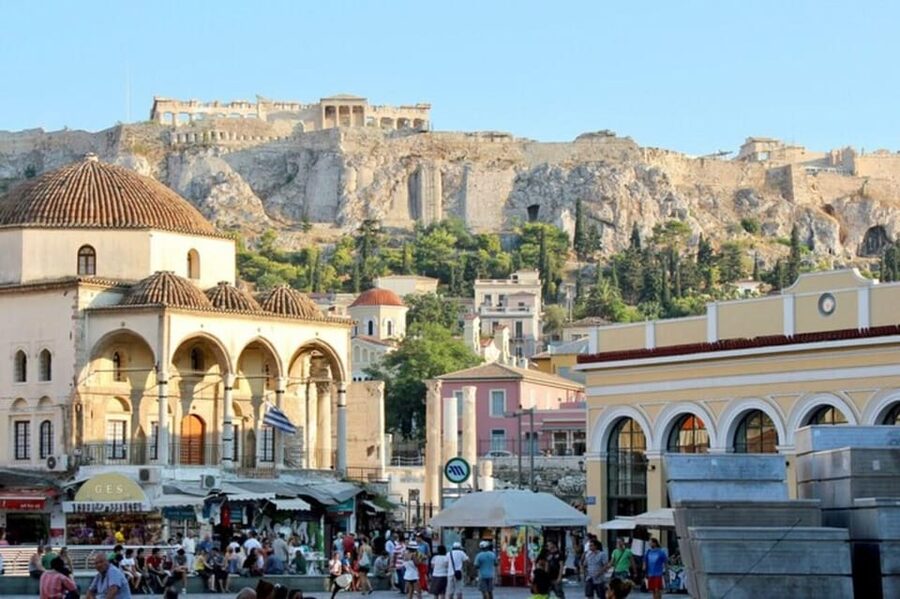
This opening should help you get your bearings. Central Athens can feel confusing, with archaeological remains, modern traffic, cafés, and narrow streets all meeting within a short walk. Starting at a clear landmark reduces the usual first-meeting fuss.
The guide names mentioned in the feedback include Gregory, Gregori, and Sunny. Gregory receives the most detailed praise for his teaching style and knowledge of philosophy and Athenian history. One recent participant also described Sunny as friendly, so the exact guide may vary by departure.
The Greek Agora and the public life of ideas
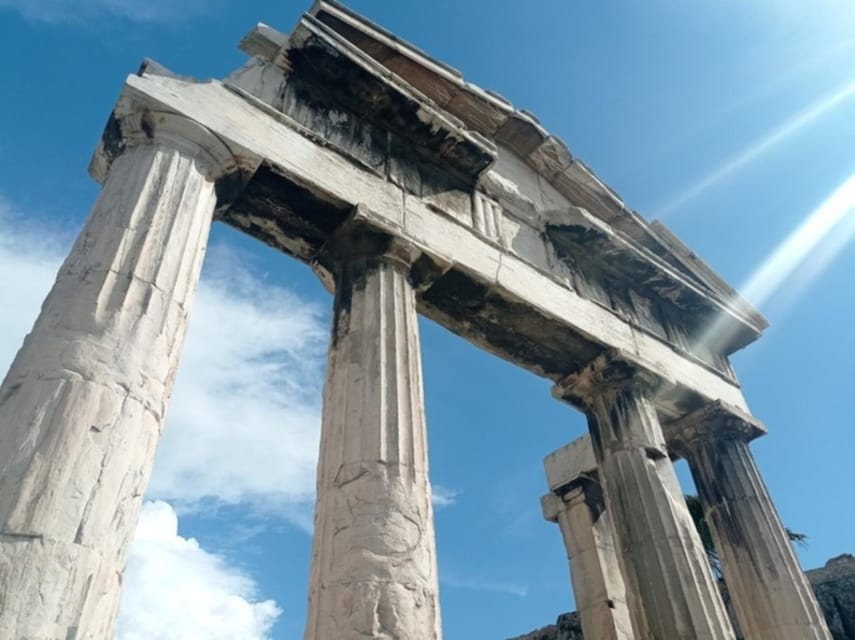
The Greek Agora is one of the most important settings on the route. In ancient Athens, this was not merely a place to shop. It was part of the city’s public life, where people met, conducted business, discussed civic matters, and encountered arguments about how society should work.
That setting helps explain why Athenian philosophy developed in such a public way. The big questions were not kept inside a private classroom. They were tested in conversation, in political life, and in disputes between people with very different views.
Your guide connects the Agora with figures including Socrates, Plato, Aristotle, and Pythagoras. You should expect stories and explanations about their approaches rather than a full academic history of every school of thought. The aim is to see how different thinkers responded to questions about reality, morality, reason, and human behavior.
I find this part especially useful if you are also visiting the Acropolis or Ancient Agora independently. Ruins can be impressive but quiet. A guide gives them a human purpose. You begin to see the open spaces as places where ideas had consequences, not just as old stones arranged for photographs.
The limitation is that this tour is not presented as an archaeological entry tour. The price includes an official tour guide, but food, drinks, and personal expenses are not included. If you want a detailed examination of every building or a formal museum-style explanation, you may need a separate site visit.
The Areopagus and the cost of speaking freely
The Areopagus brings a sharper political and moral edge to the walk. This rocky hill is one of the named highlights, and it gives the discussion a strong link to public judgment, law, and authority.
The tour uses the setting to explore the tension between an individual thinker and the society around him. Socrates is the natural center of that story. His habit of questioning accepted opinions made him an important teacher and an uncomfortable presence in Athens.
The phrase about wisdom having a price is not just decoration. Socrates became famous for exposing how little people knew, even when they claimed certainty. That method could make philosophy personal, and it helps explain why his story still feels more dramatic than a list of theories.
The Areopagus is also a physical stop where footing matters. You should bring shoes with a good grip and take care on uneven ground. The activity information specifically advises comfortable footwear and water, and I would treat both as necessities in warm weather.
You will likely get more from this stop if you join the conversation. The guide has been praised for asking the group to think through moral questions and examine its assumptions. You do not have to agree with every point, but the tour is designed to make you participate rather than simply listen.
A few more Athens trips worth weighing up
- Athens: Acropolis and Parthenon Guided Walking Tour
★ 4.6 · 5,882 reviews - Athens: Cape Sounio & Poseidon Temple Trip with Audio Guide
★ 4.4 · 4,521 reviews - Athens: Mythology of Delphi, Museum and Arachova Guided Tour
★ 4.6 · 4,008 reviews - Athens: Acropolis, Parthenon & Acropolis Museum Guided Tour
★ 4.8 · 3,579 reviews
Walking toward Socrates Prison
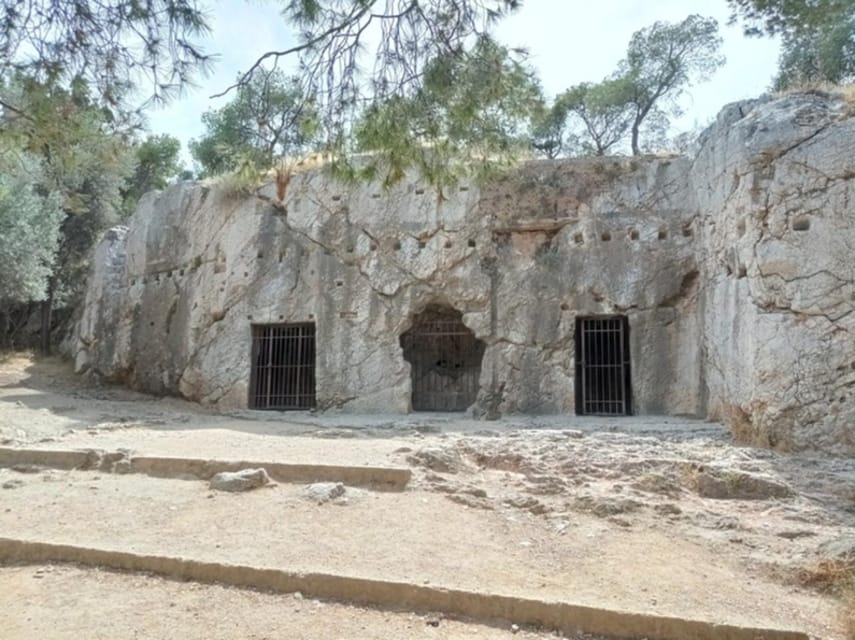
Socrates Prison is another central highlight. The site is presented as a place connected with the final chapter of Socrates’ life, giving the tour a memorable human focus after the more abstract discussions of philosophy.
Here, the story becomes one of choice and consequence. Socrates is remembered not only for asking questions, but also for the way he faced the outcome of his ideas. The stop gives your guide room to explain why his trial and death became so important to later philosophy.
You should keep expectations sensible. The appeal is the story and setting, not a grand monument. It is a lesser-known stop compared with Athens’ best-known ancient sights, and its power comes from what you learn there. Several participants valued visiting places they would not have found through a standard city guide.
That is one of the tour’s best qualities. A famous monument can show you scale and wealth. A smaller place such as Socrates Prison can show you how a person, an argument, and a political system collided.
The guide may also use this point to connect Socrates with Plato, since much of what people know about Socrates comes through later accounts, especially Plato’s dialogues. That distinction is useful. It reminds you that ancient philosophy is not only a collection of direct biographies. It is also a record shaped by students, writers, and later interpretation.
The Pnyx and the birth of public debate
The route reaches toward the hill of Pnyx, another place named in the tour description. The Pnyx is closely connected with the public life of ancient Athens and offers a natural setting for discussion about citizenship, speech, and collective decision-making.
The guide uses the route from the Agora toward the Pnyx to explain the symbolic role of these locations. You are not just moving between attractions. You are following the physical space where public debate and political thought developed alongside philosophical questioning.
This is where the tour’s wider message becomes clear. Ancient Greek philosophy did not grow separately from civic life. Arguments about truth and virtue were connected with arguments about law, power, education, and the responsibilities of citizens.
You may also find this part less immediately dramatic than Socrates Prison. It depends more on explanation and imagination than on a striking structure. Still, I think it rewards attention, especially if you want to understand why Athens became so important in the story of human thought.
Reviews of the experience repeatedly praise the guide’s ability to bring the city to life through stories. That skill matters most at places such as the Pnyx, where the meaning is greater than what remains visible on the ground.
How the Spanish guide shapes the walk
The stated live-tour language is Spanish. That is the first practical question to settle before booking. This is a talk-heavy experience, so basic conversational Spanish is not enough if you want to follow the detail comfortably.
The guide is not simply pointing out monuments and giving short facts. The format includes historical stories, philosophical concepts, questions, and discussion. You need to understand spoken Spanish well enough to follow a sustained explanation outdoors.
The most praised quality is the guide’s personal approach. Gregory is described as friendly, patient, funny, and easy to talk with. He has also been praised for tailoring explanations to individual interests, including law and society, and for answering questions about Athens beyond the tour’s main theme.
That flexibility can make a big difference. Philosophy means different things to different people. One person may care about ethics, another about politics, and another about how ancient ideas shaped modern thought. A guide who listens can make the same route feel more relevant to each person.
The tour also appears to welcome beginners. You do not need to have read Plato’s Republic or Aristotle’s Nicomachean Ethics first. The experience is structured to explain the basic schools and concepts in plain terms, while still leaving room for deeper questions.
What the $34 price really covers
At $34 per person, the tour sits in a reasonable range for a guided cultural walk lasting 150 minutes. You are getting two and a half hours of a themed experience with an official guide, which works out to roughly $13.60 per hour before considering the value of the guide’s preparation and local knowledge.
The price is attractive because the subject is focused. Instead of paying for a broad tour that gives you a few minutes on many topics, you spend the time on one story: how Athens became a center of philosophy and how its major thinkers shaped later ideas.
Still, the cost does not cover food, drinks, or personal expenses. There is no stated admission to a separate attraction included, so budget for anything else you want to visit in Athens. Bring your own water, especially in the hotter months.
I think the price is strongest for people who would otherwise walk past these locations without understanding their connection. If you already plan to study the ancient sites on your own, the tour’s value will depend on how much you want conversation and interpretation rather than additional sightseeing.
Free cancellation up to 24 hours before the start reduces the risk of booking early. The reserve-now-and-pay-later option also helps if your Athens schedule is still changing.
Who will enjoy this tour most
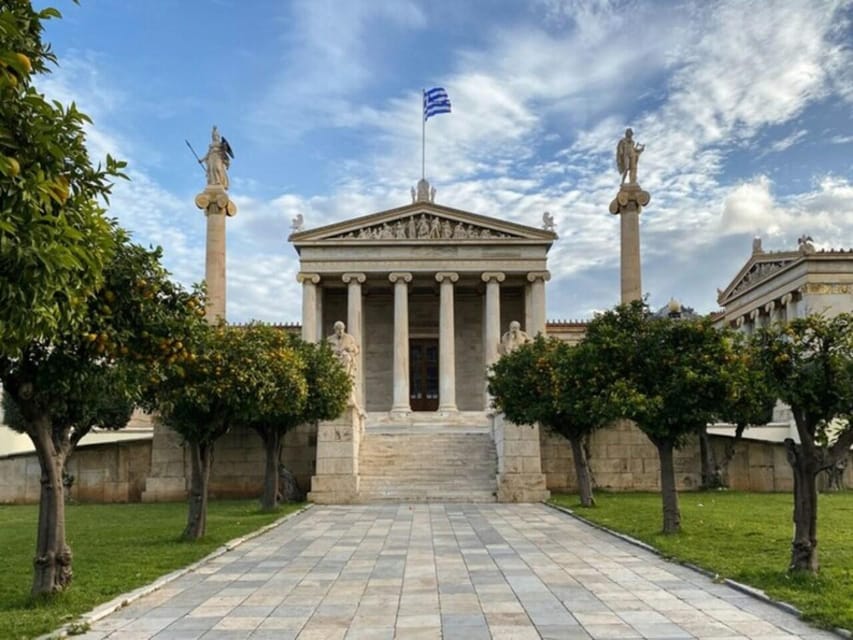
I would choose this experience if you fit one or more of these descriptions:
- You want an Athens walk built around ideas rather than only monuments.
- You enjoy asking questions and discussing moral or political problems.
- You are new to philosophy and want clear explanations without a formal classroom.
- You already know the basics and want to connect them with real places.
- You are curious about smaller sites such as Socrates Prison.
- You prefer a guide who can suggest other things to see and do in Athens.
Families with older children or teenagers may also find the question-based approach more engaging than a standard lecture, though the provided details do not specify a minimum age. The 150-minute duration is long enough to develop the topic, but it may feel demanding for anyone who dislikes walking or extended discussion.
I would skip it if your main goal is entry to major archaeological sites, a food experience, or a quick introduction to every part of Athens. This is a specialist tour, and its value rises sharply when philosophy interests you.
Practical advice for a better experience
Arrive at the Statue of Plato 10 minutes early. That gives you time to find the correct meeting point without cutting into the opening explanation.
Wear comfortable shoes. The route includes outdoor urban walking and sites with uneven surfaces, especially around rocky areas such as the Areopagus. Bring water even if the forecast looks mild.
Try to take part in the questions. The strongest feature of this tour is not simply hearing information. It is using the guide’s prompts to connect ancient arguments with your own views.
Leave room in your schedule after the walk. Gregory has sometimes continued answering questions beyond the stated time, and one participant noted that he helped with general Athens recommendations and directions toward the metro. That extra help is not guaranteed, but it shows why you should avoid booking a tight appointment immediately afterward.
Plan on the full 150 minutes. Some comments describe the experience as about two hours, but the official duration is 150 minutes, so use the longer figure when arranging your day.
Should you book the Great Greek Philosophers tour?
Book it if you want Athens to become a place of arguments, questions, and human choices rather than a row of ancient ruins. At $34, the focused subject, long walking discussion, and strong guide feedback make it a good value for curious visitors.
I would give it priority after your first essential Athens sights, especially if you are comfortable with Spanish. Gregory’s praised storytelling, friendly manner, and willingness to adapt can turn a specialist topic into an approachable afternoon.
Skip it if you want a short, quiet sightseeing walk or a tour centered on archaeological detail. But if you want to leave Athens with something to think about, this is one of the more distinctive ways to spend 150 minutes in the city.
FAQ
How long does the Great Greek Philosophers tour last?
The tour lasts 150 minutes, or two and a half hours.
What language is the tour in?
The live guided tour is in Spanish.
How much does the tour cost?
The listed price is $34 per person.
Where does the tour meet?
You meet in front of the Statue of Plato.
How early should I arrive?
You should arrive 10 minutes before the tour begins.
What places are included in the route?
The named highlights are the Statue of Plato, the Areopagus, and Socrates Prison. The route also discusses the Greek Agora and the hill of Pnyx.
What is included in the price?
An official tour guide is included.
Are food and drinks included?
No. Food, drinks, and personal expenses are not included.
Can I cancel for a full refund?
Yes. You can cancel up to 24 hours in advance for a full refund.
Just added around Athens
- Athens Hotels to Athens Airport Private Departure Transfer★ 5.0 · 40 reviews
- Private One-way Transfer between Athens International Airport and Athens Hotels★ 4.5 · 40 reviews
- Athens: Acropolis Museum Ticket with Self-Guided Audio tour App★ 3.5 · 40 reviews
- From Athens: Meteora Train Trip with Overnight Stay★ 4.8 · 40 reviews
- Athens Photography Tour★ 5.0 · 40 reviews
- Athens: Acropolis Visit and City Night Tour★ 4.7 · 40 reviews
- Delphi Full Day Private Trip From Athens With Lunch Overlooking the Sea★ 5.0 · 40 reviews
- Acropolis & Plaka Neighbourhood Private Tour with Licensed Expert★ 5.0 · 40 reviews
Guided, compared.


Acropolis, Parthenon & Acropolis Museum Guided Tour
Read our review →

Cape Sounio & Poseidon Temple Trip with Audio Guide
Read our review →
Mythology of Delphi, Museum and Arachova Guided Tour
Read our review →Acropolis, Parthenon & Acropolis Museum Guided Tour
Read our review →