
Reviewed · ACROPOLIS & PARTHENON TOURS
Athens: Private 4-Hour Tour with Acropolis and Old Town
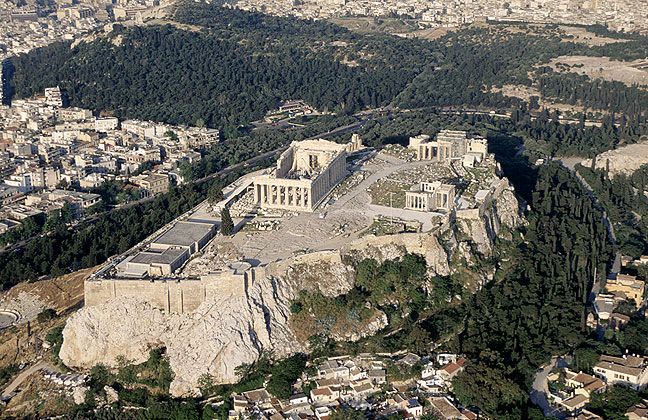
Athens rewards curious walkers. I like the private format, which gives you room to ask questions, and I like the broad route from the Acropolis and Parthenon to Plaka, Monastiraki, and the ancient civic sites. Guide Christos Theodoropoulos receives especially strong praise for clear explanations, useful Athens tips, and good stories about Greek culture from ancient times to today.
The main drawback is the extra cost at the entrance: Acropolis admission is EUR 20 per person, and transport, food, and drinks are not included. Four hours also goes quickly, so this is a smart orientation tour rather than a slow, museum-style study of every monument.
In This Review
- Key points to know before booking
- Why this four-hour Athens tour works well
- Starting near the Acropolis Metro Station
- Entering the Acropolis through the Propylaea
- Seeing the Pnyx and Areopagus below the sacred hill
- Roman Athens: the Agora, Tower of the Winds, and Hadrian’s Library
- Plaka: Athens at street level
- Monastiraki Square, the flea market, and souvlaki
- What the guide adds to the experience
- Is $377 a good price for up to six people?
- Who should book this Athens walking tour?
- Should you book it?
- FAQ
- How long is the Athens private tour?
- Where does the tour begin?
- Is the Acropolis entrance fee included?
- How much does the private tour cost?
- Is transportation included?
- Is food included?
- Which languages are available?
- What should I wear for the walking tour?
- Can I cancel the booking?
Key points to know before booking
- Private group for up to six: The $377 price works best for a family or small group of friends, especially when six people share the cost.
- A full Athens introduction: The route links the Acropolis with Plaka, Monastiraki, the Roman Agora, Hadrian’s Library, and other central sights.
- Strong guide feedback: Christos is praised for detailed explanations, entertaining stories, and taking time for questions.
- Acropolis ticket costs extra: Plan on EUR 20 per person in addition to the tour price.
- Walking comes first: Wear rubber-soled shoes and bring a hat, since the route includes ancient stone surfaces and open-air sites.
- Several languages are available: You can request English, German, Greek, or Turkish.
Why this four-hour Athens tour works well

Athens can feel scattered when you first arrive. Ancient temples, Roman remains, churches, cafés, shops, and modern traffic all share the same central streets. This tour gives those pieces a sensible order.
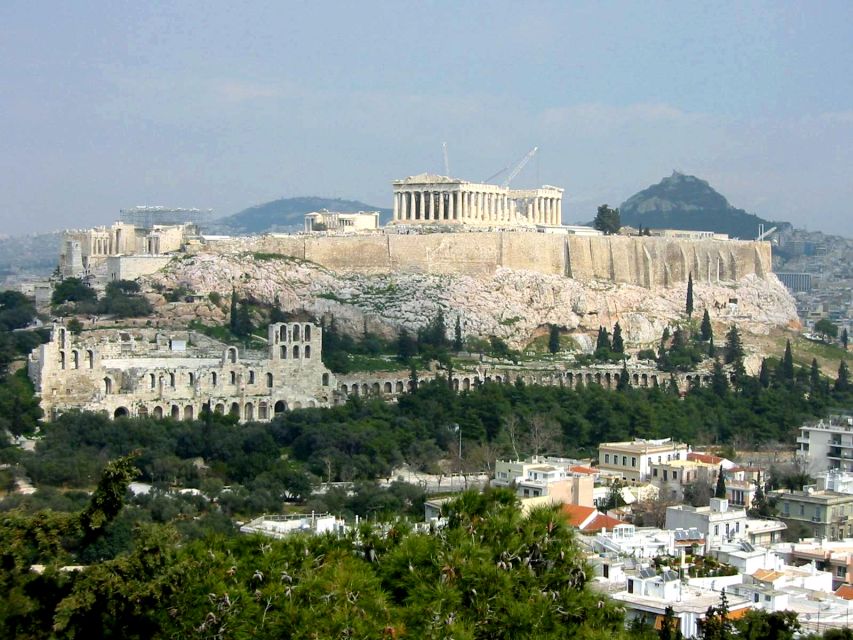
You begin at Crescendo Cafe near the Acropolis Metro Station, then walk with a licensed guide toward the Acropolis and its entrance area. From there, the route brings together the main hilltop monuments and several lower-city sights before continuing through Athens’s oldest neighborhoods.
I like this design because you get both the headline sight and the city around it. The Acropolis is essential, but Athens makes more sense when you also see the old streets, former political meeting places, market lanes, and Roman-era buildings below it.
The private format matters here. With a group of up to six, you can hear the guide more easily than in a large tour, and you can ask for clarification when a name or ancient custom gets confusing. Christos is repeatedly praised for taking questions seriously and adapting his explanations to the group.
The tour is available in English, German, Greek, and Turkish. That choice is useful for families or friends who understand one of those languages better than English. German-speaking participants have especially praised the quality of the explanations, while English-speaking visitors have highlighted Christos’s stories and broad understanding of Greek culture.
More ways to see the Acropolis:
- Athens: Acropolis & up to 5 Archaeological Sites Combo Pass
★ 4.4 · 12,619 reviews - Athens: Acropolis Ticket with Optional Audio or Live Guide
★ 4.2 · 11,055 reviews - Athens: Acropolis, Parthenon & Acropolis Museum Guided Tour
★ 4.8 · 9,316 reviews
Starting near the Acropolis Metro Station
The meeting point at Crescendo Cafe near the Acropolis Metro Station is practical for anyone staying in central Athens. You are not being sent to a distant suburb or asked to arrange a complicated pickup. Transport is not included, so you need to make your own way to the cafe.
The tour itself is a walking experience. That means you should arrive ready for several hours on foot, with comfortable footwear and a hat. Rubber soles are specifically recommended, a sensible precaution on smooth or uneven ancient paving.
There is no food or drink included. Monastiraki is a good place to buy a souvlaki during or after the route, but you should carry water unless you plan to purchase it along the way. Since this is Athens, summer heat can make a four-hour walk feel longer than it sounds.
Entering the Acropolis through the Propylaea
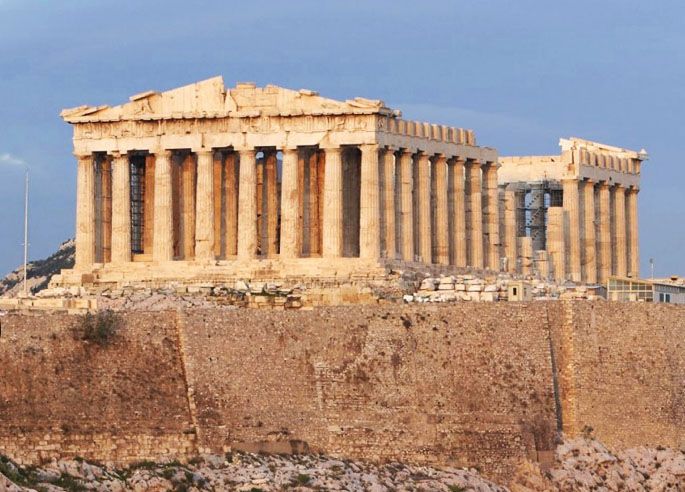
The first major focus is the Acropolis, reached through the Propylaea. This monumental gateway once served as the formal entrance to the sacred hill, and it gives the tour a strong opening. Rather than simply arriving at the Parthenon and taking pictures, you begin with the architecture that framed the approach.
A guide can help you notice how much planning went into the entrance. The Propylaea was not just a doorway. It prepared worshippers and visitors for the important buildings beyond it, while also showing the confidence of ancient Athenian design.
The Acropolis route includes the Parthenon, the Erechtheion, the Temple of Athena Nike, and the Karyatides. Each building has a different character, which helps keep the visit from becoming one long list of columns.
The Parthenon is the obvious star. It was dedicated to Athena, the city’s patron goddess, and its scale still makes an impression even after you have seen countless photographs. Your guide can put the monument into its political and religious setting, explaining why this building mattered to Athens far beyond its appearance.
The Temple of Athena Nike is smaller and more graceful. Its location beside the entrance makes it easy to miss if you are focused only on the Parthenon. A guide helps you give it the attention it deserves.
The Erechtheion is known for its unusual design and the Karyatides, the sculpted female figures used as architectural supports. The originals connected with the monument have a complicated preservation story, but the key point for your visit is the building’s irregular form. It does not have the clean, symmetrical look most people expect from a Greek temple.
Acropolis admission is separate from the tour fee and costs EUR 20 per person. You should include that in your budget before comparing this experience with other private Athens tours.
Seeing the Pnyx and Areopagus below the sacred hill
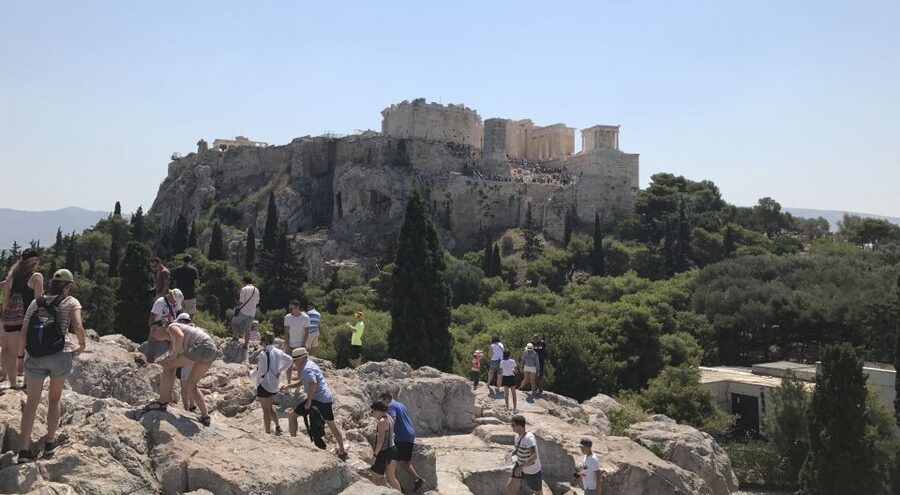
The route also includes the Pnyx and the Areopagus, two places that add political and civic meaning to the Acropolis visit.
The Pnyx is associated with the birth of democracy. Ancient Athenians gathered there to debate and make decisions, so it gives you a physical setting for one of the most influential political ideas in European history. This is more useful than hearing the word democracy in a textbook. You can connect the idea to a real meeting place on the hill.
The Areopagus offers another link to ancient Athens. It was tied to civic and judicial life, and its location helps you understand how closely sacred, political, and legal spaces sat together in the ancient city.
These stops also broaden the tour beyond the most photographed monuments. I appreciate that because the Acropolis can otherwise become a quick visit focused on the Parthenon alone. The Pnyx and Areopagus help explain how Athens functioned as a city.
The tradeoff is time. Four hours is enough for an informed overview, but not enough for an unhurried examination of every stone. You will need to keep moving, particularly if the guide is covering both the Acropolis and the old town.
More things to do in Athens:
- Athens: Cape Sounion & Poseidon Temple Sunset Half-Day Trip
★ 4.8 · 8,241 reviews - Athens: Acropolis and Parthenon Guided Walking Tour
★ 4.6 · 5,882 reviews - All Day Cruise -3 Islands to Agistri,Moni, Aegina with lunch and drinks included
★ 5.0 · 4,958 reviews - Athens, Piraeus, and Coastline: Blue Hop-On Hop-Off Bus
★ 3.9 · 4,849 reviews
Roman Athens: the Agora, Tower of the Winds, and Hadrian’s Library
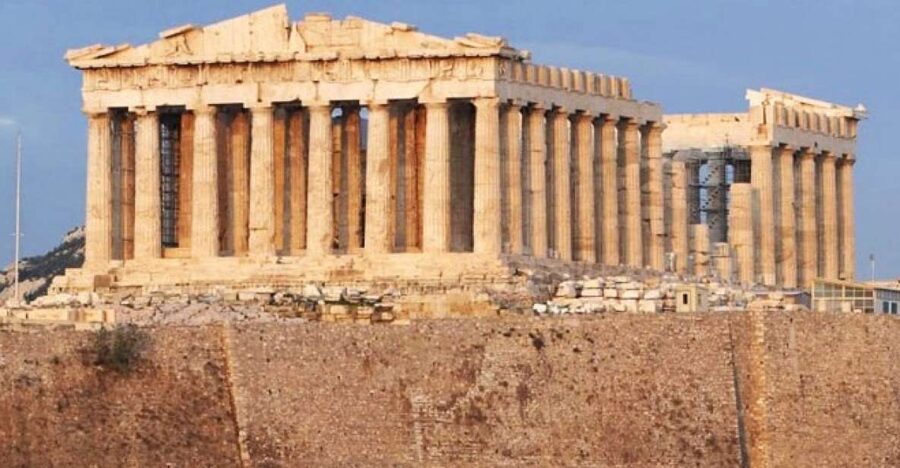
After the Acropolis area, the route turns toward the Roman Agora, the Tower of the Winds, Hadrian’s Library, and the Temple of Olympian Zeus.
The Roman Agora was a commercial and civic center during Athens’s Roman period. It helps show that Athens did not stop mattering after the classical age. The city continued to change, and Roman buildings were added to an older Greek setting.
The Tower of the Winds is one of the most memorable smaller monuments on the route. It functioned as a water clock, weather station, and timekeeping structure. Its practical purpose makes it a good counterpoint to the grand temples. Ancient Athens was not only about religious ceremonies and dramatic architecture. It also needed ways to measure time and understand weather.
Hadrian’s Library points to the Roman emperor Hadrian’s interest in Athens. The name can make the building sound like a quiet reading room, but it was part of a larger complex designed for study and public life. Your guide can help you picture the scale of the site and explain how Roman power reshaped the city.
The Temple of Olympian Zeus is another large-scale Roman-era project. Even in its ruined condition, the surviving columns convey its size. It is a useful reminder that ancient builders were working on projects that required enormous labor, money, and political ambition.
These stops are not all entered as separate attractions in the information provided, so you should think of them as viewing points along the walking route rather than a series of lengthy interior visits. If your priority is spending maximum time inside each archaeological site, this tour may feel too broad.
Plaka: Athens at street level
Plaka is one of Athens’s oldest neighborhoods, and its narrow streets offer a welcome change after the exposed stone of the Acropolis. Here you get a sense of the living city, with old buildings, small shops, cafés, and routes that wind around the base of the ancient hill.
I like the inclusion of Plaka because it gives you useful context for the rest of your stay. After this walk, you will have a better idea of where to return for dinner or a slower afternoon stroll. You also see how modern Athens has grown around its ancient center rather than replacing it completely.
This part of the tour is not a formal archaeological lecture. It is a chance to ask practical questions about the city and hear local suggestions. Martin’s feedback specifically praises Christos for answering questions and offering good tips, which is exactly what you want while walking through a neighborhood rather than standing beside a monument.
Plaka can also be busy, and the streets are not always easy for a group to navigate together. A private guide helps keep the route organized, but you should still expect a lively central district rather than a quiet village walk.
Monastiraki Square, the flea market, and souvlaki
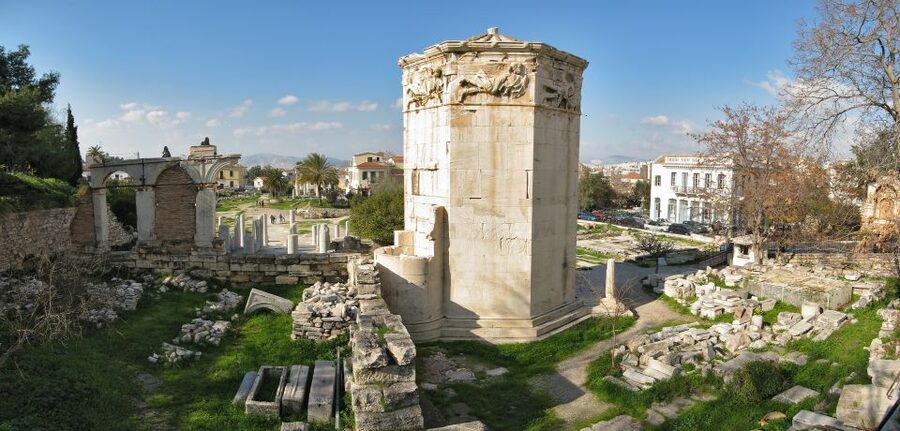
The route continues to Monastiraki Square and its popular shopping area. The flea market gives you a different view of Athens, with stalls and shops replacing the formal stonework of the Acropolis.
Monastiraki is a useful stop for first-time visitors because it is one of the city’s main meeting points. You can browse souvenirs, look for leather goods or small gifts, and get a feel for Athens’s everyday commercial life.
The tour description specifically points to souvlaki, the familiar Greek kebab-style meal. Food is not included, so any purchase is at your own expense. Still, this is a natural place to pause for a quick bite if the schedule allows, and it adds a simple local flavor to a history-heavy morning or afternoon.
The exact amount of time available for eating is not specified. I would not book this expecting a dedicated food tour. Think of souvlaki as a possible snack or lunch suggestion, not a promised tasting.
From Monastiraki, the walk continues toward Metropolitan Square. The route may also include a view of the Parliament building and the changing of the Guard, something Diane specifically valued as part of the wider Athens introduction. Since the precise timing of that sight is not guaranteed in the supplied details, ask your guide at the start if it can fit your departure time.
What the guide adds to the experience
A private tour lives or dies by its guide. Here, Christos Theodoropoulos receives the strongest praise for detailed explanations, entertaining anecdotes, strong command of Greek history and culture, and attention to individual questions.
That combination is important. Ancient Athens comes with a heavy load of names: Athena, Nike, Erechtheion, Propylaea, Areopagus, Pnyx, Hadrian, and Olympian Zeus. A guide who only recites dates can make the Acropolis feel like an exam. Christos’s style, as described through his feedback, is more conversational and story-based.
English-speaking participants describe learning far more than they would on a standard group outing. German-speaking participants praise his German, while another German-language comment notes that he took time for questions. The available languages also include Greek and Turkish.
I would choose this tour if you want interpretation rather than just directions. You can visit the Acropolis without a guide, but you may not understand why the buildings sit where they do, how the city’s political life worked, or how Greek and Roman periods overlap in central Athens.
Is $377 a good price for up to six people?
The listed price is $377 per private group of up to six, before the Acropolis entrance fee. At the full six-person capacity, that works out to about $62.83 per person for the guide, plus EUR 20 each for admission.
For two people, the guide cost rises to $188.50 each before admission. That is a significant price, but you are paying for privacy, language choice, and the ability to shape the conversation around your interests. A larger group that fills all six places gets much better value.
Transport is not included, which keeps the arrangement simple but means you must reach Crescendo Cafe independently. Food and drinks are also separate. The overall price makes the most sense when you treat the tour as an efficient introduction to Athens, not as a bargain sightseeing walk.
The 4.9 rating from 111 reviews supports the guide’s reputation, especially for explanation and personal attention. Still, a high rating does not remove the practical limits: admission costs extra, the route is on foot, and four hours cannot provide a detailed visit to every monument.
Who should book this Athens walking tour?
I would recommend it to first-time visitors who want to understand Athens quickly. It is also a good fit for families, couples, and small groups who prefer to ask questions without waiting for a large crowd.
You will likely get the most from it if you care about history but do not want a formal academic lecture. The mix of major monuments, civic sites, shopping streets, and neighborhood walking keeps the pace varied.
German-speaking groups should pay special attention to the language option, as Christos’s German explanations receive repeated praise. English, Greek, and Turkish are also available.
This is less suitable if you dislike walking, need long breaks, or want to spend most of your day inside archaeological sites. It may also disappoint you if you expect meals or transportation to be part of the package.
Book early in the day if you want to use the tour as your Athens orientation, then return later to the places that catch your interest. The activity allows free cancellation up to 24 hours in advance and offers reserve-now, pay-later booking, so it can fit a flexible itinerary.
Should you book it?
Book this tour if you want the Acropolis explained properly and also want a useful first look at Plaka, Monastiraki, the Pnyx, and the Roman-era center. The private format and Christos’s patient, story-filled guiding are the main reasons to choose it.
Before booking, add EUR 20 per person for the Acropolis and plan for your own transport and refreshments. If your group has four to six people, the price is easier to justify. If you have only two people and want a slower, site-by-site archaeological visit, compare the cost carefully.
For a compact Athens introduction that links ancient monuments with real city streets, this is a strong choice.
FAQ
How long is the Athens private tour?
The tour lasts four hours.
Where does the tour begin?
It begins at Crescendo Cafe near the Acropolis Metro Station.
Is the Acropolis entrance fee included?
No. Admission costs EUR 20 per person and is paid separately.
How much does the private tour cost?
The listed price is $377 per private group of up to six people.
Is transportation included?
No. Transport costs are not included.
Is food included?
No. Food and drinks are not included. Souvlaki is suggested as a possible food choice in Monastiraki.
Which languages are available?
The live guide is available in English, German, Greek, and Turkish.
What should I wear for the walking tour?
Rubber-soled footwear and a hat are recommended.
Can I cancel the booking?
Yes. You can cancel up to 24 hours in advance for a full refund. You can also reserve now and pay later.
Just added around Athens
- Athens Hotels to Athens Airport Private Departure Transfer★ 5.0 · 40 reviews
- Private One-way Transfer between Athens International Airport and Athens Hotels★ 4.5 · 40 reviews
- Athens: Acropolis Museum Ticket with Self-Guided Audio tour App★ 3.5 · 40 reviews
- From Athens: Meteora Train Trip with Overnight Stay★ 4.8 · 40 reviews
- Athens Photography Tour★ 5.0 · 40 reviews
- Athens: Acropolis Visit and City Night Tour★ 4.7 · 40 reviews
- Delphi Full Day Private Trip From Athens With Lunch Overlooking the Sea★ 5.0 · 40 reviews
- Acropolis & Plaka Neighbourhood Private Tour with Licensed Expert★ 5.0 · 40 reviews
Acropolis & Parthenon Tours, compared.
Acropolis & up to 5 Archaeological Sites Combo Pass
Read our review →

Acropolis, Parthenon & Acropolis Museum Guided Tour
Read our review →
Acropolis, Parthenon & Acropolis Museum Guided Tour
Read our review →

Acropolis: Acropolis and Parthenon Guided Walking Tour
Read our review →
Acropolis monuments & Parthenon Walking Tour with Optional Acropolis Museum
Read our review →Browse the lists this tour appears in