
Reviewed · MUSEUMS
Athens: National Archaeological Museum Private Guided Tour
Ancient Greece comes alive indoors. I like the private format, which lets your guide adjust the pace and answer your questions, and I like the chance to see major works such as the Antikythera mechanism with proper context. The drawback is simple: two hours can only cover the highlights of a museum with more than 11,000 exhibits.
This tour is led by Christos Theodoropoulos, an experienced licensed archaeologist who has earned high praise for clear explanations, humor, and a strong sense of timing. I also like that the price is per group, not per person, although $400 plus the €10 museum ticket can feel steep for one or two people.
You meet at the steps of the National Archaeological Museum on Patission Street, buy your own entry ticket, and spend two focused hours inside. If you want a fast, well-planned introduction rather than a long solo wander, this is a useful way to get your bearings.
In This Review
- Key points at a glance
- Why this museum deserves your time
- Meeting at 44 Patission Street
- The prehistoric galleries and the Aegean before classical Greece
- Sculpture from the seventh to fifth centuries B.C.
- Pottery, small objects, and the details of daily life
- Bronze masterpieces and the Antikythera mechanism
- Egyptian and Near Eastern antiquities
- What the private guide adds
- How the two-hour itinerary works
- Languages, timing, and group size
- Is $400 a fair price?
- Who will get the most from this tour?
- Should you book the National Archaeological Museum private tour?
- FAQ
- Where does the National Archaeological Museum tour meet?
- How long does the guided tour last?
- What is included in the tour price?
- Is the museum entry ticket included?
- Is hotel transfer included?
- Which languages are available?
- How many people can join the private group?
Key points at a glance
- The Antikythera mechanism: See the ancient device often described as the world’s oldest analogue computer.
- Five major collections: Move from prehistoric Aegean objects to sculpture, pottery, bronze works, and Egyptian and Near Eastern antiquities.
- A private group of up to six: Share one guide with your own party and ask questions without keeping pace with a large tour.
- Christos Theodoropoulos: His tours are praised for making complex Greek history understandable, lively, and well organized.
- A strict two-hour choice: The guide focuses on important pieces, but you may want extra time afterward for galleries not included in the main route.
Why this museum deserves your time
Athens has no shortage of ancient sites, but the National Archaeological Museum gives you something the Acropolis cannot: the objects themselves, gathered from across Greece and arranged to show how art and technology changed over thousands of years.
The museum began as a home for finds from excavations in and around Athens during the 19th century. It later became Greece’s central archaeological museum, with objects brought in from many regions. That wider scope matters. You are not seeing only the story of Athens. You are seeing a long sequence of cultures from prehistory through late antiquity.
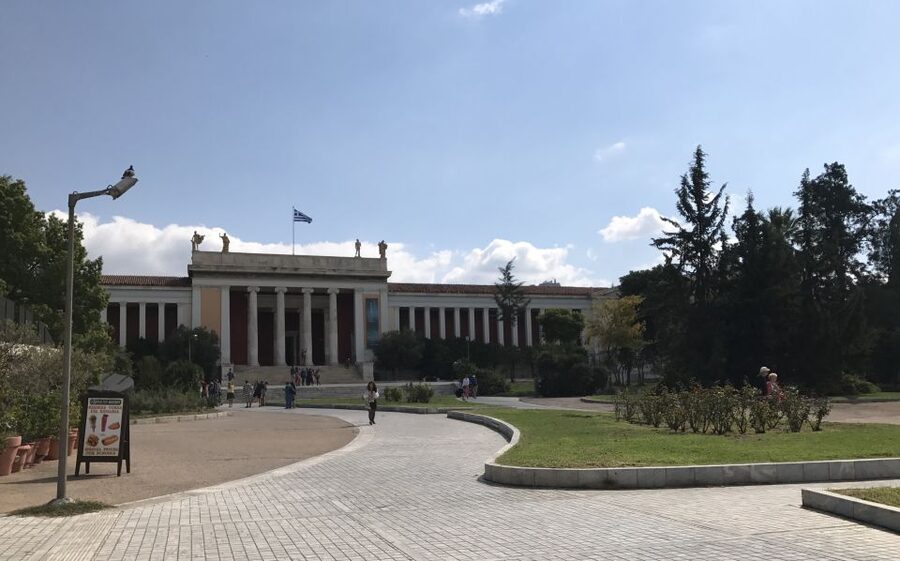
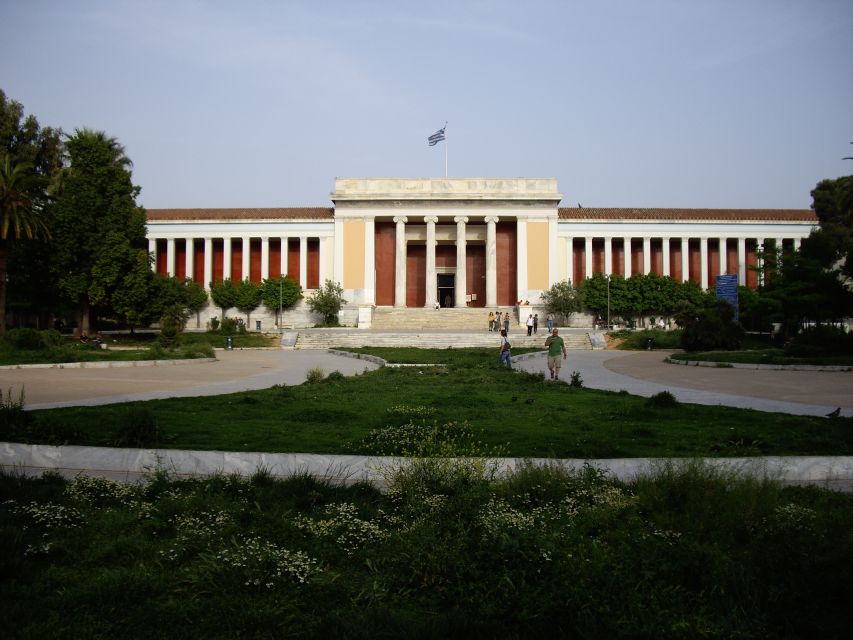
The building itself helps set the mood. It occupies an imposing neoclassical structure designed by L. Lange and later remodeled by Ernst Ziller. Inside, the exhibition areas cover about 8,000 square meters across numerous galleries and floors.
That scale is both the museum’s strength and its main challenge. You can spend hours here and still leave parts unseen. A guide is useful because the collection is too large to absorb at random, especially if you have only one morning or afternoon in Athens.
More Museums in Athens
- Athens: Acropolis, Parthenon & Acropolis Museum Guided Tour
★ 4.8 · 9,316 reviews - Athens: Mythology of Delphi, Museum and Arachova Guided Tour
★ 4.6 · 4,008 reviews - Athens: Acropolis, Parthenon & Acropolis Museum Guided Tour
★ 4.8 · 3,579 reviews
Meeting at 44 Patission Street
The tour begins outside the main entrance at 44 Patission Street, 10682 Athens. The meeting point is specifically the steps in front of the entrance, which gives you a clear place to find your guide.
Hotel transfer is not included, so you need to make your own way to the museum. That is not a serious problem for an Athens sightseeing day, but allow enough time to reach central Athens without arriving rushed.
Your museum ticket is also separate. The listed cost is €10 per person, while the guided tour itself costs $400 for a private group of up to six people. That means the value depends heavily on your group size.
For six people, the guide fee works out to about $67 per person before museum admission. For two people, it is about $200 each. Families and small groups get the strongest value, particularly if several people want to ask questions or have different interests.
The prehistoric galleries and the Aegean before classical Greece

The first major section to understand is the Collection of Prehistoric Antiquities. It covers the Aegean world from the 6th millennium B.C. to about 1050 B.C., including Neolithic, Cycladic, and Mycenaean material.
This is where a good guide can prevent the museum from becoming a parade of dates. You begin to see how communities in the Aegean made objects for daily use, burial, ceremony, and display. The collection also includes finds from the prehistoric settlement at Thera, giving you a connection to one of the most important prehistoric sites in the region.
Cycladic objects are especially useful for showing how much ancient art can say with very little decoration. Mycenaean pieces then present a different visual language, linked to palace culture, trade, weapons, luxury goods, and burial customs.
You should not expect to study every case in detail during a two-hour visit. The guide’s job is to choose representative works and connect them. That approach is far more helpful than trying to memorize every civilization and century.
Sculpture from the seventh to fifth centuries B.C.
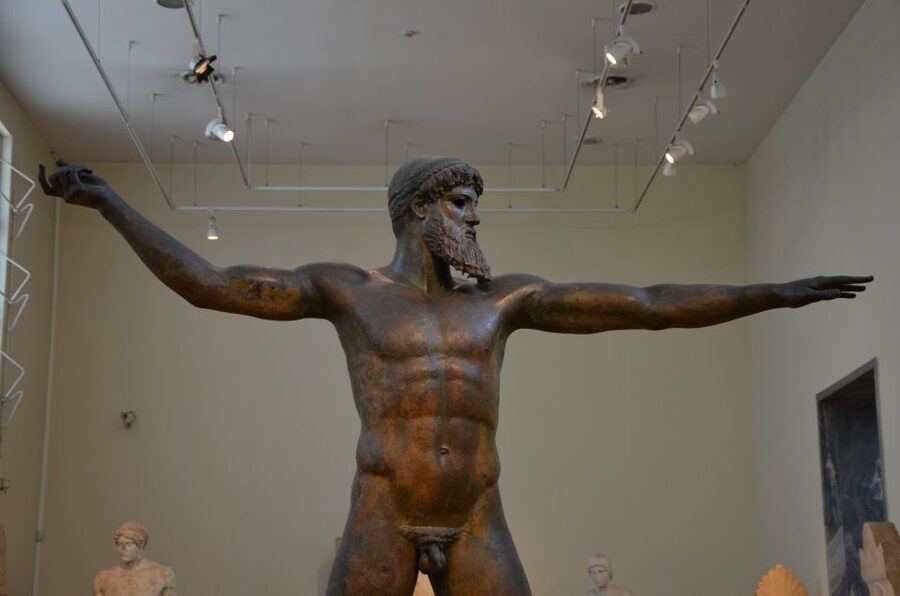
The Sculpture Collection follows the development of Greek sculpture from the 7th to the 5th centuries B.C. This is a central part of the museum, and it helps explain the shift from more rigid early forms toward figures with greater movement, proportion, and attention to the human body.
I like this section for visitors who have already seen the Acropolis but want to understand what Greek sculpture was doing before and around the classical period. A guide can point out changes that are easy to miss when you simply walk past marble figures.
The museum holds unique masterpieces, but the real value is seeing several stages together. One statue may look formal and restrained, while another begins to suggest weight, posture, or motion. With explanation, those differences become a story rather than a collection of disconnected statues.
This is also an area where two hours go quickly. If sculpture is your main interest, tell the guide early. A private tour gives you a better chance of shaping the visit around your priorities, though the supplied information does not promise a customized route for every booking.
More things to do in Athens:
- Athens: Acropolis & up to 5 Archaeological Sites Combo Pass
★ 4.4 · 12,619 reviews - Athens: Acropolis Ticket with Optional Audio or Live Guide
★ 4.2 · 11,055 reviews - Athens: Cape Sounion & Poseidon Temple Sunset Half-Day Trip
★ 4.8 · 8,241 reviews - Athens: Acropolis and Parthenon Guided Walking Tour
★ 4.6 · 5,882 reviews
Pottery, small objects, and the details of daily life
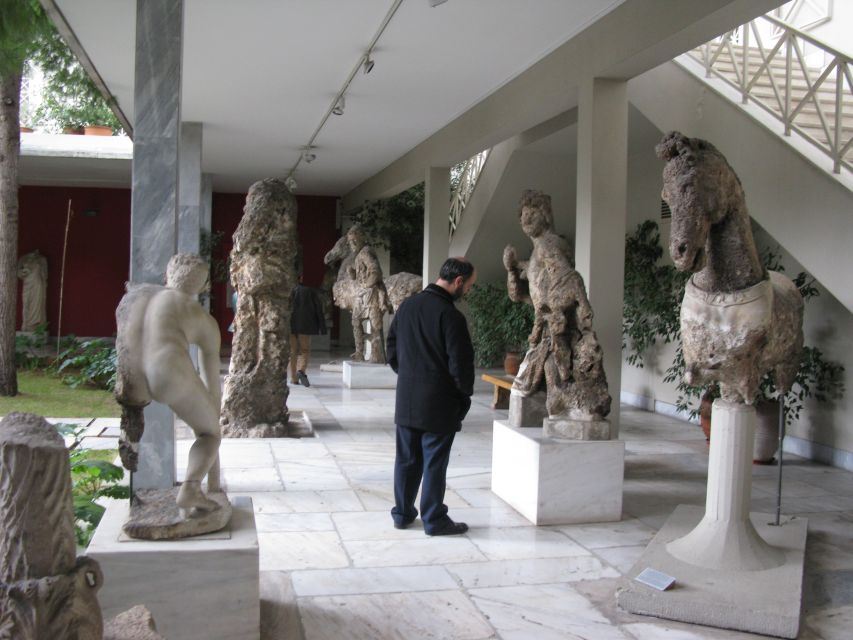
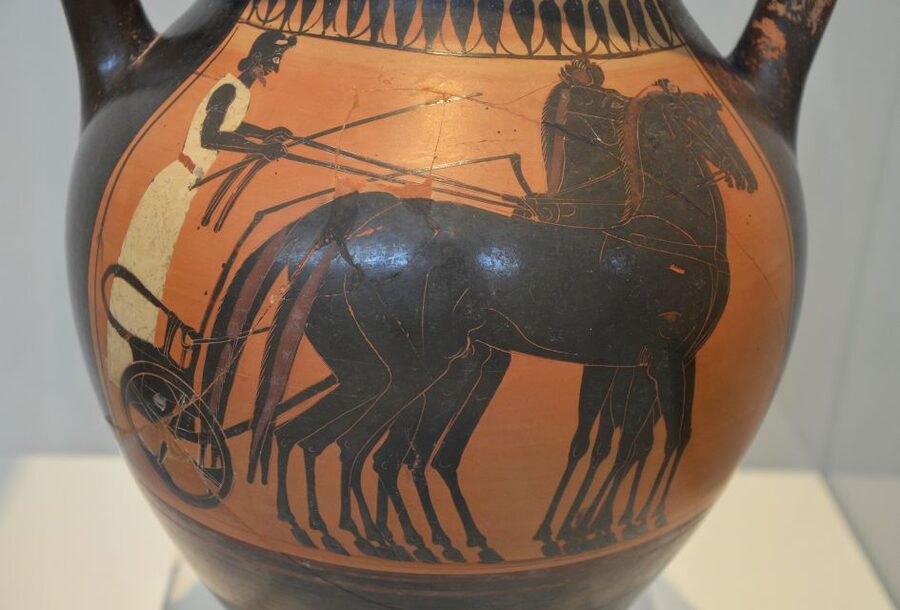
The Vase and Minor Objects Collection covers ancient Greek pottery from the 11th century B.C. through the Roman period. It also includes the Stathatos Collection, with smaller objects from different periods.
These displays add the human scale that large statues sometimes lack. Pottery can reveal scenes, clothing, tools, ceremonies, myths, and social habits. Small objects may seem less dramatic at first, but they often help explain how people lived and what they valued.
A guide is particularly helpful here because painted scenes can be easy to skim. You might notice a hero or a god, while missing the ordinary details around the scene. The tour’s educational value comes from learning how to look, not just learning names.
The limitation is that this broad section cannot receive equal time on a highlights tour. If you want to examine pottery closely, plan to stay after the guided portion. Several people who enjoyed the tour continued independently once the two hours had ended.
Bronze masterpieces and the Antikythera mechanism
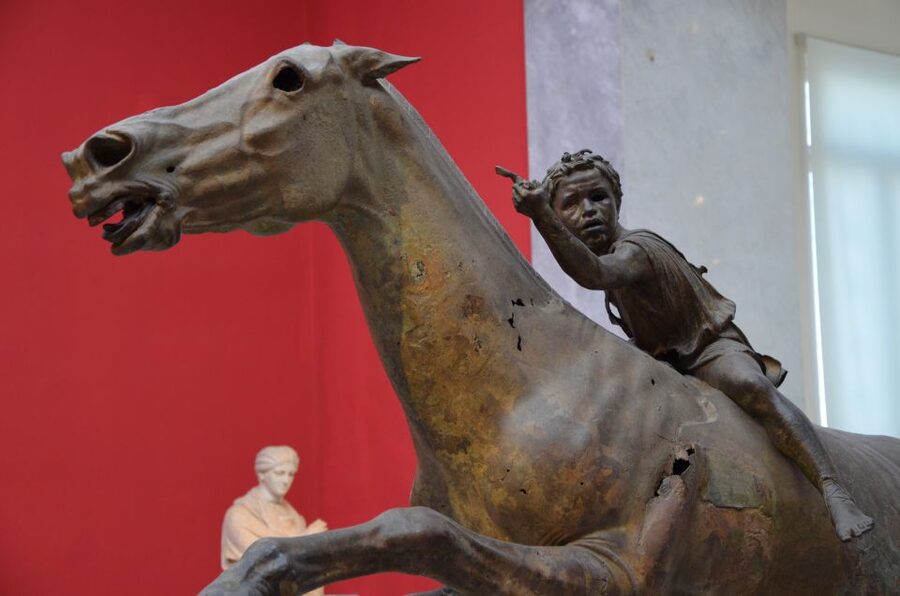
The Bronze Collection includes statues, figurines, and smaller objects. It is also home to one of the museum’s biggest draws, the Antikythera mechanism.
The mechanism is often called the world’s oldest analogue computer. That description gives you a useful idea of its importance, but the object is not easy to understand from a quick glance. Its surviving bronze parts represent an astonishing level of technical thought for the ancient world.
This is exactly the sort of object that benefits from a guide’s explanation. You can see the mechanism, learn what it was designed to calculate, and place it within the wider story of ancient Greek science and engineering.
The bronze statues also reward a guided visit. Bronze and marble create different effects, and smaller bronze figures can reveal religious practice, artistic skill, and technical ability. Ask your guide to connect the mechanism with the broader achievements of the Bronze Collection rather than treating it as an isolated curiosity.
If the Antikythera mechanism is your main reason for booking, check the route with the guide at the start. The supplied tour details identify it as a highlight, but they do not guarantee how long you will spend at the display.
Egyptian and Near Eastern antiquities
The museum’s Egyptian and Near Eastern Antiquities Collection is the only collection of its kind in Greece. Its objects range from the predynastic period, around 5000 B.C., to the Roman conquest.
This section changes the focus from the Aegean and Greek world to older and neighboring cultures. It also helps you see that ancient Greece did not develop in isolation. Objects, ideas, styles, and technologies moved around the eastern Mediterranean for centuries.
The collection is a bonus for anyone who thinks this is only a Greek sculpture museum. It broadens the visit and gives your guide another way to explain contacts between cultures.
Again, the two-hour limit matters. The museum contains enough material here for a separate visit, but a highlights tour may give you only an introduction. If you have already visited Egyptology museums elsewhere and want more time in the Greek galleries, tell your guide how to balance the route.
What the private guide adds
The strongest case for this tour is not the building or the ticket. You can enter the museum without a private guide, and the displays are labeled and arranged in a way that many people find understandable.
The advantage is interpretation. Christos Theodoropoulos has been praised for turning what could feel like a dry museum visit into a clear introduction to Greek history. His approach includes historical explanation, questions, and a sense of humor.
He is also described as good at setting priorities. That matters in a museum this large. Without a plan, you may spend too long in the first few rooms and rush through the objects you most wanted to see.
The pace can be brisk because the collection is so large. Families with children have enjoyed the tour, including children as young as seven and nine, but younger visitors may still find two hours of museum viewing tiring. A family should tell the guide at the beginning what will keep children interested.
One unusual detail comes from a visitor with a professional interest in ancient jewelry. Christos arranged access to a jewelry room that was usually locked at that time of year. You should not count on the same arrangement, since it was a special circumstance, but it shows the possible benefit of explaining your interests before the tour begins.
How the two-hour itinerary works
The published route lists one stop: the National Archaeological Museum of Athens, with a two-hour guided visit. That sounds simple because it is. There is no transport between sites and no wasted time moving across the city.
Expect an orientation to the museum and its major collections, followed by selected highlights. The guide may move quickly between prehistoric objects, sculpture, pottery, bronze works, and the Egyptian and Near Eastern rooms, depending on your group’s interests and the museum’s conditions that day.
You should think of the tour as a structured introduction, not a complete museum visit. At the end, you may want to remain inside and see additional galleries on your own. One visitor said the guide continued showing parts of the upper story after the official tour time had ended, but you should not assume extra time is included.
The private format gives you the best chance to ask for more explanation at a favorite display. Still, a two-hour booking needs discipline. If every person wants a different section, the route can become scattered. Pick two or three priorities before you meet.
Languages, timing, and group size
The live guide is available in Turkish, English, German, and Greek. Confirm that your preferred language is available when choosing a time, since the tour schedule depends on availability.
The advertised group size is up to six people. That is large enough to share the cost with family or friends, but small enough for direct conversation. One supplied account referred to a party of seven, so if your group is larger than six, confirm the permitted size before booking rather than assuming it is covered.
The official duration is two hours. Some bookings have had flexible afternoon timing, but you should check the available start times instead of planning around an assumed schedule.
Free cancellation is available up to 24 hours in advance for a full refund. You can also reserve now and pay later, which helps if your Athens plans are still shifting.
Is $400 a fair price?
For a group of up to six, the price can make sense if you care about interpretation and want a private experience. It is especially reasonable for a family or group that would otherwise need several audio guides or separate museum visits.
For one or two people, the cost is harder to justify. The museum itself is well labeled, and an independent visitor can see the major displays without paying a guide fee. A solo visitor who enjoys reading labels and setting a personal pace may prefer to spend the $400 elsewhere.
I would book it when the museum is a major priority, when your group includes people with different levels of interest, or when you want an archaeologist to select the most important works. I would skip it when you have half a day to wander, prefer silence and slow observation, or are traveling on a tight budget.
Remember to add the €10 admission ticket per person. The tour price does not include entry, and hotel transfer is not part of the service.
Who will get the most from this tour?
This experience suits first-time visitors to the National Archaeological Museum who want a clear route through a very large collection. It also works well for parents who want stories and explanations rather than a self-guided march past display cases.
History students, art lovers, and anyone curious about ancient technology should find plenty to discuss. The Antikythera mechanism alone gives the visit a strong focus, while the prehistoric and Egyptian collections keep the story from becoming only a tour of classical statues.
You may prefer to visit independently if you already know the museum well. The same is true if you want to spend an hour studying a single vase, statue, or jewelry display. A private guide gives you attention, but the fixed two-hour window still requires choices.
Should you book the National Archaeological Museum private tour?
Book this tour if you want the museum’s major works explained by a licensed archaeologist and you can share the $400 cost with a group. Christos Theodoropoulos receives especially strong praise for his clear teaching, humor, flexible approach, and ability to select highlights without losing the larger story.
Go independently if you are alone, watching your spending, or happy to read the museum’s labels at your own speed. Either way, allow more than two hours if you want to see the full collection.
For most small groups, this is a useful first look at Greece’s greatest archaeological museum. Just treat the guided portion as an orientation, then stay on for the rooms you want to explore more slowly.
FAQ
Where does the National Archaeological Museum tour meet?
You meet at the steps in front of the main entrance of the Athens National Archaeological Museum, at 44 Patission Street, 10682 Athens.
How long does the guided tour last?
The guided museum visit lasts two hours.
What is included in the tour price?
The price includes an experienced licensed archaeologist guide for a private group.
Is the museum entry ticket included?
No. The museum entry ticket is separate and listed at €10 per person.
Is hotel transfer included?
No. You need to make your own way to the National Archaeological Museum.
Which languages are available?
The live guide is available in Turkish, English, German, and Greek.
How many people can join the private group?
The tour is advertised for a private group of up to six people.
Just added around Athens
- Athens Hotels to Athens Airport Private Departure Transfer★ 5.0 · 40 reviews
- Private One-way Transfer between Athens International Airport and Athens Hotels★ 4.5 · 40 reviews
- Athens: Acropolis Museum Ticket with Self-Guided Audio tour App★ 3.5 · 40 reviews
- From Athens: Meteora Train Trip with Overnight Stay★ 4.8 · 40 reviews
- Athens Photography Tour★ 5.0 · 40 reviews
- Athens: Acropolis Visit and City Night Tour★ 4.7 · 40 reviews
- Delphi Full Day Private Trip From Athens With Lunch Overlooking the Sea★ 5.0 · 40 reviews
- Acropolis & Plaka Neighbourhood Private Tour with Licensed Expert★ 5.0 · 40 reviews
Museums, compared.

Acropolis, Parthenon & Acropolis Museum Guided Tour
Read our review →
Mythology of Delphi, Museum and Arachova Guided Tour
Read our review →Acropolis, Parthenon & Acropolis Museum Guided Tour
Read our review →
Acropolis monuments & Parthenon Walking Tour with Optional Acropolis Museum
Read our review →
Athens All Included: Acropolis and Museum Guided Tour with Ticket
Read our review →
Acropolis Museum Ticket with optional Audio Guide
Read our review →
Small-Group Delphi, Museum & Arachova Day Trip
Read our review →
Parthenon & Acropolis Museum with Audio or Live Tour Option
Read our review →Browse the lists this tour appears in