
Reviewed · ACROPOLIS & PARTHENON TOURS
Acropolis & Acropolis Museum PRIVATE Expert led Guided Tour
Athens makes ancient stone feel close. This private tour pairs the Acropolis and Parthenon with the Acropolis Museum, giving you the monuments and the objects that explain them. I like the chance to ask direct questions, and I like that a state-accredited licensed archaeological guide can adjust the discussion for history fans, families, or curious first-timers.
The second big strength is the personal pace. Guides such as Marina, Vicky, Lydia, Elina, and Marissa have been praised for clear storytelling, useful photo stops, crowd awareness, and patient explanations. The main drawback is price: at $163 per person, before admission tickets, it is a serious expense for a couple or small group.
In This Review
- Key points to know before booking
- Why a private guide changes the Acropolis visit
- Starting at the Theater of Dionysus
- The old defensive walls and the climb upward
- Propylaea, Temple of Athena Nike, and the first great views
- The Parthenon: more than the famous photograph
- The Erechtheion and the contest between Athena and Poseidon
- The Acropolis Museum puts the hill back together
- What the private format is worth at $163
- Timing, comfort, and guide quality
- Who should book this experience?
- Should you book the Acropolis and museum tour?
- FAQ
- How long does the private Acropolis and museum tour last?
- Is admission included in the $163 price?
- Where does the tour meet?
- Can the guide meet me at my hotel?
- Which languages are available?
- Is this tour suitable for wheelchair users?
- Can I choose an alternative to the museum?
Key points to know before booking
- A private licensed guide makes the ancient stones readable: You get context, mythology, architecture, and answers instead of simply walking past famous ruins.
- The Acropolis and museum complete each other: The hill gives you the setting, while the museum gives you sculptures, artifacts, models, and explanations of what once stood there.
- The tour can work well for families: Guides have kept children engaged and adjusted the pace for a group member with medical needs.
- The best value comes with more people: The same private guide cost is easier to justify for a family or group than for two people.
- Tickets are extra and require attention: The operator can arrange skip-the-line tickets after booking, but you must answer its message and confirm the correct time slot.
- Expect walking, stone surfaces, and stairs: This is not suitable for wheelchair users, and hot weather can make the climb tiring.
Why a private guide changes the Acropolis visit
You can walk up the Acropolis on your own and recognize the Parthenon. The harder part is understanding what you are seeing, what has vanished, and why the hill mattered so much to ancient Athens.
That is where this tour earns its keep. Your guide is not simply reading signs aloud. The format allows you to stop and ask why a temple was built, how a myth shaped the site, or what an ancient structure looked like before centuries of damage, reuse, and removal.
The tour is private to your group, with guide languages offered in English, German, Italian, and Greek. That matters most at crowded monuments, where a large group can make every explanation feel rushed. A private format also lets you say, I want more architecture or please explain the mythology, and steer the time toward your interests.
The guide can meet you at the stated meeting point, Makrigianni 7, near the Acropolis Museum. If your hotel is an easy walk from the Acropolis, hotel meeting may be possible, but hotel pickup and drop-off are not included as a standard service.
More Museums in Athens
- Athens: Acropolis, Parthenon & Acropolis Museum Guided Tour
★ 4.8 · 9,316 reviews - Athens: Mythology of Delphi, Museum and Arachova Guided Tour
★ 4.6 · 4,008 reviews - Athens: Acropolis, Parthenon & Acropolis Museum Guided Tour
★ 4.8 · 3,579 reviews
Starting at the Theater of Dionysus
The route begins around the Acropolis complex, with the Theater of Dionysus as an early stop. This is a smart place to begin because it connects the stones on the hill with the drama, politics, and public life of Athens.
Your guide explains that this theater is considered the world’s oldest and puts ancient Greek plays into place. You can look at the stage and seating while considering how famous works were performed roughly 3,000 years ago, rather than treating the theater as another pile of weathered stone.
The listed guided time here is about 15 minutes. That is enough for a focused explanation, but not a long archaeological lecture. If theater history is your main interest, tell the guide early. The private setup gives you a better chance of getting more detail than you would on a fixed group route.
The old defensive walls and the climb upward
Before reaching the famous temples, you encounter the Acropolis defenses. The thick walls, described as about five meters across, were built by ancestors of the classical Greeks rather than by the people usually associated with the Parthenon.
That detail gives you a useful sense of time. The Acropolis was not created in one neat burst during the fifth century BC. It carries layers from earlier societies, later rebuilding, religious change, warfare, and modern preservation.
The ascent continues toward the Propylaea, the grand entrance to the upper site. The guide brings in the enormous statue of Athena that once stood nearby, including the striking image of its bronze spear tip catching the sun. The point is not just visual drama. You begin to understand how the Acropolis announced Athenian power to people approaching the city and to sailors moving through the ancient Mediterranean.
The climb requires attention. You will be walking over uneven historic surfaces and ascending to the monuments, so sturdy footwear and a reasonable pace are sensible. The tour is not suitable for wheelchair users.
Propylaea, Temple of Athena Nike, and the first great views
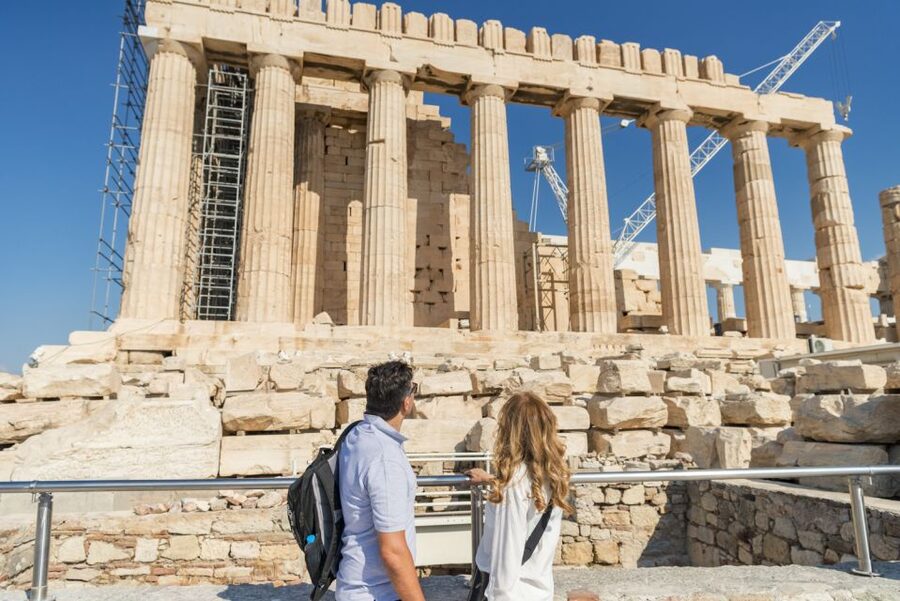
The Propylaea is more than a gateway. It frames your arrival at the sacred upper precinct and shows how carefully the approach to the temples was planned.
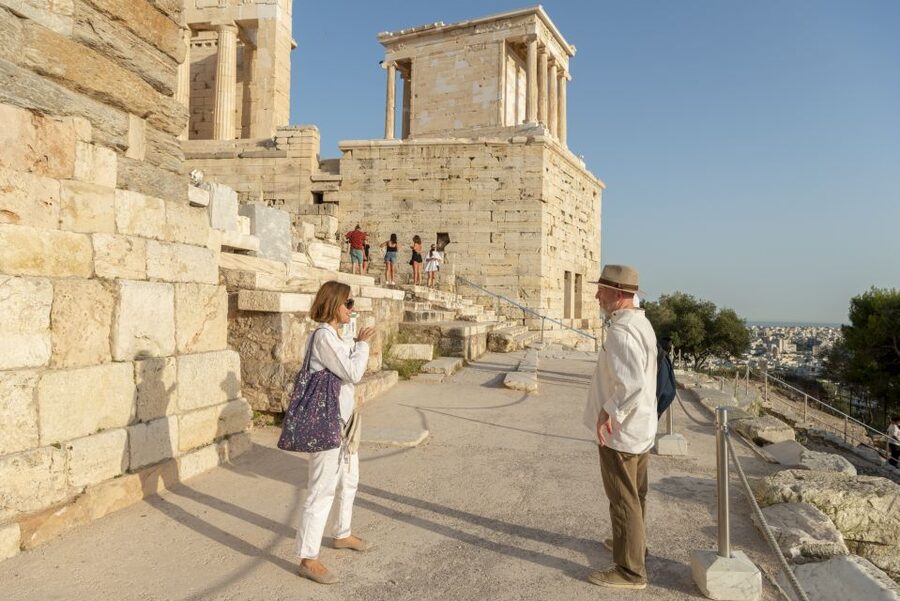
Next comes the Temple of Athena Nike, a small structure with a large symbolic role. Your guide explains its connection with victory and the way its position relates to the entrance and the city beyond. The listed stop is about 15 minutes, which keeps the route moving while giving you a clear explanation of the temple’s purpose and mythology.
The views begin to open as you climb. Athens spreads below, and the guide helps you connect the modern city with the ancient setting. These pauses are also practical. Several people specifically valued guides who found shade, kept a sensible pace, pointed out restrooms, and chose good places for photographs, especially during hot summer visits.
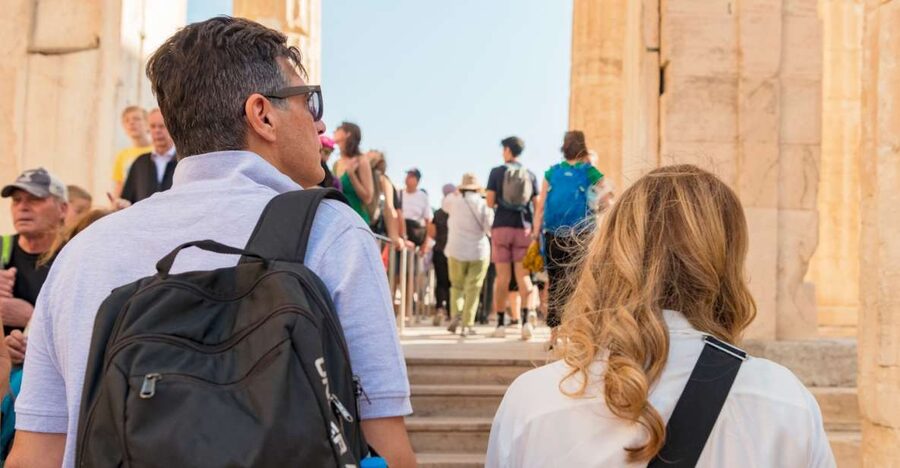
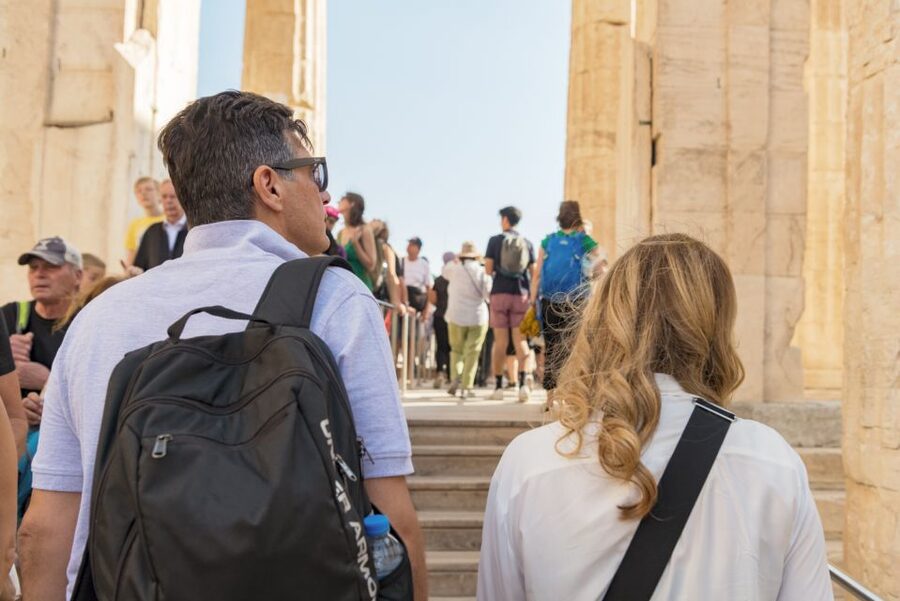
Do not expect an empty Acropolis. The private guide can help you find better angles and avoid some larger groups, but the site remains one of Athens’ busiest attractions. An early start can help. One guide was praised for taking the group up before the worst crowds, while another was credited with handling entry logistics smoothly.
More ways to see the Acropolis:
- Athens: Acropolis & up to 5 Archaeological Sites Combo Pass
★ 4.4 · 12,619 reviews - Athens: Acropolis Ticket with Optional Audio or Live Guide
★ 4.2 · 11,055 reviews - Athens: Acropolis and Parthenon Guided Walking Tour
★ 4.6 · 5,882 reviews - Athens: Acropolis Ticket with Audio Guide
★ 4.0 · 3,575 reviews
The Parthenon: more than the famous photograph
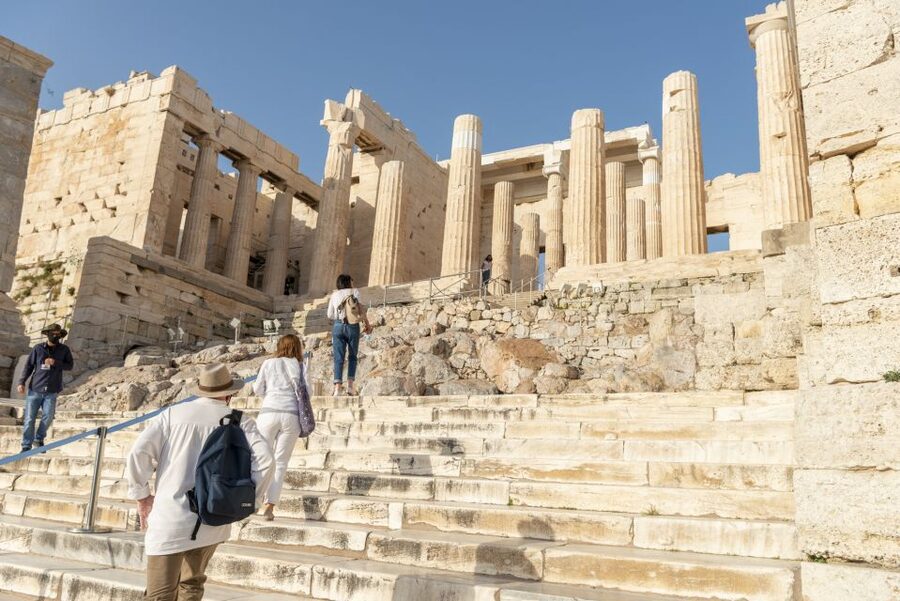
The Parthenon is the centerpiece, but a good explanation keeps it from becoming a quick photo stop. Your guide discusses its architecture, religious purpose, decoration, and place in the Athenian Golden Age.
The listed guided time is about 15 minutes, though the wider Acropolis visit lasts about 1.5 hours in the full itinerary. That distinction matters. You will have time to look at the Parthenon alongside the other monuments, but the route is designed to cover major points rather than provide an exhaustive architectural seminar.
Expect to hear about the temple as a masterpiece of art and design, while also learning how mythology and civic identity shaped its meaning. You can ask questions about the damage and missing elements, though the supplied details do not promise a specific reconstruction presentation on the hill itself.
For many people, the value is in having someone point out what the eye misses. Columns, reliefs, sightlines, and surviving fragments make more sense when someone explains how they fit together. One guide was praised for connecting Athens with other parts of a month-long Greek trip, which is helpful if you are visiting Delphi, Olympia, or other ancient sites afterward.
The Erechtheion and the contest between Athena and Poseidon
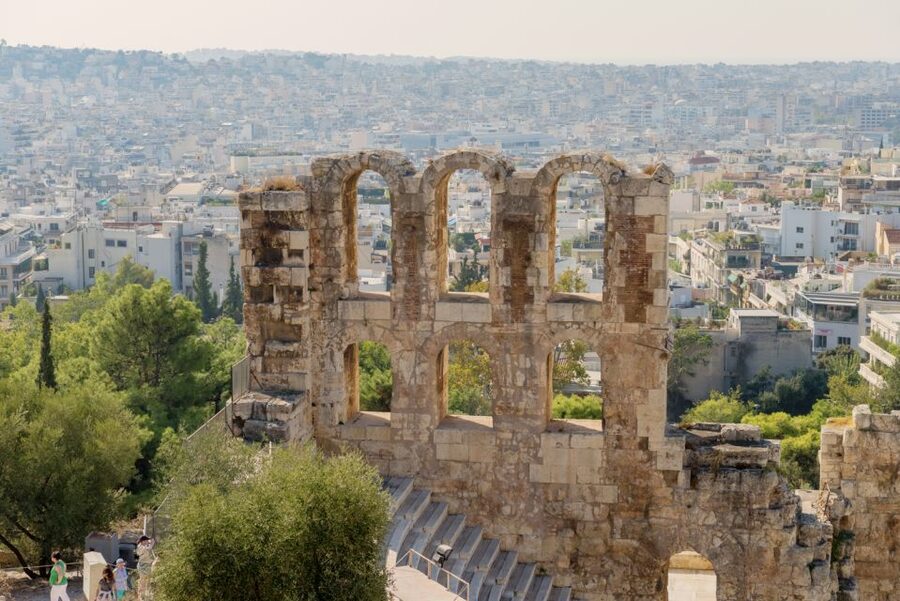
The Erechtheion offers a different mood from the Parthenon. Its unusual design and association with several cults make it a natural place to discuss the myths that shaped the Acropolis.
The central story is the contest between Athena and Poseidon for the city’s protection. Your guide explains the symbolism around that struggle and the mythology linked to the site. The tour also brings out the importance of the Erechtheion as a sacred place rather than treating it as a secondary temple.
This is one of the moments when a private guide can make the visit more personal. If you have heard Greek myths but never understood how they relate to actual places, ask your guide to connect the story to the architecture and the rock itself.
The route then descends through the olive trees toward the Odeon of Herodes Atticus. The theater is still used during the summer, so you see an ancient performance space that remains part of Athens’ cultural life. It is a useful reminder that the Acropolis is not only an archaeological site behind glass. Some of its spaces still serve the city.
The Acropolis Museum puts the hill back together
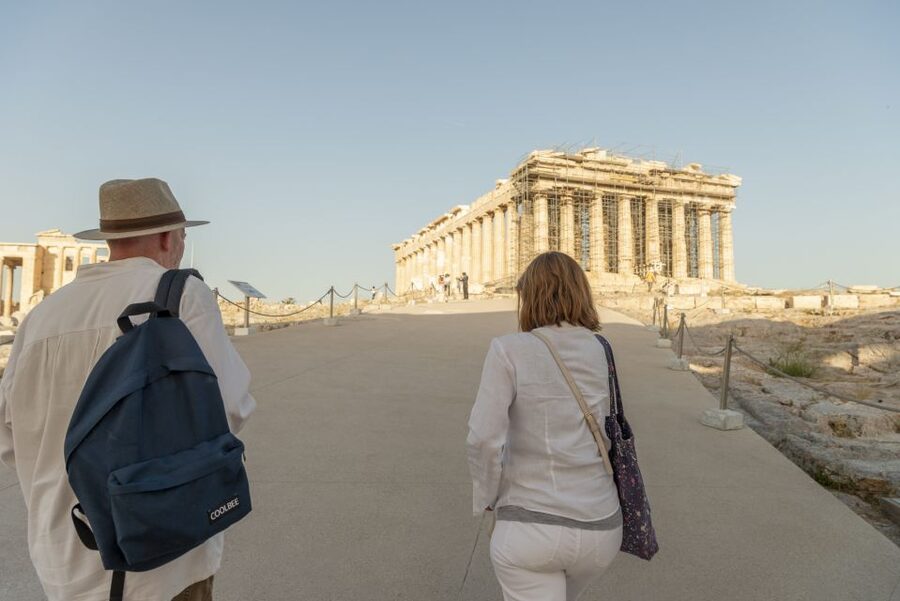
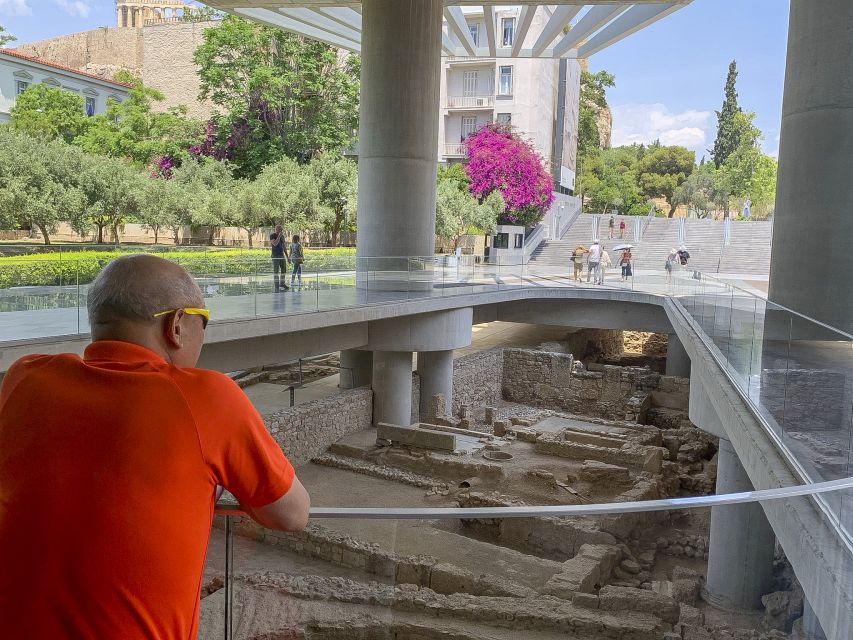
The museum is the strongest partner to the outdoor visit. On the hill, you see temples and fragments in their original setting. In the museum, you see sculpture, artifacts, models, videos, and interactive displays that help explain what the Acropolis looked like and how its objects were used.
The museum portion is listed at about 1.5 hours. That gives you enough time for the main galleries and the guide’s key selections, though the building contains more than any short tour can cover.
I especially like the order used by some guides: museum first, then the Acropolis. One visitor found that approach useful because the museum explanations made the later ruins easier to understand. Other versions begin on the hill, then finish indoors. Ask about the order if it matters to you, since the supplied route describes the Acropolis first but guide accounts show that the sequence can vary.
Your guide highlights the essential objects and explains how they relate to the temples outside. This is where the tour moves beyond familiar myth. You can ask about daily life, religious practice, artistic methods, and the meaning of individual artifacts. Guides have been praised for making complicated material approachable without turning the outing into a stiff classroom lesson.
The museum also offers a break from the sun and uneven ground. Still, the complete Acropolis and museum route is a lot of information in a short span. If you prefer a slow look at every sculpture, you may want to return to the museum on your own after the tour.
What the private format is worth at $163
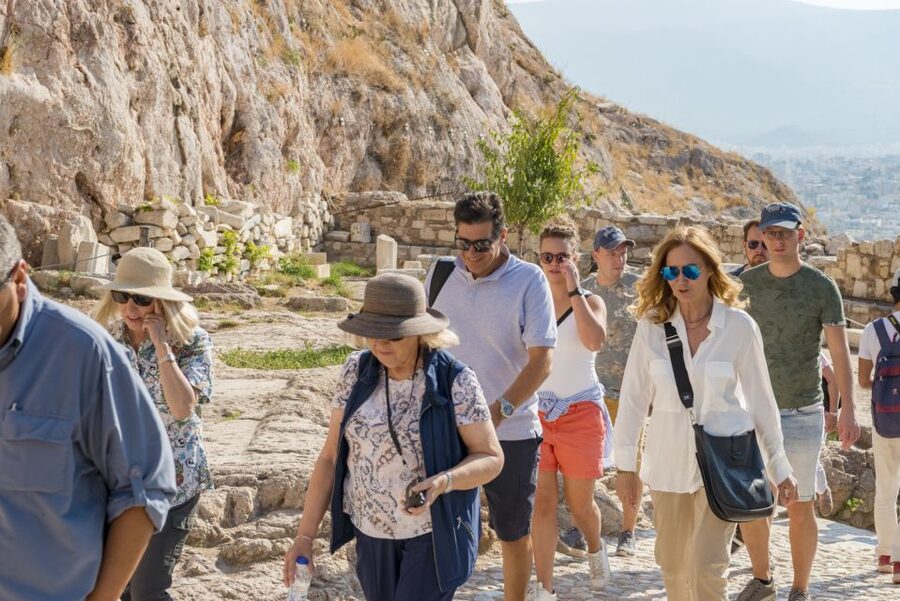
At $163 per person, this is not a budget way to see the Acropolis. Admission fees are not included, and the operator contacts you after booking to ask if it should purchase skip-the-line tickets. You need to reply. If you do not, it assumes you have bought the right tickets and time slots yourself, and it does not accept responsibility for delays caused by missing or incorrect admission.
The price makes more sense for a family or group sharing one private guide. A group of six or seven can spread the cost across more people while still getting direct access to the guide’s explanations. For two people, the cost is harder to justify, though the private pace and freedom to ask questions can make it worthwhile if ancient history is central to your trip.
You are paying for interpretation, not transport or entry. That distinction is important. The tour does not include hotel drop-off, and the guide may finish inside the Acropolis so you can stay longer for photos and views. If you want to continue to the museum, make sure your chosen option includes it.
There are also flexible versions. You can select an Acropolis-only tour or combine the Acropolis with the Ancient Agora instead of the museum. The Agora option suits you if philosophy, early democracy, and the remains of a classical Greek temple interest you more than museum displays.
Timing, comfort, and guide quality
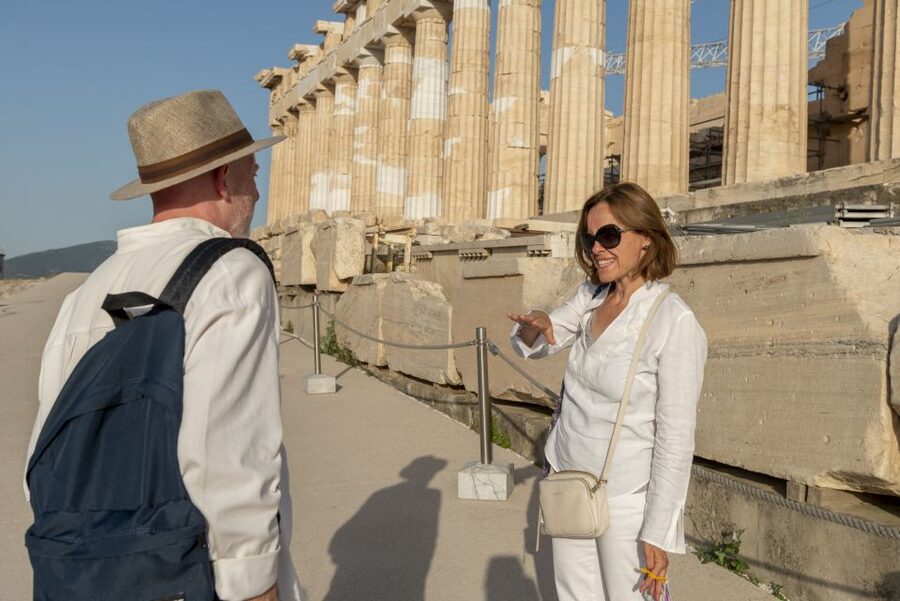
The stated duration ranges from 1.5 to 3 hours, depending on the option. The combined Acropolis and museum experience is the longer choice, with the outdoor visit and museum visit each receiving substantial attention.
Summer heat deserves respect. The exposed hill has limited shade, and the stone surfaces can feel demanding. Guides such as Marina were praised for finding shaded paths, maintaining a comfortable pace, helping with water breaks, and pointing out facilities. Another guide patiently adapted when one person had medical issues. That does not remove the physical demands, but it shows why a private format can help.
Guide quality is the heart of this experience. Aleksandra was praised for adding new details even to someone who had visited the Acropolis many times. Vicky, Lydia, Elina, Marina, Marissa, Komissa, Kalliope, Maria, and Lisa were all singled out for warmth, clear explanations, patience, or lively storytelling at different times.
The overall rating is 4.9 from 241 reviews, with especially strong praise for historical context, mythology, museum interpretation, pacing, and help with photographs. The comments are unusually consistent on one point: the guide turns a familiar landmark into a connected story.
Who should book this experience?
This suits first-time visitors who want to understand the Acropolis rather than simply photograph it. It also works for repeat visitors, since one guide added fresh details to someone who had visited several times.
Families are a good match, especially when children need a guide who can keep the pace lively. The private format also suits mixed-interest groups because you can ask for more mythology, architecture, art, or practical orientation.
History fans will appreciate the archaeological framing, but you do not need specialist knowledge. The strongest praise goes to guides who explain complex subjects in ordinary language and keep the outing relaxed.
I would think twice if you are watching every euro, dislike walking uphill, or want a long, unhurried museum visit. You can see the major sights independently for much less, though you will need to build your own understanding from signs, displays, and prior reading.
Should you book the Acropolis and museum tour?
Book it if you want the Acropolis to make sense, not just appear on your camera roll. The pairing with the museum is the main reason to choose this version, and the private guide is most valuable when you ask questions and let the discussion follow your interests.
For a couple, the price is high once tickets are added. For a family or larger group, the cost is easier to defend, and the help with heat, crowds, pacing, and photographs adds real practical value.
Choose the full Acropolis and museum route for the clearest overall picture. Choose the Acropolis and Ancient Agora option if democracy and philosophy matter more to you. If you book, respond promptly about admission tickets, request an early start if available, and arrive ready for stairs, sun, and a great deal of ancient Athens in a few hours.
FAQ
How long does the private Acropolis and museum tour last?
The duration is 1.5 to 3 hours, depending on the option selected. The combined Acropolis and Acropolis Museum version is the longer experience, with about 1.5 hours listed for each main part.
Is admission included in the $163 price?
No. Admission and ticket costs are separate. After booking, the operator may contact you to ask if it should purchase skip-the-line tickets for you.
Where does the tour meet?
The meeting point is Makrigianni 7, Athina, 117 42, close to the Acropolis Museum. Your guide will hold a sign with your name.
Can the guide meet me at my hotel?
Hotel meeting may be possible if your hotel is within an easy walk of the Acropolis. Hotel pickup and drop-off are not included.
Which languages are available?
The live guide may conduct the tour in English, German, Italian, or Greek.
Is this tour suitable for wheelchair users?
No. The experience is listed as unsuitable for wheelchair users.
Can I choose an alternative to the museum?
Yes. Flexible options include an Acropolis-only tour or a route combining the Acropolis with the Ancient Agora, where ancient philosophers taught and democracy was born.
Just added around Athens
- Athens Hotels to Athens Airport Private Departure Transfer★ 5.0 · 40 reviews
- Private One-way Transfer between Athens International Airport and Athens Hotels★ 4.5 · 40 reviews
- Athens: Acropolis Museum Ticket with Self-Guided Audio tour App★ 3.5 · 40 reviews
- From Athens: Meteora Train Trip with Overnight Stay★ 4.8 · 40 reviews
- Athens Photography Tour★ 5.0 · 40 reviews
- Athens: Acropolis Visit and City Night Tour★ 4.7 · 40 reviews
- Delphi Full Day Private Trip From Athens With Lunch Overlooking the Sea★ 5.0 · 40 reviews
- Acropolis & Plaka Neighbourhood Private Tour with Licensed Expert★ 5.0 · 40 reviews
Acropolis & Parthenon Tours, compared.
Acropolis & up to 5 Archaeological Sites Combo Pass
Read our review →

Acropolis, Parthenon & Acropolis Museum Guided Tour
Read our review →
Acropolis, Parthenon & Acropolis Museum Guided Tour
Read our review →

Acropolis: Acropolis and Parthenon Guided Walking Tour
Read our review →
Acropolis monuments & Parthenon Walking Tour with Optional Acropolis Museum
Read our review →Browse the lists this tour appears in