Reviewed · ATHENS TOURS
Unexpected Athens Orientation Tour
Athens reveals itself street by street. This four-hour walk makes sense of the city beyond the Acropolis, moving from grand Syntagma Square through polished Kolonaki, political Exarchia, artistic Psiri, and busy Monastiraki. I like the way it shows modern Greek life alongside older layers of history, rather than treating Athens as a box of ancient ruins.
I also like the small maximum of 12 people. Guides such as Nikos, Leo, Simos, Antigoni, and Elissavet have been praised for making the walk personal, answering questions, and adjusting the conversation to the group. The main drawback is simple: this is a serious walk, with hills and some steep climbs. On a hot day, four hours can feel longer than the advertised duration.
- Five very different districts: Move from government buildings and luxury shops to student cafés, street art, ruins, and flea-market lanes.
- A modern view of Athens: The tour explains how the capital developed, including its political life, neighborhoods, architecture, and recent past.
- Small groups capped at 12: A compact group makes crowded streets easier to manage and gives you more time to ask questions.
- A useful first-day introduction: Starting at Syntagma and ending in Monastiraki helps you get your bearings before exploring alone.
- A walking tour with hills: Comfortable shoes, water, and a little stamina matter more here than a polished outfit.
- Good guide-led local advice: Guides may suggest cafés, restaurants, bookstores, and places suited to your interests.
In This Review
- Why This Is a Different Athens Walking Tour
- Starting at Syntagma Square at 9:30
- Kolonaki and Lykavittos: Athens at Its Most Polished
- Exarchia: Students, Politics, and Everyday Athens
- Psiri: Craft Shops Turned Food and Art District
- Monastiraki: Ruins, Street Food, and a Natural Finish
- The Guide Makes or Breaks the Morning
- How Much Walking Should You Expect?
- What the Small Group Adds
- When to Book and How to Use It
- Who Should Book Unexpected Athens?
- Should You Book It?
- FAQ
- How long is the Unexpected Athens Orientation Tour?
- Where does the tour start?
- Where does the tour end?
- What time does the tour begin?
- How large is the group?
- Is food included?
- Can I cancel for a full refund?
Why This Is a Different Athens Walking Tour
Many first visits to Athens follow a familiar path: Acropolis, Ancient Agora, Plaka, and perhaps the National Archaeological Museum. Those places deserve your time, but they do not fully explain how present-day Athenians live, work, argue, shop, eat, and meet.
The Unexpected Athens Orientation Tour takes a wider view. It uses neighborhoods as the main story, showing how the character of the city changes after only a few blocks. You see polished Kolonaki, politically charged Exarchia, and newly fashionable Psiri in one morning. That contrast is the point.
The tour costs $64.12 per person for about four hours. I consider that fair value if you want context and local orientation, especially at the beginning of your stay. You are not paying for entrance tickets, since the stops are viewed from public streets and squares. You are paying for a guide who connects scattered sights and explains what you are seeing.
The tour has earned a 4.9 rating from 305 ratings, with 99 percent recommending it. That strong record fits the experience’s main strength: the guide. Several guides have received especially warm praise, including Nikos, Leo, Simos, Antigoni, Mary-Kate, and Elissavet. Guide quality can vary on any scheduled walking tour, but the repeated praise for clear explanations and friendly personalities is encouraging.
Starting at Syntagma Square at 9:30
The meeting point is Syntagma Square, Plateia Syntagmatos, at 9:30 in the morning. This is a practical place to begin because Syntagma is the city’s central crossroads and a major reference point for getting around Athens.
The square is dominated by the Greek Parliament, once the Royal Palace. It is not a quiet ceremonial plaza. People are constantly crossing it, heading to work, shopping streets, public transport, and government offices. That human movement gives you an immediate sense of Athens as a working capital rather than only an open-air museum.
You spend about 30 minutes here, with no admission fee. Expect an introduction to the city and its political center, followed by an explanation of how the surrounding streets connect to the rest of central Athens.
Starting at 9:30 has two advantages. The cooler morning hours are easier for walking, and you begin before the day reaches its full heat. If you have just arrived in Athens, the tour also gives you a useful mental map for the days ahead.
More things to do in Athens:
- Athens: Acropolis & up to 5 Archaeological Sites Combo Pass
★ 4.4 · 12,619 reviews - Athens: Acropolis Ticket with Optional Audio or Live Guide
★ 4.2 · 11,055 reviews - Athens: Acropolis, Parthenon & Acropolis Museum Guided Tour
★ 4.8 · 9,316 reviews
Kolonaki and Lykavittos: Athens at Its Most Polished
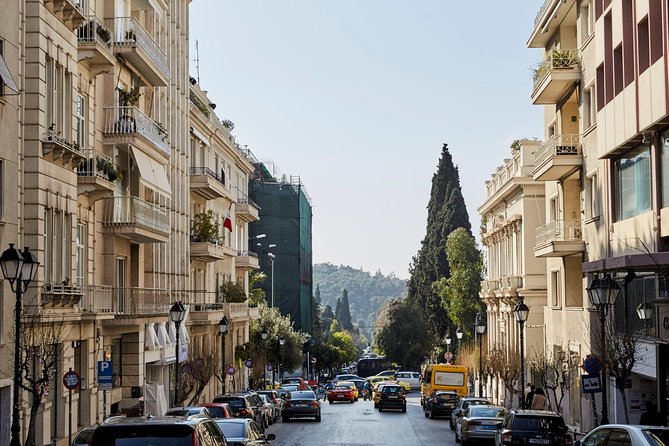
From Syntagma, the route heads toward Kolonaki and Lykavittos, where you spend about an hour. This is the capital’s upmarket central district, marked by designer boutiques, smart cafés, and gourmet restaurants.
Kolonaki is useful as a contrast to the rest of the morning. Here, you see a more polished side of Athens, with expensive shopping and sidewalk dining. The guide can explain how this district fits into the city’s social and commercial life, rather than simply pointing out attractive streets.
The Lykavittos section includes uphill walking, and this is where the physical demands begin to matter. The tour does not appear to be a flat promenade. Past participants specifically advise good walking shoes, and several note uphill stretches. The climbs are manageable for many people, but you should not book this expecting an effortless stroll.
This hour also gives the guide room to discuss the changes in central Athens over time. The tour’s focus is not only ancient Greece. You hear about the making of the modern Greek state, the growth of Athens, and the way different groups have shaped its neighborhoods.
Exarchia: Students, Politics, and Everyday Athens
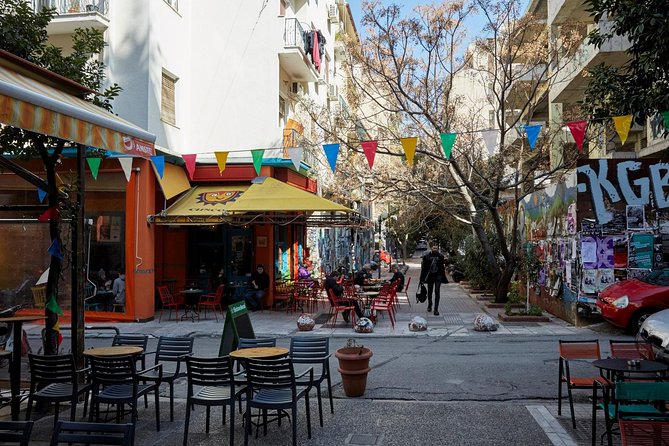
The route then shifts sharply into Exarchia, a district known for progressive politics, university life, inexpensive tavernas, bars, and snack shops. You spend roughly an hour here.
Exarchia is valuable because it breaks the postcard image of Athens. Instead of formal monuments and souvenir stalls, you see a neighborhood with a strong identity and a reputation for political debate. Nearby educational institutions help give the area a student presence, while affordable places to eat and drink keep it tied to ordinary city life.
This is also a good place to listen closely to your guide. Exarchia can be difficult to understand from a quick walk alone. A guide can provide context for the neighborhood’s social ideas and explain why it feels different from Kolonaki, even though the two areas are close together.
The tour’s broader themes become clearer here. Athens is not one uniform city. It is a collection of districts shaped by class, age, politics, work, art, and migration. Seeing those differences in one morning makes the city easier to read.
Psiri: Craft Shops Turned Food and Art District
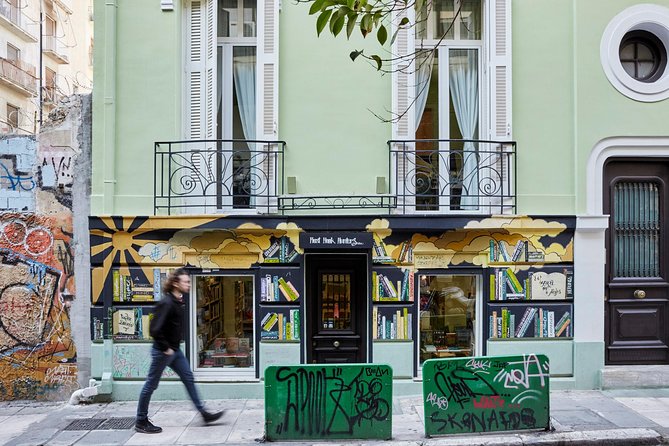
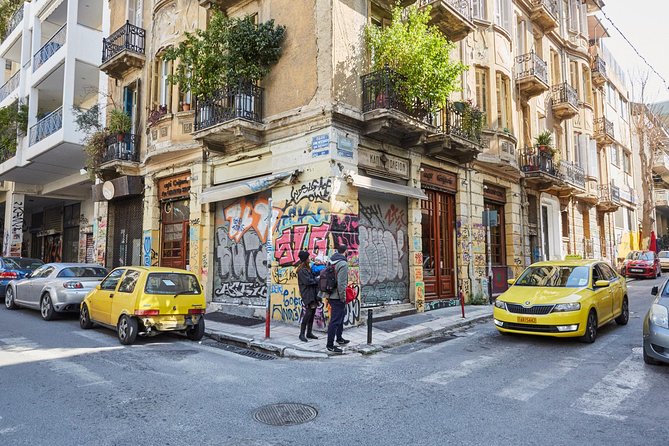
After Exarchia, the walk continues to Psiri for about an hour. This neighborhood was traditionally associated with small workshops and local craftsmen. Today, it is known for evening food and drink, along with some of Athens’ best street art.
Psiri gives the tour a lively change of pace. Old working spaces now sit near bars, restaurants, and walls covered with fresh-looking art. The guide helps you notice the shift from a crafts district to one of the city’s popular night-time areas.
I like this stop because it shows urban change in a direct, visible way. You do not need a lecture about redevelopment when you can see old commercial patterns beside newer restaurants and art. The neighborhood makes a useful bridge between Athens’ working past and its current social life.
The timing matters, too. Visiting Psiri during a morning orientation lets you see the streets before the evening food and drink scene becomes the main attraction. Your guide may also offer restaurant suggestions for later. Elissavet, in particular, has been praised for following up with tailored recommendations, and other guides have helped people choose places for lunch.
A completely different sort of day out in Athens:
- Athens: Cape Sounion & Poseidon Temple Sunset Half-Day Trip
★ 4.8 · 8,241 reviews - Athens: Acropolis and Parthenon Guided Walking Tour
★ 4.6 · 5,882 reviews - All Day Cruise -3 Islands to Agistri,Moni, Aegina with lunch and drinks included
★ 5.0 · 4,958 reviews - Athens, Piraeus, and Coastline: Blue Hop-On Hop-Off Bus
★ 3.9 · 4,849 reviews
Monastiraki: Ruins, Street Food, and a Natural Finish
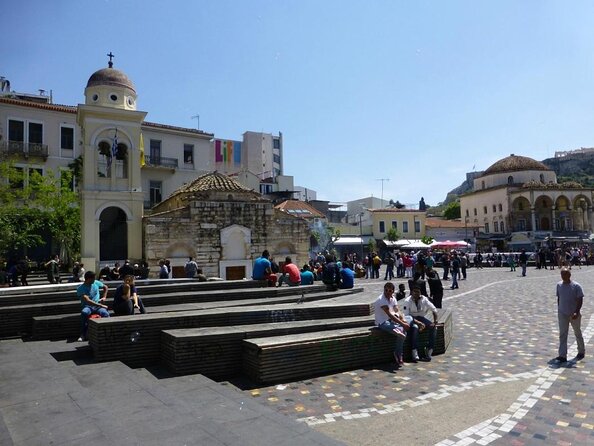
The walk ends in Monastiraki after about 30 minutes there. This is a fitting finish because Monastiraki brings together several sides of Athens: ancient remains, shopping, street food, Ottoman-era traces, and the city’s metro system.
The area includes Hadrian’s Library, a major reminder that the ancient city is still woven into modern streets. You may also encounter one of Athens’ few surviving Ottoman mosques, along with the flea-market atmosphere that makes Monastiraki popular with bargain hunters.
One of the more unusual details is an underground river hidden in a metro station. That kind of small urban fact is exactly what makes a guide-led orientation useful. You might walk past the station on your own without realizing what lies below it.
Monastiraki is also a practical place to finish. You are left near food, shopping, public transport, and several major sights. The tour does not return you to Syntagma, so plan your next move from Monastiraki. That is not a serious problem, but you should know the walk is point-to-point.
The Guide Makes or Breaks the Morning
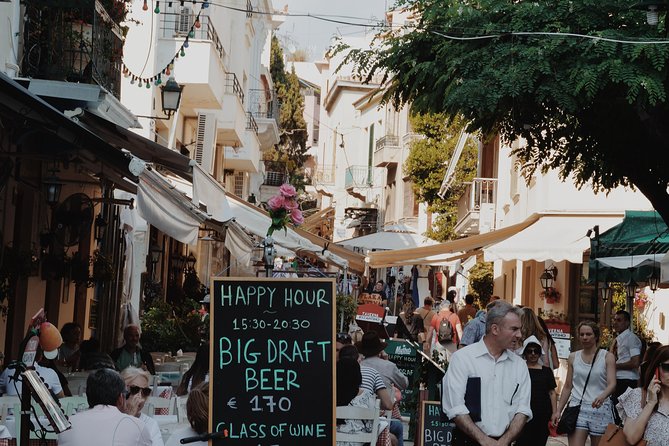
The strongest part of this experience is the guiding. The route itself is good, but the value comes from someone explaining why these districts differ and how the pieces fit together.
Nikos has been praised for his friendly manner, broad understanding of Athens, and habit of working group questions into the walk. Leo is noted for connecting modern history with buildings, street art, and local culture. Simos, an archaeologist and cultural historian, has provided detailed explanations of architecture, the city’s development, excavated ruins in commercial streets, and a bunker linked to the Nazi occupation.
Antigoni has been praised for making the walk engaging and approachable, while Mary-Kate has been described as especially friendly and helpful with local suggestions. Elissavet has a reputation for adapting the route’s conversation to individual interests and sharing restaurant ideas afterward.
Those details matter because this is not a ticketed monument tour with a fixed script you can mostly absorb from signs. The guide needs to explain connections that are easy to miss: why a neighborhood developed as it did, how Athens changed during the last 75 years, and how ancient remains sit beside ordinary shops.
You should also ask questions. The small group makes that easier, and the guides appear willing to respond rather than rush through prepared points.
How Much Walking Should You Expect?
You should expect a full morning on foot, not a gentle 30-minute orientation. One description of the experience calls it four hours, while the route allocates about 30 minutes to Syntagma, one hour to Kolonaki and Lykavittos, one hour to Exarchia, one hour to Psiri, and 30 minutes to Monastiraki. In practice, allow the whole morning and possibly a little extra time.
The route includes uphill sections, especially around Lykavittos and other parts of central Athens. Some people have found the pace relaxed and the walk manageable, including older participants, but that does not remove the need for comfortable shoes.
Bring water, particularly in warm weather. A coffee stop may be included during the walk, giving you a chance to rest and try Greek coffee, though tastes differ. Food and drinks are not included in the price, so budget separately for refreshments.
The tour is suitable for most people according to the supplied details, and service animals are allowed. Still, the best fit is someone comfortable walking for several hours over city streets and hills.
What the Small Group Adds
The tour is limited to 12 people. That is a meaningful advantage in central Athens, where sidewalks and lanes can become crowded and noisy.
A small group lets you stay closer to the guide and hear explanations more clearly. It also makes it easier to stop without blocking a large group, and it gives you a better chance to ask about food, culture, history, or places to visit later.
The group may be smaller than the advertised limit. Some departures have had only three people, creating a more personal walk and making it easier to adjust the discussion. You should not assume every date will be nearly private, but the 12-person cap keeps the experience from becoming a large procession.
This format suits solo visitors and couples especially well. Families with older children may also enjoy it, but one rating specifically wished the age policy were clearer because young children can affect a long walking tour. The official information says most people can participate, but it does not state an age minimum.
When to Book and How to Use It
The tour is often booked about 53 days ahead, which suggests planning early if your dates are fixed. Confirmation normally arrives at booking, although reservations made within one hour of departure are confirmed as soon as possible and depend on availability.
I would place this tour near the beginning of an Athens stay. It helps you understand the center before you return to areas on your own. Monastiraki, Psiri, Exarchia, and Kolonaki will feel less confusing after you have heard how they differ.
It is also useful before choosing restaurants or planning an evening. Guides may point you toward places that match your interests, and the final stop in Monastiraki leaves you in a convenient part of the city for lunch.
The tour is offered in English and uses a mobile ticket. Hotel pickup and drop-off are not included, so you must reach Syntagma Square independently and arrange your own way onward from Monastiraki.
Free cancellation is available if you cancel at least 24 hours before the local start time. Cancellations or changes made inside that window are not refunded, and the tour requires a minimum number of participants. If that minimum is not met, you are offered another date or experience, or a full refund.
Who Should Book Unexpected Athens?
Book this if you want Athens to feel like a living city, not simply a set of ancient sites. It is especially useful for first-time visitors, people staying several days, and anyone interested in modern Greek politics, neighborhoods, architecture, street art, food culture, and the changes of the last century.
You will get the most from it if you enjoy asking questions and noticing details. The tour is not built around entering major monuments, so it should complement an Acropolis visit rather than replace one.
You may want to skip it if your priority is ancient archaeology only, if you dislike walking uphill, or if four hours on city streets sounds tiring. It is also not the best choice for someone seeking a short, flat introduction.
Should You Book It?
Yes, if you want a smart first look at modern Athens and can handle a long walk. At $64.12, the price is reasonable for four hours with a small group and a strong guide-led focus, especially since the experience can save you from wandering past important details without understanding them.
Wear good shoes, carry water, and arrive ready for hills. Book it early in your stay, then use your new sense of the city to choose where to eat, shop, and explore next.
FAQ
How long is the Unexpected Athens Orientation Tour?
The tour lasts approximately four hours. The route includes about 30 minutes at Syntagma, one hour in Kolonaki and Lykavittos, one hour in Exarchia, one hour in Psiri, and 30 minutes in Monastiraki.
Where does the tour start?
It starts at Syntagma Square, Plateia Syntagmatos, in Athens.
Where does the tour end?
The tour ends in Monastiraki, Athens. Hotel drop-off is not included.
What time does the tour begin?
The scheduled start time is 9:30 am.
How large is the group?
The tour has a maximum of 12 participants.
Is food included?
No. Food and drinks are not included in the price. A coffee stop may occur during the walk, but you should budget separately for anything you buy.
Can I cancel for a full refund?
Yes. You can cancel up to 24 hours before the experience start time for a full refund. Cancellations or changes made less than 24 hours before the start are not refunded.
Just added around Athens
- Athens Hotels to Athens Airport Private Departure Transfer★ 5.0 · 40 reviews
- Private One-way Transfer between Athens International Airport and Athens Hotels★ 4.5 · 40 reviews
- Athens: Acropolis Museum Ticket with Self-Guided Audio tour App★ 3.5 · 40 reviews
- From Athens: Meteora Train Trip with Overnight Stay★ 4.8 · 40 reviews
- Athens Photography Tour★ 5.0 · 40 reviews
- Athens: Acropolis Visit and City Night Tour★ 4.7 · 40 reviews
- Delphi Full Day Private Trip From Athens With Lunch Overlooking the Sea★ 5.0 · 40 reviews
- Acropolis & Plaka Neighbourhood Private Tour with Licensed Expert★ 5.0 · 40 reviews
Athens Tours, compared.
Acropolis & up to 5 Archaeological Sites Combo Pass
Read our review →

Acropolis, Parthenon & Acropolis Museum Guided Tour
Read our review →
Cape Sounion & Poseidon Temple Sunset Half-Day Trip
Read our review →

All Day Cruise -3 Islands to Agistri,Moni, Aegina with lunch and drinks included
Read our review →
Athens, Piraeus, and Coastline: Blue Hop-On Hop-Off Bus
Read our review →