Reviewed · ATHENS TOURS
Philosophy and Democracy tour of Athens
Ideas come alive on Athens’ streets. This 3.5-hour walking tour links famous ruins with the birth of philosophy and democracy, giving you more than a parade of old stones. I especially like the way it connects ancient debates to modern democracy, and the chance to visit less familiar places such as Kerameikos and the Pnyx. Guide Panos is repeatedly praised for making complex subjects clear, lively, and often funny.
The tour costs $50.81 per person, which is fair for a small group of no more than 15 people and a guide-led walk through several major sites. The main drawback is that admission tickets for Kerameikos, Hadrian’s Library, the Roman Agora, the Tower of the Winds, and the Ancient Agora are not included. You should also expect a good amount of walking, sun, and uneven ground.
In This Review
- Key Points Before You Book
- Why This Athens Walk Is Different
- Kerameikos: Cemetery, Pottery, and Pericles’ Speech
- The Flea Market and the Shift to Modern Athens
- Hadrian’s Library and the Roman Agora
- The Tower of the Winds: Athens’ Ancient Clock
- Plaka: A Short Break Between Ancient Sites
- The Ancient Agora: Where Arguments Became Public
- The Prison of Socrates and the Limits of Certainty
- The Pnyx: Democracy With an Acropolis View
- What the Guide Adds to the Experience
- Price, Tickets, Timing, and Practical Value
- Who Should Book This Athens Experience?
- Should You Book the Philosophy and Democracy Tour?
- FAQ
- How long is the Philosophy and Democracy tour of Athens?
- What language is the tour offered in?
- Where does the tour start?
- Where does the tour end?
- Are admission tickets included?
- How large is the tour group?
- Can I cancel for a full refund?
Key Points Before You Book
- Kerameikos gives the tour an unusual start: This former pottery district and ancient cemetery is tied to Pericles’ famous funeral speech about Athenian democracy.
- The Pnyx is the tour’s big idea made physical: You visit the hill where citizens gathered to discuss and decide matters affecting Athens.
- Panos is the guide most often praised: His clear explanations, humor, passion, and ability to answer questions shape the experience.
- The route fills in the gaps around the Acropolis: You see the Ancient Agora, Roman Agora, Hadrian’s Library, Socrates’ prison, Plaka, and more.
- Admission fees need planning: Several archaeological stops are viewed or discussed from outside unless you purchase the required entry tickets.
- Bring water and wear sensible shoes: The pace is described as comfortable, but the walk lasts about three and a half hours.
Why This Athens Walk Is Different
Most first-time Athens tours focus on the Acropolis and Parthenon. That makes sense, but it can leave you with a grand monument and little sense of how Athenian society worked below the hill.
This tour takes a different route. It uses archaeological sites as stopping points for conversations about politics, ethics, citizenship, public life, and the work of philosophers such as Socrates and Plato. You are not simply told what a building was. You are asked to consider what happened there and why those ideas still affect modern life.
That approach suits me. Athens becomes easier to understand when you connect its stones to arguments about power and responsibility. The tour also helps place later Roman buildings and neighborhoods into the longer story of the city.
The group limit of 15 matters here. A lecture about democracy works better when you can hear the guide and ask questions. The feedback about Panos is unusually consistent: he is described as clear, personable, patient, passionate, and entertaining. One particularly useful detail is that he speaks loudly and clearly enough that earphones were not needed.
The route is offered in English and lasts approximately 3 hours and 30 minutes. It begins at the Statue of Theseus and ends on Theorias Street, close to the Acropolis area. The end point makes sense for continuing your sightseeing, although you should not assume that the tour includes entry to the Acropolis itself.
More things to do in Athens:
- Athens: Acropolis & up to 5 Archaeological Sites Combo Pass
★ 4.4 · 12,619 reviews - Athens: Acropolis Ticket with Optional Audio or Live Guide
★ 4.2 · 11,055 reviews - Athens: Acropolis, Parthenon & Acropolis Museum Guided Tour
★ 4.8 · 9,316 reviews
Kerameikos: Cemetery, Pottery, and Pericles’ Speech
Kerameikos is an excellent opening stop because it quickly moves you away from the standard Athens checklist. The name refers to pottery, since ceramic workshops once operated here. It later became the city’s cemetery for many centuries.
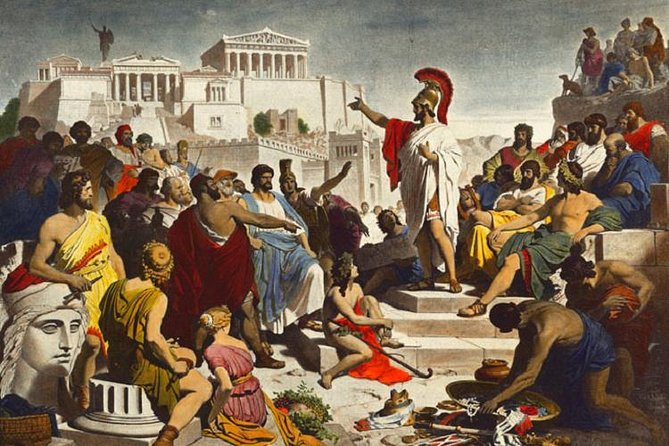
The site is also linked with prominent Athenians and with Pericles’ funeral speech for the first Athenian casualties of the Peloponnesian War. That speech praised the city’s way of life and its democratic values. Hearing about it in the area connected with Athens’ dead gives the discussion a serious tone.
You have about 15 minutes here. That is enough for an introduction and a strong explanation, but not enough for a slow archaeological visit. Admission is not included, so confirm how the stop will be handled on your date if you want to enter the site rather than view it as part of the walk.
I like this stop because it sets up the tour’s main question: what did Athens mean when it called itself free and democratic? The answer was never simple, and a good guide can show both the achievement and the limits of the system.
The Flea Market and the Shift to Modern Athens
The walk then passes through the Athens flea market at an easy pace. The stated stop is about 15 minutes and admission is free.
This portion gives your mind a break from dates and political theory. It also lets you see a living part of central Athens rather than moving from one fenced archaeological site to another. The market is part of the city’s present-day rhythm, which helps the old and new Athens sit side by side.
Do not expect a long shopping visit. The tour uses the flea market as part of the route, not as a dedicated retail excursion. If you want time to browse stalls carefully, you will need to return later.
This is also where insider suggestions about places to eat, drink, and explore can be useful. The experience specifically includes local tips, so keep a note on your phone when the guide mentions places that suit your plans.
Hadrian’s Library and the Roman Agora
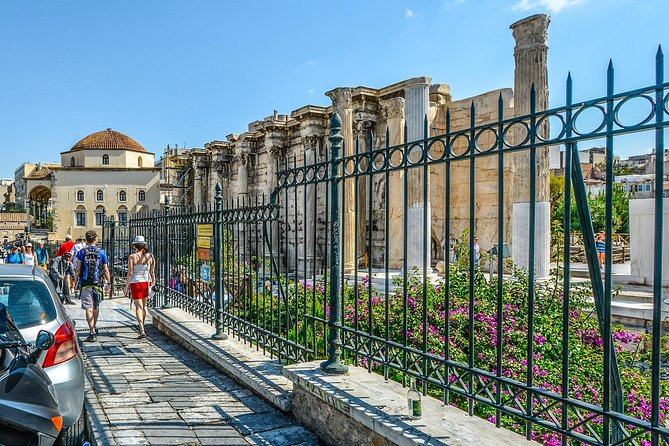
Hadrian’s Library was created by Roman Emperor Hadrian in AD 132 on the north side of the Acropolis. It reminds you that Athens remained important long after the classical period, even as Roman power shaped the city.
The stop lasts about 15 minutes, and admission is not included. The value here comes less from a long visit and more from understanding the city’s changing role. Athens was not frozen in the age of Socrates. Roman rulers added their own buildings and used the city’s cultural reputation for political purposes.
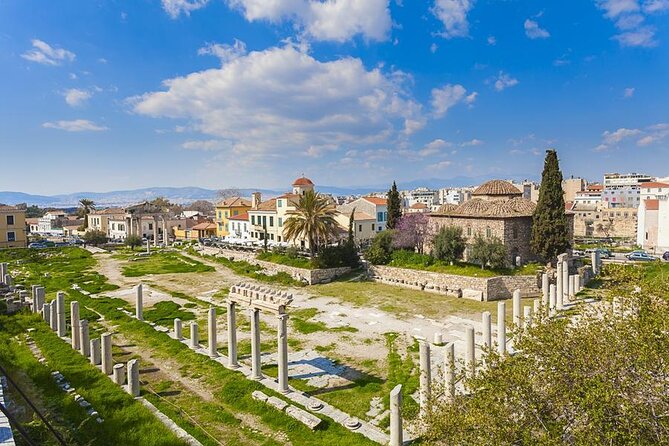
The Roman Agora lies north of the Acropolis and east of the Ancient Agora. It offers another short lesson in how public and commercial life developed under Roman rule. You may find the sequence of sites slightly confusing without a guide, since the names are similar and the ruins are close together. Panos’ role is to make those locations fit into one clear timeline.
A completely different sort of day out in Athens:
- Athens: Cape Sounion & Poseidon Temple Sunset Half-Day Trip
★ 4.8 · 8,241 reviews - Athens: Acropolis and Parthenon Guided Walking Tour
★ 4.6 · 5,882 reviews - All Day Cruise -3 Islands to Agistri,Moni, Aegina with lunch and drinks included
★ 5.0 · 4,958 reviews - Athens, Piraeus, and Coastline: Blue Hop-On Hop-Off Bus
★ 3.9 · 4,849 reviews
The Tower of the Winds: Athens’ Ancient Clock
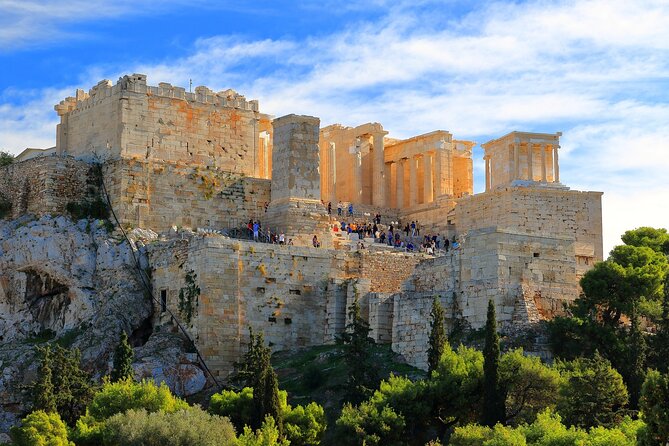
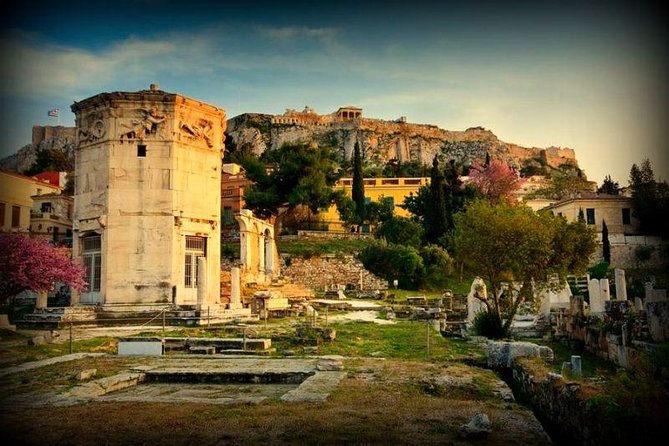
The Tower of the Winds gets only about five minutes, but it is one of the most memorable details on the route.
The octagonal building was made by Andronicus of Kyrristos in the first century BC. It served as a wind indicator, a clock, and a weather station. The clock used sunlight, while a hydraulic system could produce an hourly sound on cloudy days.
That combination makes the tower surprisingly easy to appreciate. You are looking at a practical scientific instrument, not only a decorative ruin. Calling it the Big Ben of Athens is a useful comparison, though the tower also served as an early meteorological station.
Admission is not included. The short stop means you should listen closely, take a quick look, and save detailed photographs for another visit if needed.
Plaka: A Short Break Between Ancient Sites
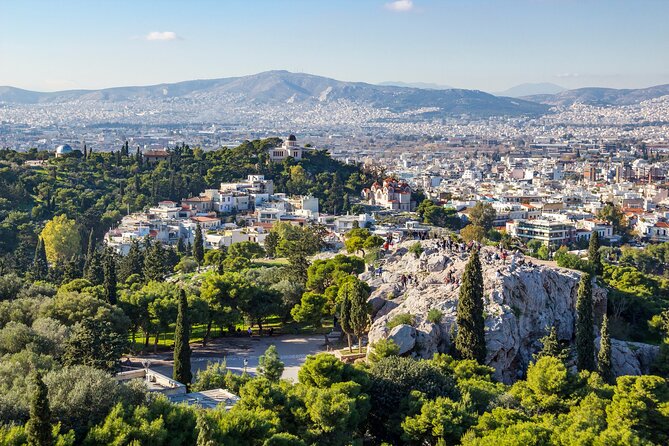
Plaka is a scenic Athens neighborhood with narrow streets and small houses. The route includes it as an unnumbered stop, so the exact amount of time there is not specified.
This is a pleasant change of scale. After large archaeological areas and broad political themes, Plaka brings you into a more intimate part of the city. You can see why the neighborhood is popular, but the tour is not designed as a full Plaka walking tour.
Use this section to notice the contrast between ancient civic spaces and the compact streets of modern Athens. It is also a sensible point to ask for food or drink suggestions if you have not already done so.
The Ancient Agora: Where Arguments Became Public

The Ancient Agora is the intellectual center of the tour. This was the heart of Athens, where citizens, politicians, philosophers, and ordinary residents walked, met, argued, and handled public business.
The names connected with this area form a remarkable roll call: Socrates, Plato, Solon, Themistocles, Pericles, Thucydides, Sophocles, and Aristophanes. The point is not that every one of them spent every day in the same spot. The point is that the Agora was the kind of public setting where civic life, theater, politics, and philosophical debate could overlap.
The scheduled stop is about 20 minutes, with admission not included. That is a short visit for such an important site. If you want to explore the Agora museum and ruins at leisure, plan a separate visit or allow extra time after the tour.
The benefit of seeing it with this theme is clear. You learn to picture philosophy as something argued in public, not just read later in a quiet classroom. The guide can also explain how Athenian democracy depended on participation, speech, persuasion, and conflict.
The Ancient Agora is often one of the strongest parts of the walk because it connects the famous names to an actual urban setting. You are not only learning what Socrates thought. You are considering where people encountered one another and how ideas traveled through the city.
The Prison of Socrates and the Limits of Certainty
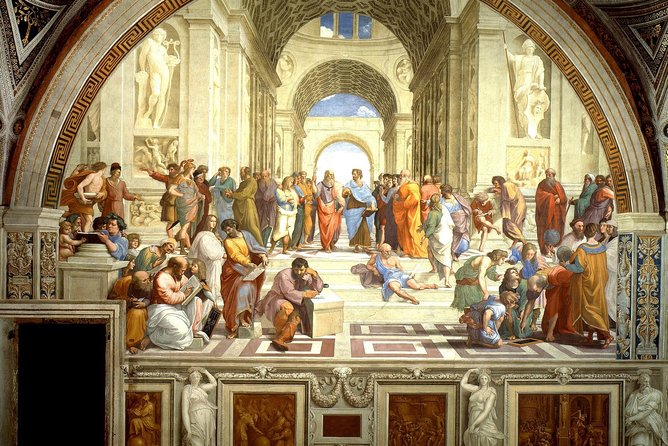
The stop called the Prison of Socrates lasts about 10 minutes and is free to visit.
The wording is important. This is a place where the tour pays tribute to Socrates, not a full museum visit. The location helps bring the philosopher’s final years into the conversation, but you should not expect a large preserved prison complex or a long archaeological presentation.
That restraint is helpful. The tour is about ideas and places together, not about claiming that every ancient story can be proved in exact detail. Socrates is a natural figure for this kind of walk because his method depended on questions, doubt, and testing assumptions.
If you enjoy tours that leave you thinking after the guide has moved on, this stop should work well. Families can enjoy it too. One review describes children aged 11 and 15 responding very positively, which suggests the material can suit younger listeners when presented with energy and humor.
The Pnyx: Democracy With an Acropolis View
The Pnyx is the tour’s defining stop. The hill is described as the cradle of democracy because it was an early place where citizens gathered to make decisions about their future.
You have about 30 minutes here, the longest stop on the route. Admission is free. The hill also offers views of the Acropolis and Athens, giving the abstract discussion a strong visual finish.
The Pnyx helps you grasp a basic fact about Athenian democracy: it was direct participation by citizens, not the representative system most modern countries use. The comparison with modern democracy is one of the tour’s main themes, so this is the place to ask questions about who had a political voice, how decisions were made, and where the ancient system fell short.
The stop is also a good reminder that democracy was not born as a polished idea. It developed through arguments, reforms, tensions, and exclusions. A thoughtful guide should explain both its influence and its limits.
Because the Pnyx is outdoors, weather matters. The experience may be canceled in poor weather, with a different date or full refund offered. Bring water, particularly since the walk can take place in strong Athens sun. Comfortable shoes are sensible for the hills and archaeological ground.
What the Guide Adds to the Experience
The guide makes or breaks a subject-heavy walking tour. Here, Panos receives the strongest praise. His style is described as humorous, passionate, patient, and able to explain difficult philosophical ideas without making them feel like homework.
That last point is important. Philosophy can become a string of names and theories. The best moments on this tour appear to come when Panos links an idea to a place, a person, or a question you recognize from modern life.
You should also expect room for questions. Several comments describe the tour as thought-provoking and interactive, with opportunities to ask along the way. That makes the small group size more than a marketing detail.
The experience is aimed at adults, but it can work for older children and teenagers who enjoy history or debate. It is less suitable if you want a quiet photo walk, a fast tour of monuments, or a visit focused only on the Acropolis.
Price, Tickets, Timing, and Practical Value
At $50.81 per person, this is a good-value tour if you want interpretation rather than transport or a formal meal. You are paying for about three and a half hours of guiding, a route through several historic areas, and a focused explanation of Athens’ political and philosophical influence.
The value is strongest for a first or second day in Athens. One useful piece of advice from the experience is to take this tour early in your stay. The guide’s explanation of how Athens changed through the centuries can make later archaeological visits easier to follow.
The price does not include admission to several sites. That matters because your final cost will rise if you choose to enter Kerameikos, Hadrian’s Library, the Roman Agora, the Tower of the Winds, or the Ancient Agora. Some stops are free, including the flea market, the Prison of Socrates, and the Pnyx.
The tour accepts mobile tickets, is offered in English, and has a maximum group size of 15. It starts at the Statue of Theseus, Athens 105 55, and finishes at Theorias 21, Athens 105 58. The route is near public transportation, and service animals are allowed. Most people can take part, though the amount of walking deserves attention.
Free cancellation is available up to 24 hours before the start time for a full refund. Changes or cancellations inside that window are not accepted, and the cut-off follows local Athens time. The tour also requires a minimum number of participants, so a cancellation for that reason brings the choice of another date or experience, or a full refund.
Who Should Book This Athens Experience?
I would choose this tour if you enjoy history, politics, ethics, and stories about how cities shape ideas. It is particularly useful for anyone who has already seen the Acropolis and wants to understand the wider city.
Families with older children may find it rewarding, especially if the children enjoy asking why and how. The tone is educational but not stiff, and the guide’s humor helps keep the material moving.
You should think twice if you have limited walking ability, dislike outdoor sightseeing in warm weather, or want long visits inside each archaeological site. The itinerary gives many places a brief look, so the tour favors breadth and explanation over slow examination.
Should You Book the Philosophy and Democracy Tour?
Book it if you want Athens to make sense beyond the Parthenon. The Pnyx, Ancient Agora, and Kerameikos give the tour a strong sense of place, while Panos’ clear and lively teaching brings the political and philosophical material within reach.
Skip it if your main goal is a detailed Acropolis tour or extensive time inside ruins. For most history-minded visitors, though, the $50.81 price is reasonable, especially in a small group and with a route that includes places you might otherwise miss.
Take it early, bring water, wear comfortable shoes, and keep your afternoon open for any site where you want a longer visit. You should finish with more than a list of ancient names. You should have a better sense of why Athens still matters.
FAQ
How long is the Philosophy and Democracy tour of Athens?
The tour lasts approximately 3 hours and 30 minutes.
What language is the tour offered in?
The tour is offered in English.
Where does the tour start?
It starts at the Statue of Theseus in Athens, Greece.
Where does the tour end?
It ends at Theorias 21, Athina 105 58, Greece.
Are admission tickets included?
Admission tickets are not included for Kerameikos, Hadrian’s Library, the Roman Agora, the Tower of the Winds, or the Ancient Agora. The flea market, Prison of Socrates, and Pnyx are listed as free stops.
How large is the tour group?
The experience has a maximum of 15 travelers.
Can I cancel for a full refund?
Yes. You can cancel at least 24 hours before the start time for a full refund. Cancellations or changes made less than 24 hours before the start time are not accepted for a refund.
Just added around Athens
- Athens Hotels to Athens Airport Private Departure Transfer★ 5.0 · 40 reviews
- Private One-way Transfer between Athens International Airport and Athens Hotels★ 4.5 · 40 reviews
- Athens: Acropolis Museum Ticket with Self-Guided Audio tour App★ 3.5 · 40 reviews
- From Athens: Meteora Train Trip with Overnight Stay★ 4.8 · 40 reviews
- Athens Photography Tour★ 5.0 · 40 reviews
- Athens: Acropolis Visit and City Night Tour★ 4.7 · 40 reviews
- Delphi Full Day Private Trip From Athens With Lunch Overlooking the Sea★ 5.0 · 40 reviews
- Acropolis & Plaka Neighbourhood Private Tour with Licensed Expert★ 5.0 · 40 reviews
Athens Tours, compared.
Acropolis & up to 5 Archaeological Sites Combo Pass
Read our review →

Acropolis, Parthenon & Acropolis Museum Guided Tour
Read our review →
Cape Sounion & Poseidon Temple Sunset Half-Day Trip
Read our review →

All Day Cruise -3 Islands to Agistri,Moni, Aegina with lunch and drinks included
Read our review →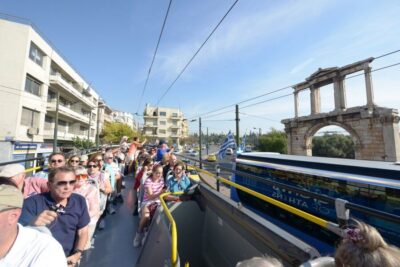
Athens, Piraeus, and Coastline: Blue Hop-On Hop-Off Bus
Read our review →