Reviewed · ATHENS TOURS
Biblical Tour Letters ToThe Corinthians St Paul’s Footsteps 6Hour
Faith meets ancient stone here. This six-hour private tour follows St. Paul’s path from Athens to Corinth, combining Mars Hill, the Corinth Canal, ancient sanctuaries, and the places linked with Paul’s letters and missionary work. I like the private vehicle, with Wi-Fi, air-conditioning, water, and pickup from your hotel, apartment, or cruise ship. I also like the human touch praised by guests, especially guides such as Chris, Yiannis, Panos, Alex, Christos, and Andreas, who explain the sites with stories rather than dry dates.
The main drawback is the amount packed into roughly six hours and fifteen minutes. Several stops are short, and your driver cannot guide you inside archaeological sites unless you pay extra for a licensed guide. At $170.50 per person, the price can be good for a small group, but entrance fees and lunch are extra.
In This Review
- Five Things to Know Before You Go
- Why This Corinth Tour Works for Bible Readers
- From Athens Hotels to Areopagus Hill
- Daphni Monastery and the Road West
- The Corinth Canal: A Big View in Twenty Minutes
- Isthmia, Poseidon, and the Games
- Ancient Corinth and the Bema of Gallio
- Cenchreae and Phoebe’s Connection
- What the Driver Can and Cannot Do
- Is $170.50 a Fair Price?
- Who Should Book This Experience?
- Final Verdict: A Strong Choice for Paul’s Corinth
- FAQ
- How long does the tour last?
- Where can pickup and drop-off take place?
- Is this a private tour?
- Is the tour offered in English?
- Is a licensed guide included?
- What entrance fees are extra?
- Is lunch included?
- What is included in the vehicle?
- Can I cancel for a full refund?
Five Things to Know Before You Go
- Mars Hill connects directly to Acts 17: You visit Areopagus Hill, where Paul spoke about the Unknown God to the Athenians.
- A private minivan keeps the day easy: Pickup and return are offered from Athens hotels, apartments, and the cruise port.
- The Corinth Canal is a quick but memorable stop: You see the narrow cut that separates mainland Greece from the Peloponnese.
- The tour links faith with archaeology: Ancient Corinth, Isthmia, Cenchreae, and the Temple of Apollo give physical context to Paul’s life.
- Expect a driver-host, not an included site guide: The English-speaking driver provides commentary on the road, but only a licensed guide may lead you inside archaeological sites.
- The strongest praise goes to the personal service: Guests especially valued punctual pickups, clean vehicles, bottled water, flexible pacing, and engaging storytelling.
Why This Corinth Tour Works for Bible Readers
I see the appeal right away. Reading Acts or First Corinthians in Athens can feel abstract. Then you reach the hill where Paul addressed the Athenians, the forum where he may have faced Gallio, and the port connected with Phoebe and Paul’s vow. The places do not prove every detail of the biblical account, but they give the text a firm setting.
The experience also works for people who care about Greek history beyond the Bible. Corinth was a major city on the narrow link between central Greece and the Peloponnese. Its position shaped trade, war, religion, politics, and travel. Paul arrived in a city that mattered long before Christianity and continued to matter after his time.
The tour is private or semi-private, with the advertised format usually limited to two to four people and a vehicle capable of carrying up to eight. That distinction matters. A small party gives you room to ask questions and request a little more time at a stop, though the full schedule means flexibility is not unlimited.
More things to do in Athens:
- Athens: Acropolis & up to 5 Archaeological Sites Combo Pass
★ 4.4 · 12,619 reviews - Athens: Acropolis Ticket with Optional Audio or Live Guide
★ 4.2 · 11,055 reviews - Athens: Acropolis, Parthenon & Acropolis Museum Guided Tour
★ 4.8 · 9,316 reviews
From Athens Hotels to Areopagus Hill
Pickup is offered from an Athens hotel, an Airbnb apartment, or a cruise ship. The driver waits in the hotel lobby, at the entrance of an apartment building, or at the port gate with a sign. The company also says it monitors flights for airport pickup, but airport service costs an extra €60 per booking.
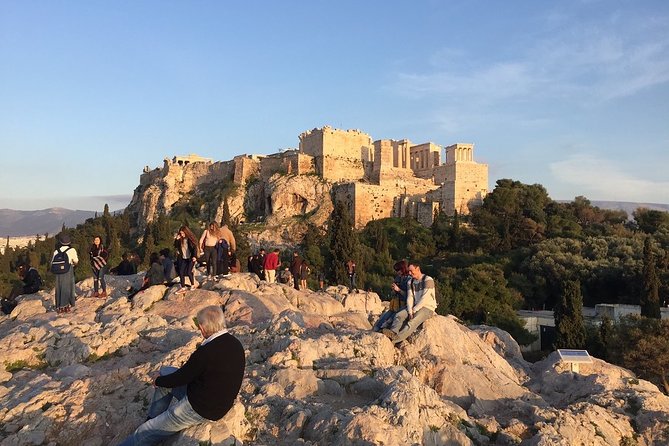
Your first stop is Areopagus Hill, also called Mars Hill. This is the rocky outcrop near the Acropolis where Acts places Paul’s speech to the Athenians. The visit lasts about 15 minutes, with admission included.
That short stop has real meaning, but it is not a full Acropolis visit. You are not getting a long tour of the Parthenon or the Acropolis Museum. The focus is Paul’s speech and the view across Athens. Wear shoes with a firm grip, since rocky ground and steps can be awkward.
This is also a good early moment to ask your driver about the difference between Paul’s message in Athens and his later work in Corinth. Guests especially praised Chris and Christos for answering questions and making room for conversation, so use the drive and stops actively. A question from you can turn a standard explanation into a more useful one.
Daphni Monastery and the Road West
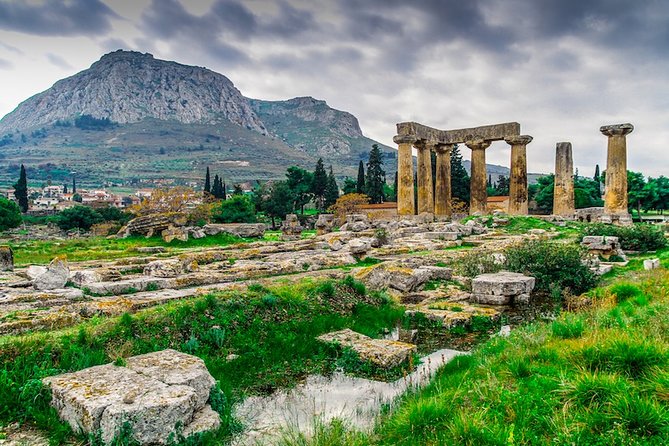
The Monastery of Daphni adds a Byzantine chapter to the day. Located on the slopes of Mount Aigaleo, it was built on the site of an ancient sanctuary associated with Apollo. Fortified walls, towers, and two gates give the complex a defensive look, while its mosaics provide the artistic heart of the visit.
The monastery has passed through several phases. Cistercian monks used it during the Frankish period, and it later returned to Orthodox control after the Ottoman conquest. Earthquakes caused major damage, and restoration work continues.
You have about 20 minutes here, and admission is listed as included. That is enough for a focused look, not a leisurely study of every feature. I like this stop because it keeps the tour from becoming only a sequence of biblical locations. It shows how sacred places in Greece were reused and reshaped across centuries.
The Corinth Canal: A Big View in Twenty Minutes
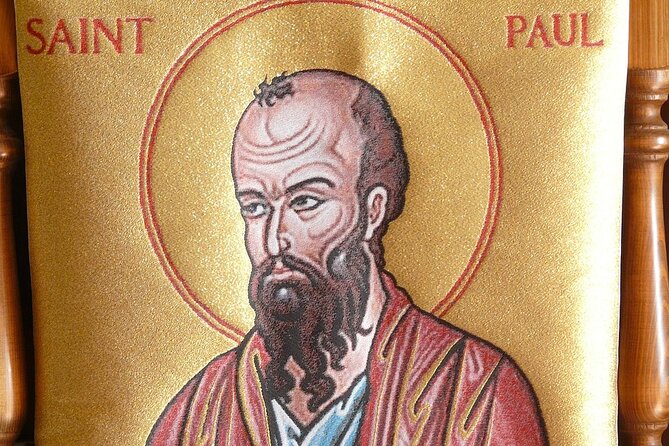
The drive toward Corinth takes about an hour, according to the experience description and guest accounts. This is where the vehicle matters. Air-conditioning, bottled water, Wi-Fi, and a clean private minivan make the long road section easier, especially in warm weather.
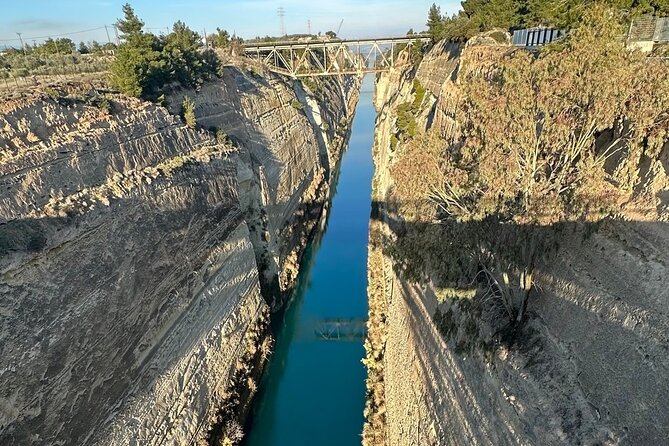
At the Corinth Canal, you have roughly 20 minutes. Admission is free. The canal cuts through the Isthmus of Corinth, linking the Gulf of Corinth with the Saronic Gulf. It separates the mainland from the Peloponnese in practical terms, making the Peloponnese an island.
The idea is ancient, but the canal was completed in the late 19th century. Before that, ships had to sail around the Peloponnese, adding about 185 nautical miles. The ancient alternative was the diolkos, a stone track used to move ships overland on wheeled platforms.
This stop is visual and quick. You will not spend hours examining engineering details, but the narrow walls and drop below make a strong impression. Keep your expectations in proportion: it is a scenic pause, not a boat trip through the canal.
A completely different sort of day out in Athens:
- Athens: Cape Sounion & Poseidon Temple Sunset Half-Day Trip
★ 4.8 · 8,241 reviews - Athens: Acropolis and Parthenon Guided Walking Tour
★ 4.6 · 5,882 reviews - All Day Cruise -3 Islands to Agistri,Moni, Aegina with lunch and drinks included
★ 5.0 · 4,958 reviews - Athens, Piraeus, and Coastline: Blue Hop-On Hop-Off Bus
★ 3.9 · 4,849 reviews
Isthmia, Poseidon, and the Games
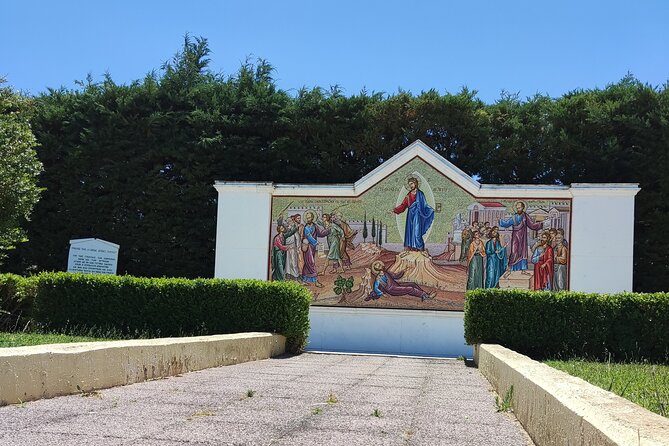
Isthmia connects the geography of Corinth with the ancient Greek world of sport and worship. The Isthmian Games were among the most important athletic competitions in Greece, ranking after the Olympic Games at Olympia. The site occupied a key point where the Peloponnese met central Greece.
The tour gives about an hour to the Isthmia area, followed by a separate 30-minute visit to the archaeological site of Isthmia. The schedule includes the Temple of Poseidon, the stadium, the Sanctuary of Palaimon, a theater, and Roman bath remains with mosaics.
The Temple of Poseidon was built and rebuilt several times after fires and damage. The stadium preserves a starting mechanism called the ysplex, a rare surviving example of its kind in Greece. The Sanctuary of Palaimon honored a youthful figure associated with sailors, and Roman ceremonies included night services and bull sacrifices.
The Archaeological Museum of Isthmia adds smaller objects that help explain the sanctuary. You might see an Archaic marble pediment from the first Temple of Poseidon, colored glass from Kechreai, amphorae, animal figurines, offerings, and material from Mycenaean and Roman cemeteries. A golden bull figurine is one especially distinctive object.
The museum admission is not included. The listed fee for the Archaeological Site of Isthmia is €5 per person. The schedule gives you only a short museum visit, so you will need to move with purpose.
This is one place where an optional licensed guide could help. The driver can explain the history from outside, but Greek law does not allow a driver to act as a guide inside an archaeological site. A licensed guide can be arranged for €160 per booking, subject to availability. For a group of four or more, that cost may make more sense when divided among the party.
Ancient Corinth and the Bema of Gallio
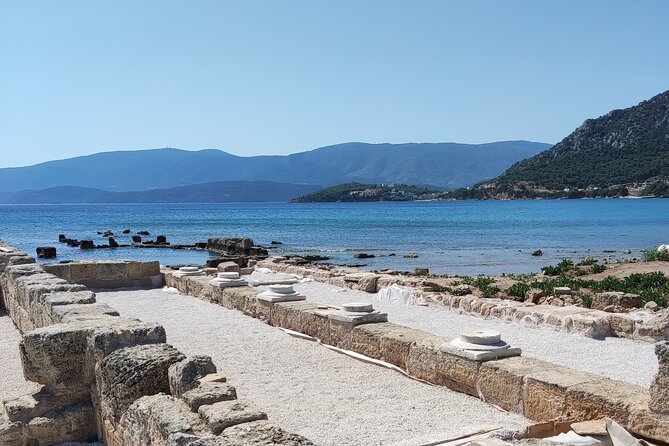
Ancient Corinth is the central stop. The archaeological visit lasts about an hour, and the entrance fee is listed as €15 per person. Lunch stops are scheduled, but your meal is not included.
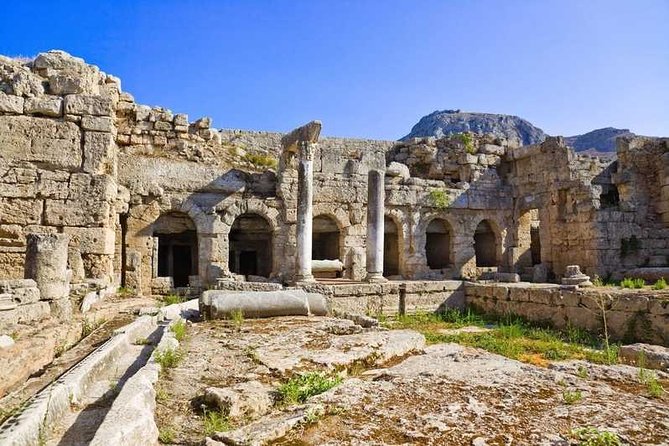
Corinth was a major city-state on the isthmus, roughly between Athens and Sparta. It was destroyed by Rome in 146 BC, rebuilt in 44 BC, and later became the Roman provincial capital of Greece. That Roman setting is crucial for understanding Paul’s time there.
Paul stayed in Corinth for about a year and a half around AD 51 to 52. Acts connects him with Priscilla and Aquila, tentmaking work, preaching, and a dispute brought before the Roman proconsul Gallio. The Bema, a raised platform in the Roman Forum, is traditionally linked with Paul’s hearing.
You can look across the forum and picture the civic setting, but keep one careful distinction in mind: tradition identifies the Bema as the place of Paul’s trial, yet the surviving stones do not provide a personal label saying Paul stood there. A good guide should explain that difference rather than blur faith and archaeology together.
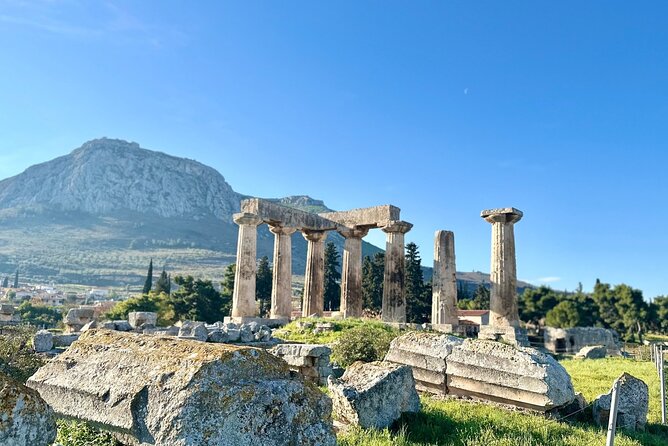
The Temple of Apollo is another key sight. Built around 550 BC, it is among the earliest Doric temples in the Peloponnese and mainland Greece to use monolithic columns. Only part of the structure survives, but the columns make the ancient city feel immediate.
The itinerary also includes the modern Church of St. Paul on Apostolou Pavlou Street. This church honors the apostle’s connection with Corinth and reflects the continuing religious importance of the city. It is a short visit of about 20 minutes and helps bridge ancient Corinth with modern Greek Christianity.
Cenchreae and Phoebe’s Connection
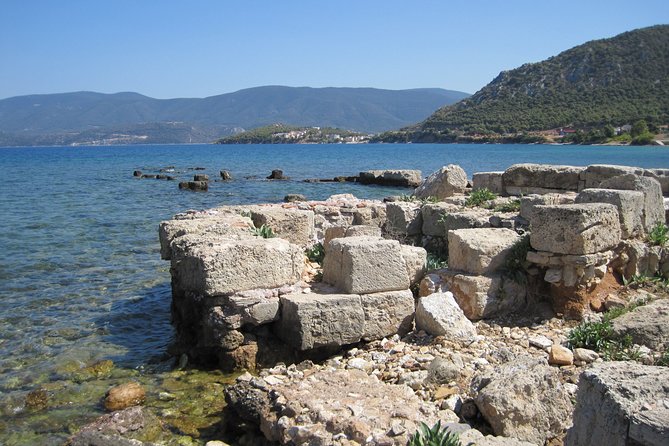
Kechries, the modern village at ancient Cenchreae, is the eastern port of Corinth associated with Paul’s departure by sea. The stop lasts about 30 minutes and admission is free.
Acts 18:18 places Paul at Cenchreae, where he had his hair cut after making a vow. In Romans 16:1, Paul refers to Phoebe, associated with the local Christian assembly. These references make Cenchreae especially important for readers who want more than a general Paul-themed outing.
The site is not presented as a large, fully restored monument. Its value comes from the setting and the biblical connection. You are looking at the port area where movement between Corinth and the wider Mediterranean world took place.
What the Driver Can and Cannot Do
The driver is more than a person behind the wheel. The strongest praise centers on clear communication, punctuality, warm conversation, and the ability to explain Greek history and Paul’s life during the drive.
Chris was singled out for sending pickup updates, providing a clean vehicle, water, chocolates, umbrellas, and even offering a jacket when rain arrived. Yiannis and Yannis were praised for patience, kindness, and flexible service. Panos, Alex, Christos, Andreas, and John were also praised for making the history understandable and personal.
Still, do not book this expecting an included licensed guide inside every ruin. The driver can explain the sites from outside and before you enter, but official guiding inside archaeological areas requires the additional licensed guide service. That is the most important practical limit of the tour.
Is $170.50 a Fair Price?
At $170.50 per person, this is not a budget bus outing. It is a private transport and interpretation service built around a long day beyond Athens. The value improves when two to four people share the vehicle, particularly if you want hotel or port pickup and a schedule shaped around your group.
You should add €15 per person for Ancient Corinth and €5 per person for Isthmia. Lunch is extra, gratuities are optional, and the licensed guide costs €160 per booking if you want formal guiding inside the sites.
For a cruise passenger, the price also buys peace of mind. Pickup and return are designed around the ship, and one guest specifically praised the guide for accommodating a return to the port before departure. Confirm your ship timing clearly before setting out, but the service is designed for this use.
The tour is less suitable if you want a slow archaeological study. With Areopagus, Daphni, the canal, Isthmia, Ancient Corinth, Cenchreae, Apollo, and St. Paul’s Church in one outing, some visits will feel brisk.
Who Should Book This Experience?
I would choose this tour if you are a Christian interested in Acts and the Corinthian letters, a first-time visitor seeking a private day outside Athens, or a cruise passenger with limited time. It also fits a small family or group that values personal pickup, flexible conversation, and a comfortable vehicle.
You will get the most from it if you read Acts 17 and 18, Romans 16, and First and Second Corinthians beforehand. Bring the passages on your phone or in a Bible. The ancient stones become much more useful when you know which names and events to watch for.
I would think twice if your main goal is the Acropolis, a long museum visit, or detailed archaeological instruction at every site. The emphasis is on connections, storytelling, and seeing many places in one day.
Final Verdict: A Strong Choice for Paul’s Corinth
I recommend this tour for its personal service, clear biblical focus, and unusually broad route. The private minivan, hotel or port pickup, water, Wi-Fi, and small-group format remove much of the effort involved in reaching Corinth.
Book it knowing that the schedule is full and formal site guiding costs extra. If you accept that tradeoff, you get a thoughtful way to connect Acts with real places, from Mars Hill to Cenchreae. For Bible readers and history-minded visitors, that connection is worth the time and the added cost.
FAQ
How long does the tour last?
The experience lasts approximately 6 hours and 15 minutes.
Where can pickup and drop-off take place?
Pickup and drop-off are offered from an Athens hotel, Airbnb apartment, or cruise ship port. Airport pickup is also available for an additional €60 per booking.
Is this a private tour?
Yes. Only your group participates. The advertised small-group format is generally two to four people, with a luxury minivan that can hold up to eight passengers.
Is the tour offered in English?
Yes. The tour is offered in English, and the driver provides historical and biblical commentary during the journey.
Is a licensed guide included?
No. The English-speaking driver provides information but cannot guide inside archaeological sites under Greek law. A licensed guide may be arranged for €160 per booking, subject to availability.
What entrance fees are extra?
Ancient Corinth costs €15 per person, and the Archaeological Site of Isthmia costs €5 per person. The Corinth Canal and Kechries stop do not have an admission charge listed.
Is lunch included?
No. Lunch stops are scheduled, but the cost of the meal is not included.
What is included in the vehicle?
Transportation is provided in a modern private vehicle with air-conditioning, Wi-Fi, and bottled water. Luggage storage may be possible, depending on how much you carry.
Can I cancel for a full refund?
You can cancel at least 24 hours before the start time for a full refund. Changes or cancellations made less than 24 hours before the start time are not accepted for a refund. If poor weather causes cancellation, you will be offered another date or a full refund.
Just added around Athens
- Athens Hotels to Athens Airport Private Departure Transfer★ 5.0 · 40 reviews
- Private One-way Transfer between Athens International Airport and Athens Hotels★ 4.5 · 40 reviews
- Athens: Acropolis Museum Ticket with Self-Guided Audio tour App★ 3.5 · 40 reviews
- From Athens: Meteora Train Trip with Overnight Stay★ 4.8 · 40 reviews
- Athens Photography Tour★ 5.0 · 40 reviews
- Athens: Acropolis Visit and City Night Tour★ 4.7 · 40 reviews
- Delphi Full Day Private Trip From Athens With Lunch Overlooking the Sea★ 5.0 · 40 reviews
- Acropolis & Plaka Neighbourhood Private Tour with Licensed Expert★ 5.0 · 40 reviews
Athens Tours, compared.
Acropolis & up to 5 Archaeological Sites Combo Pass
Read our review →
Acropolis, Parthenon & Acropolis Museum Guided Tour
Read our review →
Cape Sounion & Poseidon Temple Sunset Half-Day Trip
Read our review →

All Day Cruise -3 Islands to Agistri,Moni, Aegina with lunch and drinks included
Read our review →
Athens, Piraeus, and Coastline: Blue Hop-On Hop-Off Bus
Read our review →