Reviewed · ATHENS TOURS
Biblical Tour Letters to The Corinthians – St Paul’s Footsteps
Paul’s Corinth is more than a Bible footnote. This private Athens tour follows the apostle from Areopagus Hill to the Corinth Canal, Ancient Corinth, Isthmia, and the port of Cenchreae, linking scripture with the places where Paul preached, worked, and traveled. I especially like the freedom to adjust the route and the chance to use a private vehicle for up to four people.
I also like the drivers’ personal touch. Alex, Kostas, Spyros, Constantine, Pericles, and others have been praised for their history, local knowledge, patience, and ability to suggest extra stops. The main drawback is that the driver is not a licensed guide and does not enter the archaeological sites with you, unless you arrange a guide upgrade.
In This Review
- Key points to know before booking
- Why this private Corinth tour works for Christian history
- Leaving Athens at Areopagus Hill
- Crossing the Corinth Canal
- The Diolkos and the ancient transport route
- Isthmia, the games, and Paul’s working world
- Inside the Archaeological Site of Isthmia
- Ancient Corinth and the Bema
- The Temple of Apollo and Corinth’s older gods
- Cenchreae, the port where Paul set out
- Lunch by the sea and the climb to Akrokorinthos
- Vehicles, drivers, and the guide question
- Who should book this tour?
- Final verdict: a strong choice with one important upgrade
- FAQ
- How long does the St. Paul Corinth tour take?
- Is pickup included?
- How many people can join the private tour?
- Is the tour offered in English?
- Does the driver enter the archaeological sites?
- Can I request a licensed tour guide?
- Are admission fees included?
- Can I cancel for a full refund?
Key points to know before booking
- Paul’s Athens sermon begins at Areopagus Hill, the rocky meeting place linked with his speech about the Unknown God.
- The private format gives you control, including the vehicle type, pace, and possible itinerary changes.
- Ancient Corinth is the heart of the day, with Paul’s Bema, the Temple of Apollo, and the Roman Forum.
- Isthmia adds the athletic setting, including the sanctuary, stadium area, theater, and museum.
- Cenchreae connects Paul’s teaching with travel, since this eastern port was where he departed for Syria.
- The $386.18 group price covers up to four people, but site admission, lunch, and a licensed guide cost extra.
Why this private Corinth tour works for Christian history
The route has a clear purpose: it follows St. Paul’s footsteps through Athens and the Corinth region. You are not simply driving to a collection of ancient ruins. You are moving through the setting of Acts 17 and Acts 18, then considering the Corinthian church addressed in First and Second Corinthians.
That focus makes the tour especially useful if you want historical context for Paul’s letters. Corinth was a commercial crossroads between mainland Greece and the Peloponnese, with ports, temples, athletic contests, political gatherings, and people from many parts of the ancient world. Paul’s Christian message took root in a city already filled with competing ideas and religious traditions.
The private setup matters here. You can ask questions, pause at a place that interests you, or spend less time at a site you have already seen. One party used that flexibility to skip Mars Hill after visiting the Acropolis and spend more time around Corinth instead. That is exactly the kind of adjustment a private tour should allow.
The tour is priced at $386.18 per group of up to four. Split four ways, that is about $96.55 per person before admissions and lunch. For a full private day with hotel pickup, air-conditioning, bottled water, WiFi, and transportation, that can be good value, particularly for a family or small group. A couple pays more per person, but gains a private car and a route shaped around their interests.
More things to do in Athens:
- Athens: Acropolis & up to 5 Archaeological Sites Combo Pass
★ 4.4 · 12,619 reviews - Athens: Acropolis Ticket with Optional Audio or Live Guide
★ 4.2 · 11,055 reviews - Athens: Acropolis, Parthenon & Acropolis Museum Guided Tour
★ 4.8 · 9,316 reviews
Leaving Athens at Areopagus Hill
The day begins with pickup from your accommodation in Athens. The first stop is Areopagus Hill, also called Mars Hill, beside the Acropolis area.
This is where Paul addressed the Athenian council and spoke about the altar dedicated to an Unknown God. The stop is short, listed at about 20 minutes, and admission is free. You will need to take care on the rocky ground, but the setting gives the opening of the tour real force. Paul was speaking in the intellectual center of ancient Athens, not in a quiet rural outpost.
If you have already toured the Acropolis and Mars Hill, tell the driver before setting out. The private format means that this stop can potentially be shortened or skipped, giving you more time later in Corinth. If you want the full biblical sequence, keep it. It sets up the rest of the day well.
The driver can explain the setting in fluent English, but remember that drivers do not enter sites as official guides. Their commentary is useful between stops, while the actual archaeological areas are generally self-guided unless you arrange a licensed guide.
Crossing the Corinth Canal
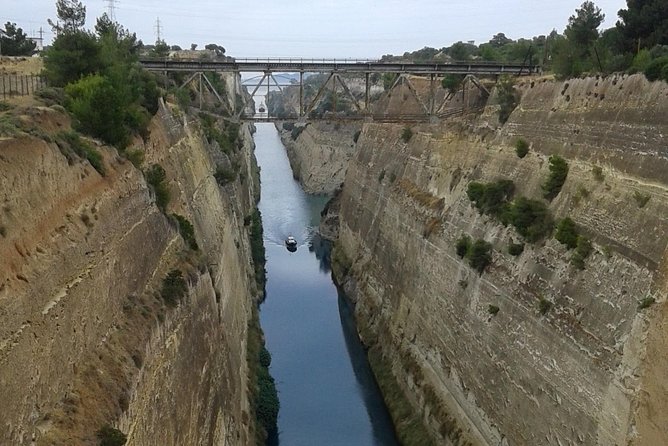
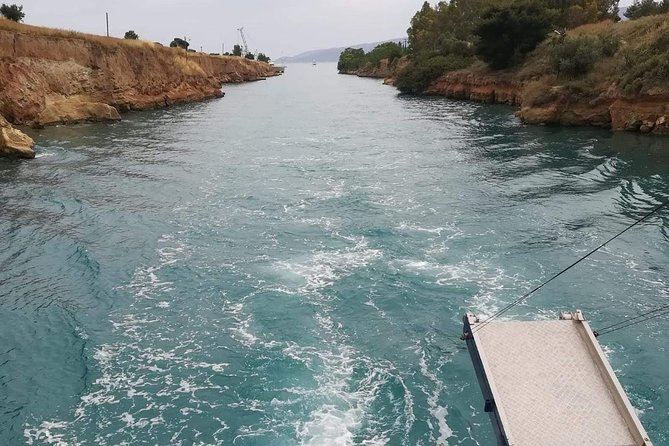
The drive from Athens to Corinth takes you toward the narrow isthmus that separates mainland Greece from the Peloponnese. The Corinth Canal is a quick but worthwhile stop, with about 30 minutes to look across the deep channel and take photographs.
The canal was completed in the 19th century, yet the idea is much older. Periander, ruler of ancient Corinth, reportedly imagined a shortcut for ships more than 2,000 years ago. Before the canal, vessels sailing around the Peloponnese had to cover roughly 185 additional nautical miles.
This is not a Roman or biblical monument, so it should not be confused with something Paul would have seen in its present form. Its value is geographical. The canal helps you understand why Corinth mattered. Control of this narrow passage gave the city influence over movement between the Aegean and Ionian Seas.
The Diolkos and the ancient transport route
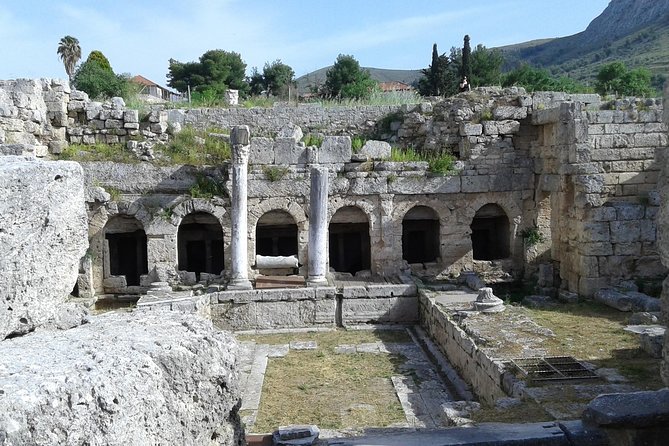
Near the canal, the Diolkos offers a look at an older solution to the same problem. In antiquity, ships and cargo could be moved across the Isthmus of Corinth rather than sailing around the Peloponnese.
The stop lasts about 20 minutes and is free. It is not the largest site on the route, but it gives useful context before you reach Ancient Corinth. Merchants, sailors, and cargo passed through this area, and the connection between trade and religion becomes easier to understand.
I would treat the Diolkos as a short orientation stop rather than a major attraction. If you are trying to spend extra time inside Ancient Corinth, this is one place you might keep brief.
A completely different sort of day out in Athens:
- Athens: Cape Sounion & Poseidon Temple Sunset Half-Day Trip
★ 4.8 · 8,241 reviews - Athens: Acropolis and Parthenon Guided Walking Tour
★ 4.6 · 5,882 reviews - All Day Cruise -3 Islands to Agistri,Moni, Aegina with lunch and drinks included
★ 5.0 · 4,958 reviews - Athens, Piraeus, and Coastline: Blue Hop-On Hop-Off Bus
★ 3.9 · 4,849 reviews
Isthmia, the games, and Paul’s working world
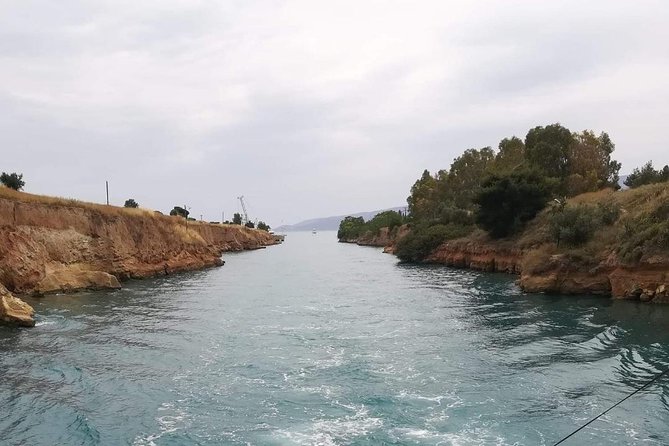
Isthmia brings together athletics, religion, politics, and Paul’s daily work. The sanctuary was home to the Isthmian Games, the second most important athletic competition in the ancient Greek world after the Olympics. The games honored Poseidon and drew athletes and spectators from across Greece.
The tour allows about an hour at the wider Isthmia area, followed by the museum and archaeological site. The setting helps explain the athletic language found in Paul’s letters. Images of training, racing, discipline, and competition made sense to people who lived near major games.
The tour also connects Paul with tentmaking work around Isthmia. The supplied account presents him as working near the games, serving athletes and people passing through while sharing the Christian message. That detail makes Paul feel less like a distant religious figure and more like a working man speaking with people in ordinary settings.
The Archaeological Museum of Isthmia takes about 30 minutes. Its displays include objects from the sanctuary of Poseidon, statues, votive offerings, burial finds, and glass panels from Kenchreai. Those glass panels are especially relevant because Cenchreae was the port from which Paul departed for Syria.
The museum admission is not included. The tour lists a combined entrance fee of €15 per person for Ancient Corinth and the Archaeological Museum of Corinth, though you should confirm the exact ticket arrangements for the sites you enter. Carry some time and budget for admissions rather than assuming every stop is free.
Inside the Archaeological Site of Isthmia
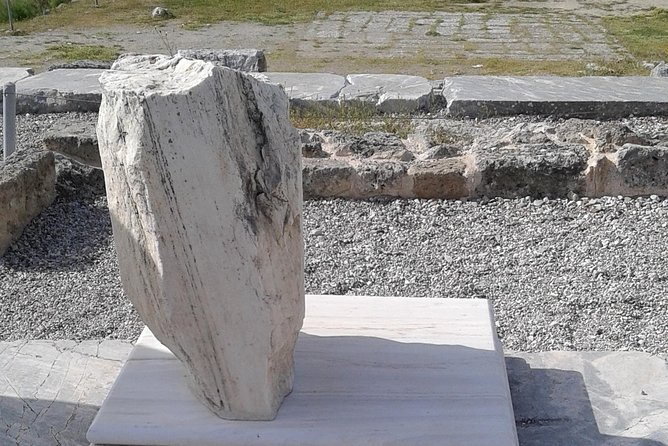
The archaeological site provides a closer look at the religious and sporting world Paul encountered. You can see remains associated with the Temple of Poseidon, the stadium, and the Sanctuary of Palaimon, a protector of sailors.
The ancient theater was used for musical events connected with the Isthmian Games. Roman mosaics with sea creatures and scenes from Dionysian myths add another layer to the site. This is where the tour’s Christian theme becomes a contrast between the pagan customs of Corinth and the faith Paul preached.
Some of the stops listed for Isthmia are short, around 40 minutes or less. That may be enough for a focused visit, but it will not feel like a slow archaeological study. If you want to read every sign and examine each ruin, tell the driver early and consider arranging the day around fewer stops.
Isthmia also had a role in political and military meetings because of its strategic position. That detail is easy to miss, yet it matters. Paul was preaching in a place where athletes, merchants, religious officials, politicians, and military figures already crossed paths. His audience was varied, and the location helps explain the reach of the early Corinthian church.
Ancient Corinth and the Bema
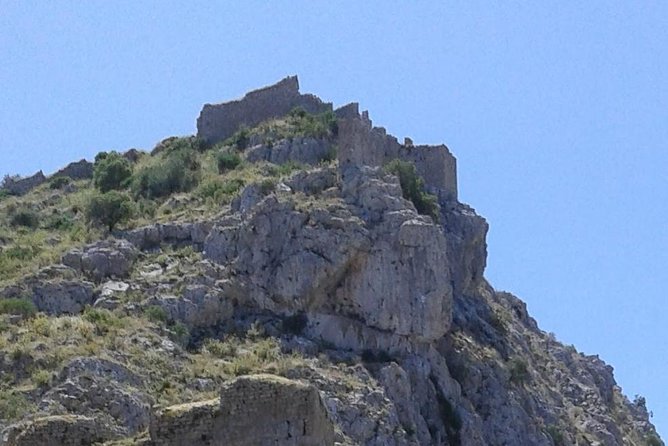
Ancient Corinth is the main event. Plan on about an hour at the site, though the exact pace depends on your group and whether you use a licensed guide.
Paul lived and preached in Corinth for more than 18 months, around 51 to 52 AD. The city was an important center of trade and culture, and Paul’s letters to the Corinthians later addressed disputes, moral questions, worship, leadership, and the practical problems of a growing Christian community.
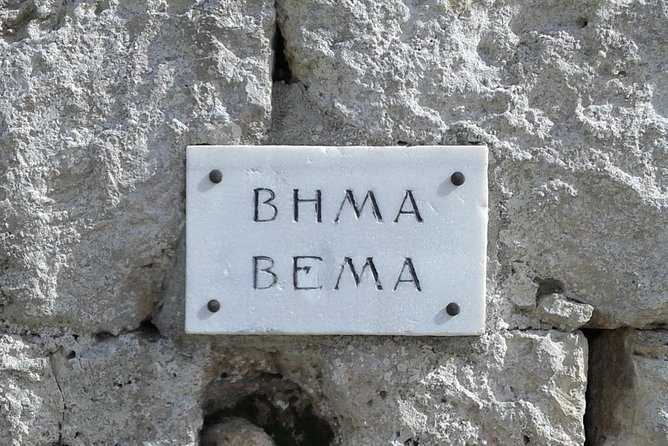
The Bema, or judgment seat, is the most important Paul-related feature. According to Acts, Paul was brought before the Roman proconsul Gallio after being accused of illegal teaching. Gallio treated the matter as a religious dispute and refused to intervene. That decision allowed Paul to continue his work without Roman action against him.
Standing near the Bema gives the biblical account a firm physical setting. You can picture the Roman forum, the public accusations, and Paul defending his mission in a city where civic authority and religious debate were closely linked.
Ancient Corinth is also where the limits of the driver arrangement become clear. Your driver can explain the site before or after you enter, but will not accompany you inside as an official guide. If scripture and archaeology are the main reason you are booking, request a licensed guide when reserving. Availability is not guaranteed, so ask early.
The Temple of Apollo and Corinth’s older gods
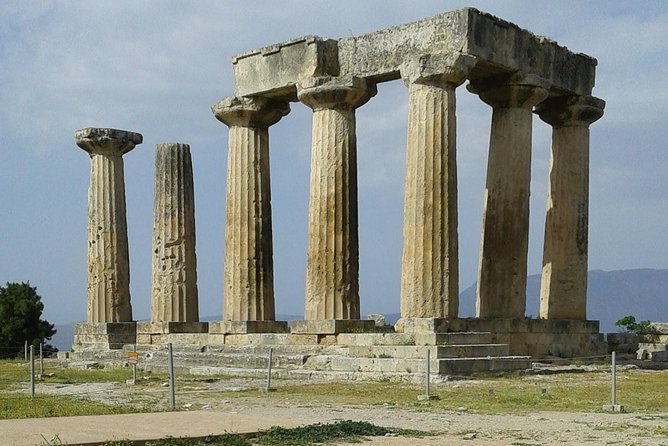
The Temple of Apollo is one of the most recognizable remains at Ancient Corinth. Built around 560 BC, it is an early Doric temple with large monolithic limestone columns.
Paul would have seen the temple dominating the ancient city. Its presence gives you a strong sense of the religious setting he faced. He was not speaking into an empty spiritual space. Corinth had established gods, temples, public rituals, and traditions that shaped daily life.
The temple stop is listed at about 30 minutes and is free as a viewing point within the site itinerary. It is a good place to pause and consider the scale of Paul’s challenge. His message about one God and Jesus Christ was proclaimed among major pagan monuments, not apart from them.
Cenchreae, the port where Paul set out
Kechries is the modern name used for ancient Cenchreae, Corinth’s eastern port. This coastal stop takes about 30 minutes and is free.
Acts 18:18 places Paul at Cenchreae during his second missionary journey. Before leaving for Syria with Priscilla and Aquila, he cut his hair to fulfill a vow. The account also connects Cenchreae with Phoebe, whom Paul commends in his letter to the Romans as a servant of the church there.
This stop is quieter than Ancient Corinth and more reflective. You are looking at a port site tied to departure, travel, and the spread of Christian communities. It reminds you that Corinth was not only a city where Paul preached. It was also a base from which he continued his mission.
Lunch by the sea and the climb to Akrokorinthos
Lunch is not included, but the route allows about an hour at a traditional seaside Greek taverna in Corinth. That is a practical break after several archaeological stops. You pay for your own meal, and the tour does not set a fixed lunch price.
Akrokorinthos is the final major stop. The fortress rises above Ancient Corinth and provides wide views over the area. The tour allows about 40 minutes, so expect a brief visit rather than a full exploration of the fortress.
The climb and uneven ground may not suit every group. If you have limited mobility, ask the provider how far the vehicle can take you and how much walking is required. If you can make the approach, the height gives useful geographic context. You can see why Corinth was valuable as a defensive and commercial center, and why Paul’s work there reached beyond one small neighborhood.
A church dedicated to the Apostle Paul, called Apostolou Pavlou, adds a modern Christian stop. It honors the period when Paul spent about 18 months in Corinth and helped establish one of Greece’s early Christian communities. The visit is short, about 20 minutes, but gives the day a present-day place for prayer and reflection.
Vehicles, drivers, and the guide question
You can choose among several vehicle types, including a private sedan or a larger option. Make sure the vehicle you book matches your expectations. One unhappy booking involved a sedan, while the passenger expected a van. The provider stated that the sedan had been booked and supplied as described.
The package includes air-conditioning, bottled water, WiFi, private transportation, and a professional driver. The strongest praise has gone to the drivers’ punctuality, patience, local route knowledge, and personal commentary. Alex helped one group adjust the day around an existing Athens visit. Kostas was praised for finding important sites and good photo locations. Spyros, Constantine, Pericles, and others were described as friendly and well informed about Corinth and Paul.
That said, a driver is not the same as a licensed guide. Drivers can answer questions and provide commentary in fluent English, but they do not enter the sites with you. If you want formal archaeological interpretation, biblical source discussion, and help reading site details, request the licensed guide upgrade.
Who should book this tour?
I would choose this tour if you want a private, faith-focused day outside Athens and prefer flexibility over a fixed coach schedule. It suits families, couples, and small groups of up to four, especially when the cost can be shared.
It is also a good choice for cruise passengers or people with limited time in Athens who want transportation handled from pickup to return. The route covers a lot, so you can see the canal, Isthmia, Ancient Corinth, Cenchreae, and Akrokorinthos without arranging several separate transfers.
I would be more cautious if you want slow, detailed archaeology. The itinerary is ambitious, and one party found the pace too fast even though every listed place was visited. Tell the driver what matters most, and do not hesitate to drop a minor stop in favor of more time at Ancient Corinth.
Free cancellation is available up to 24 hours before the start time. Cancellations or changes inside that window are not accepted for a refund.
Final verdict: a strong choice with one important upgrade
Book this St. Paul tour if being in the places connected with Acts and the Corinthian letters matters more to you than having a formal guide at every ruin. The private car, hotel pickup, adjustable schedule, and highly praised drivers give it real practical value.
For the best version of the day, request a licensed guide and confirm the vehicle type before departure. Budget separately for the €15 site admission listed for Ancient Corinth and the museum, plus lunch. With those details settled, this is a thoughtful way to connect Athens, Corinth, Isthmia, and Cenchreae into one focused day.
FAQ
How long does the St. Paul Corinth tour take?
The experience lasts approximately eight hours.
Is pickup included?
Yes. This is a private tour, and pickup is offered from your accommodation.
How many people can join the private tour?
The price covers one private group of up to four people.
Is the tour offered in English?
Yes. The tour is offered in English, and drivers can provide commentary in fluent English.
Does the driver enter the archaeological sites?
No. The drivers are not official licensed guides and do not accompany you inside the sites. They can answer questions and provide historical commentary outside them.
Can I request a licensed tour guide?
Yes. A licensed guide can be requested, subject to availability.
Are admission fees included?
No. The listed entrance fee for Ancient Corinth and the Archaeological Museum of Corinth is €15 per person and can be paid on site. Lunch is also not included.
Can I cancel for a full refund?
Yes, if you cancel at least 24 hours before the experience start time. Cancellations made less than 24 hours in advance are not refunded.
Just added around Athens
- Athens Hotels to Athens Airport Private Departure Transfer★ 5.0 · 40 reviews
- Private One-way Transfer between Athens International Airport and Athens Hotels★ 4.5 · 40 reviews
- Athens: Acropolis Museum Ticket with Self-Guided Audio tour App★ 3.5 · 40 reviews
- From Athens: Meteora Train Trip with Overnight Stay★ 4.8 · 40 reviews
- Athens Photography Tour★ 5.0 · 40 reviews
- Athens: Acropolis Visit and City Night Tour★ 4.7 · 40 reviews
- Delphi Full Day Private Trip From Athens With Lunch Overlooking the Sea★ 5.0 · 40 reviews
- Acropolis & Plaka Neighbourhood Private Tour with Licensed Expert★ 5.0 · 40 reviews
Athens Tours, compared.
Acropolis & up to 5 Archaeological Sites Combo Pass
Read our review →

Acropolis, Parthenon & Acropolis Museum Guided Tour
Read our review →
Cape Sounion & Poseidon Temple Sunset Half-Day Trip
Read our review →

All Day Cruise -3 Islands to Agistri,Moni, Aegina with lunch and drinks included
Read our review →
Athens, Piraeus, and Coastline: Blue Hop-On Hop-Off Bus
Read our review →