
Reviewed · AUDIO TOURS
Athens: Roman Agora E-Ticket and Audio Guide
Ancient Athens fits in a small space. This $18 Roman Agora ticket combines skip-the-line entry with an offline audio tour, making it easy to visit the Gate of Athena Archegetis, Tower of the Winds, fountain house, shops, and mosque at your own pace. I like the downloadable storytelling and the fine Acropolis view, especially for a first visit to Athens. The main catch is the short visit, usually 45 minutes to an hour, which can make the price feel high if you only want a quick look.
I also like that the audio works in six languages and does not require mobile data once downloaded. You will need your own charged smartphone and headphones, though, and the app’s directions may take some patience. One French booking review found the audio hard to follow around the site, while another praised it for bringing the ancient setting to life. That difference tells you exactly what to expect: good content, but not a live guide to point you in the right direction.
In This Review
- Key points before you book
- What the Roman Agora adds to an Athens day
- Entering through the Gate of Athena Archegetis
- Meeting the Winds at the Tower of the Winds
- Fountain house, shops, and ancient public routines
- The Mosque of the Conqueror and later layers
- How the audio guide works in practice
- Finding your way without a live guide
- The Acropolis view and the value of a short visit
- Accessibility, comfort, and timing
- Who will get the most from this experience
- Should you book the Roman Agora audio guide?
- FAQ
- How long does the Roman Agora audio tour take?
- What does the $18 price include?
- Is there a live guide?
- Do I need a smartphone?
- Do I need headphones?
- Can I use the audio tour without mobile data?
- Which languages are available?
- Is the app compatible with Windows phones?
- How much storage space do I need?
- Are reduced admission tickets included with skip-the-line access?
Key points before you book
- A compact archaeological visit: Plan on 45 minutes to one hour for the Roman Agora itself.
- Three standout sights: The Gate of Athena Archegetis, Tower of the Winds, and Mosque of the Conqueror form the core of the visit.
- Audio works offline: Download the app, narration, text, and maps before arriving to avoid roaming charges.
- No live guide: You explore independently, with no group meeting point or hotel transportation.
- Six language choices: Audio is available in English, Spanish, German, French, Italian, and Greek.
- Bring the right gear: You need a charged Android or iOS phone, 100 to 150 MB of free storage, and headphones.
What the Roman Agora adds to an Athens day
The Roman Agora is a small archaeological site near the heart of old Athens. It gives you a close look at practical city life during the Roman period, rather than only grand temples and heroic statues.
That difference matters. At larger ancient sites, it is easy to focus on monumental architecture and miss the ordinary machinery of urban life. Here, the fountain house, shops, toilets, and public buildings help you think about how people actually used Athens.
You can also see the long change from classical Greek city to Roman-era settlement. The site carries traces of civic activity, trade, sanitation, religion, and later Ottoman use. The audio tour’s short stories are designed to connect those remains with daily habits and historical events.
The Roman Agora is not a huge complex. That is both its strength and its limit. You will not spend half a day wandering between distant ruins, and you do not need a detailed route plan. But if you expect another Acropolis-sized monument, you may find the visit modest.
More things to do in Athens:
- Athens: Acropolis & up to 5 Archaeological Sites Combo Pass
★ 4.4 · 12,619 reviews - Athens: Acropolis Ticket with Optional Audio or Live Guide
★ 4.2 · 11,055 reviews - Athens: Acropolis, Parthenon & Acropolis Museum Guided Tour
★ 4.8 · 9,316 reviews
Entering through the Gate of Athena Archegetis
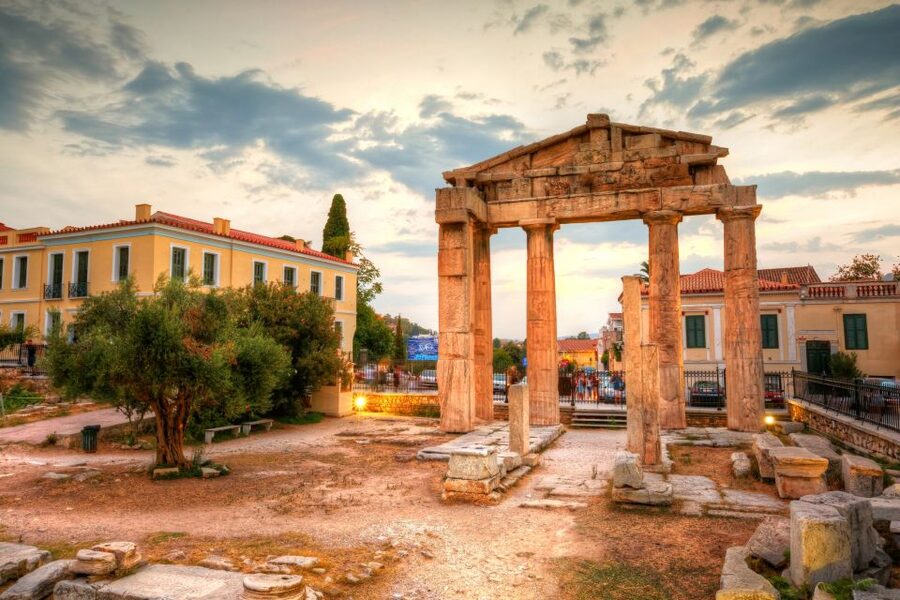
The Gate of Athena Archegetis is one of the most impressive surviving features of the site. Its columns and broad stone form create a clear sense of arrival, even though the Roman Agora itself is compact.
The gate was built as an entrance to the marketplace area. It helps you picture the Roman Agora as a working part of the city, not just an archaeological field. Listen to the opening audio material here, then pause to examine the proportions and surviving stonework.
This is a good place to use the map in the app. A self-guided tour gives you freedom, but you must keep track of where you are. The most useful approach is simple: stop at each major feature, start the matching audio section, and look around before moving on.
If your phone screen is difficult to read in bright sun, download the content and check the map before entering. The audio can be used offline, and you will not need to depend on a steady signal while walking.
Meeting the Winds at the Tower of the Winds

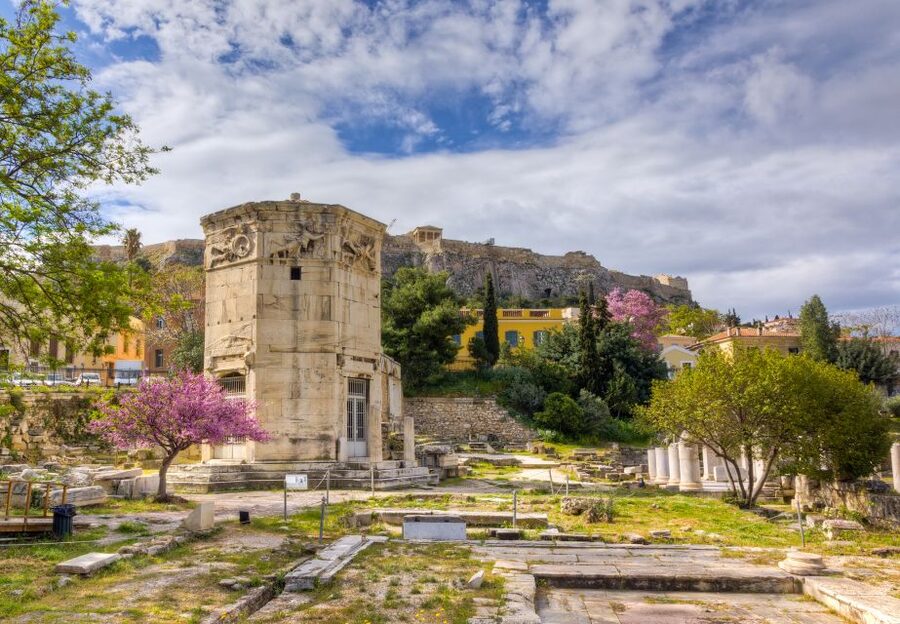
The Tower of the Winds is the site’s star attraction. This unusual octagonal building served as a water clock, weather station, and timekeeping structure. Its connection with the winds gives the audio tour a natural story to tell, and it adds a bit of personality to an otherwise practical ancient complex.
Look closely at the carved figures associated with the winds around the tower. The building is valuable not only for its appearance but also for what it reveals about Greek and Roman interest in weather, time, water, and measurement.
This stop rewards a slow look. You might be tempted to take a quick photograph and move on, but the structure makes more sense when you understand its purpose. The audio narration can help you connect the carvings and engineering with everyday needs in ancient Athens.
The Tower of the Winds is also where the self-guided format feels most natural. You can listen, stop the narration, examine the building, and replay a section without holding up a group. If you prefer lively conversation with a person, however, the absence of a live guide will be noticeable.
Fountain house, shops, and ancient public routines
The fountain house and shops provide some of the most useful context in the Roman Agora. These remains are less famous than the tower, but they help explain how the space functioned.
A fountain house points to the importance of water in city life. Shops suggest commerce and the steady movement of goods and people. The Vespasianae, or public toilets, offer another reminder that ancient cities depended on basic public facilities just as modern cities do.
These details may sound less glamorous than marble columns, but they make the visit more human. You begin to think about errands, water collection, buying goods, and public life rather than only emperors and temples.
The audio content is especially useful at these smaller remains because ruins can be hard to read without help. Walls and foundations rarely explain themselves. A short story can give each area a purpose and help you understand why it mattered.
Still, keep your expectations measured. The site is described as a pocket-size journey through two thousand years, not a fully reconstructed ancient neighborhood. You will see remains and interpretive material, not a complete marketplace restored to its original appearance.
More self guided tours in Athens:
- Athens: Cape Sounio & Poseidon Temple Trip with Audio Guide
★ 4.4 · 4,521 reviews - Athens: Acropolis Ticket with Audio Guide
★ 4.0 · 3,575 reviews - From Athens: Delphi Full Day V.R. Audio Guided Tour
★ 4.6 · 3,028 reviews - Athens: Acropolis Museum Ticket with optional Audio Guide
★ 4.4 · 2,652 reviews
The Mosque of the Conqueror and later layers
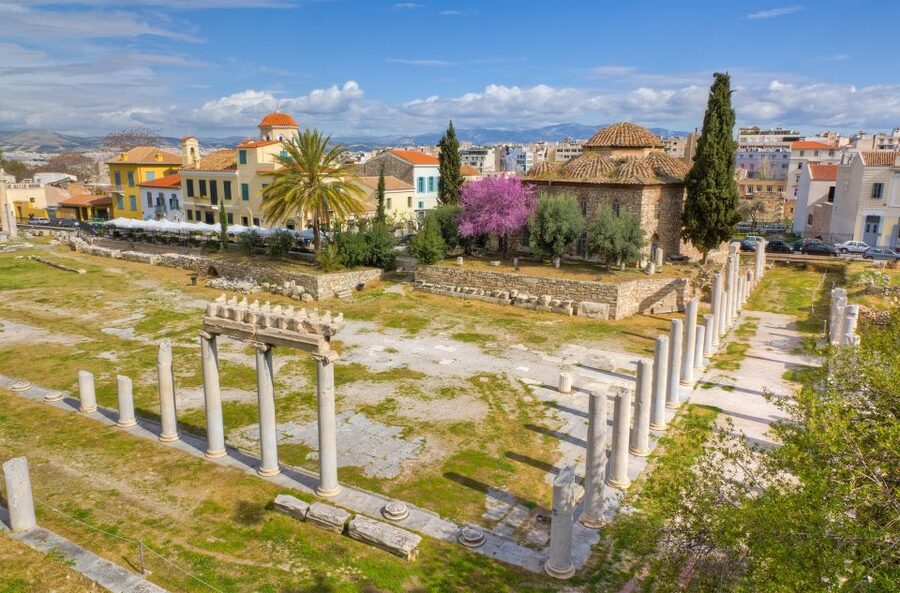
The mosque adds a later chapter to the Roman Agora. Its presence shows that the area continued to matter after the ancient Greek and Roman periods.
This is one of the strongest reasons to use an audio guide. Without context, the mosque may seem disconnected from the classical ruins around it. With narration, you can place it within the changing story of Athens and understand that archaeological sites often contain several periods at once.
The tour also encourages you to look beyond the most famous ancient layer. Athens is not only a classical Greek city frozen in time. Roman, Byzantine, Ottoman, and modern influences have all shaped what you see.
The site’s mixture of buildings and remains makes it a worthwhile addition if you like history presented through physical evidence. If your schedule is very tight and you want only the most famous classical monuments, you may prefer to spend your limited time elsewhere.
How the audio guide works in practice
After booking, you receive an email with instructions and an activation link. Download the app and the audio tour before you arrive. Check your spam folder if the message does not appear promptly.
The content includes audio narration, written information, and maps. It is stored offline, which is helpful if you do not have a Greek SIM card or want to avoid roaming costs.
You can use the tour at any time before or after your visit, and it can be replayed. That flexibility is useful if you want to preview the site before arriving or revisit the stories later in your hotel.
The audio is available in English, Spanish, German, French, Italian, and Greek. Choose the language that lets you follow historical details most comfortably, even if that differs from the language you normally use on tours.
There is one practical warning: the product is sold per device, not per person. If two people want to listen separately, each device needs access. You will also need an Android phone running version 5.0 or later, or a compatible iPhone. Windows phones are not supported, and several older Apple devices are excluded.
Free space of 100 to 150 MB is required. Charge your phone fully, bring headphones, and download everything on reliable Wi-Fi. These are small steps, but they prevent the most common problems with app-based tours.
Finding your way without a live guide

There is no live guide and no standard meeting point for the audio experience. The meeting details can vary by the option booked, so read the arrival instructions carefully rather than assuming someone will meet you at the entrance.
The lack of a guide gives you control. You can linger at the Tower of the Winds, move quickly through a less interesting section, or pause the narration when the site gets busy.
It also means you must manage the route yourself. One French-language booking review gave the audio a very poor rating because the user found orientation difficult. That is a fair concern with any self-guided tour, especially at a compact archaeological site where several remains sit close together.
Use the map before you start. Match the narration to visible features, and do not be afraid to pause and reposition yourself. If you want constant direction, explanations tailored to your questions, or help identifying every stone, hire a live guide instead.
The Acropolis view and the value of a short visit
The Roman Agora offers a splendid view of the Acropolis. That view adds value because you can connect the smaller Roman-era site with Athens’ larger ancient setting.
Allow at least 45 minutes if you want to listen to the main audio sections and examine the principal buildings. An hour gives you more breathing room for photographs, the shops, fountain house, Vespasianae, and mosque.
The short duration can work well between larger Athens sights. It is easy to add a compact visit to a day focused on the Acropolis, Plaka, or other central attractions. You get archaeological context without committing to a long guided outing.
The price is harder to judge. At $18 per person, the ticket may be reasonable if you value skip-the-line entry, offline narration, and the chance to explore without a group schedule. It feels less attractive if the site is quiet and you could buy a ticket easily at the entrance.
One recent booking review made exactly this point: the ticket seemed expensive for the amount of time, and purchasing on-site appeared easy because the site was nearly empty. Yet the same person strongly praised the audio guide. Your value calculation should therefore depend on the narration, not just admission.
The adult ticket includes skip-the-line service. Free and reduced admission tickets do not receive skip-the-line privileges and must be obtained at the on-site ticket booth. If you qualify for reduced admission, check the rules before paying for this product.
Accessibility, comfort, and timing
The Roman Agora is partially accessible for people with disabilities. Because the site is archaeological, surfaces and routes may not be equally easy throughout, so confirm your needs before booking if full access is essential.
Wear comfortable shoes. You will be walking over an outdoor archaeological site while looking between your phone and the ruins, so stable footwear matters.
The stated duration is 45 minutes to one hour, but your pace is your own. Audio tours often take longer when you pause for photographs or replay a section. They can also take less time if you skip stories.
The course of the visit may be modified, and special restrictions can be imposed. Follow the instructions in effect on the day of your visit.
Do not expect transportation, food, drinks, or hotel pickup. This is simply admission plus digital interpretation, so plan the visit as one stop within your own Athens day.
Who will get the most from this experience
I would recommend it most to independent visitors who want more than bare admission but do not want to join a scheduled group.
It suits you if you:
- Like to set your own pace
- Prefer audio stories to long written signs
- Want information in one of six languages
- Have a compatible smartphone and headphones
- Enjoy connecting famous monuments with ordinary city life
- Have roughly an hour for a central Athens sight
Families may appreciate the freedom to pause or skip sections, though each person needs access through the appropriate device arrangement. History-minded visitors will likely enjoy the details about the Tower of the Winds, shops, fountain house, and Vespasianae.
I would be more cautious if you dislike phone-based tours, have trouble navigating without a guide, or are choosing the ticket mainly for the admission price. In those cases, the audio may not justify the extra cost.
Should you book the Roman Agora audio guide?
Book it if you want a short, flexible visit with useful historical narration and skip-the-line adult entry. The Tower of the Winds, Gate of Athena Archegetis, Acropolis view, and practical remains give the Roman Agora more substance than its size suggests.
Skip it if you only want to step inside, take a few photographs, and leave, especially when the site appears quiet and an on-site ticket is easy to buy. The $18 price is mainly paying for convenience and interpretation.
My best advice is to treat this as a focused one-hour history stop, not a major half-day attraction. Download the app before leaving your hotel, charge your phone, bring headphones, and use the map to keep your bearings. Do that, and the Roman Agora can turn a small collection of ruins into a clear picture of how Athens worked across several eras.
FAQ
How long does the Roman Agora audio tour take?
The stated duration is 45 minutes to one hour.
What does the $18 price include?
It includes an adult entry ticket to the Roman Agora, skip-the-line service, and a self-guided audio tour for a smartphone.
Is there a live guide?
No. This is a self-guided audio tour, and no live guide is provided.
Do I need a smartphone?
Yes. You need a compatible Android or iOS smartphone to download and use the app and audio tour.
Do I need headphones?
Headphones are not supplied, but they are listed as something to bring. They make it easier to hear the narration while walking around the site.
Can I use the audio tour without mobile data?
Yes. The tour includes offline text, audio narration, and maps. Download the content before your visit.
Which languages are available?
The audio guide is available in English, Spanish, German, French, Italian, and Greek.
Is the app compatible with Windows phones?
No. Windows phones are not compatible. Some older Apple devices are also excluded, including iPhone 5, iPhone 5C, older iPod Touch models, iPad 4th generation or older, and iPad Mini 1st generation.
How much storage space do I need?
You need approximately 100 to 150 MB of free storage on your phone.
Are reduced admission tickets included with skip-the-line access?
No. Free and reduced admission tickets must be obtained at the on-site ticket booth and do not include skip-the-line privileges.
More Audio Tours in Athens
- Athens: Acropolis Ticket & Optional Self-Guided Audio Tours
★ 4.1 · 2,542 reviews - Parthenon & Acropolis Museum with Audio or Live Tour Option
★ 4.1 · 2,446 reviews - Athens: Peloponnese Highlights Day Trip and V.R. Audio Guide
★ 4.5 · 1,425 reviews - Athens: Acropolis Ticket with Multilingual Audio Guide
★ 3.9 · 926 reviews
Just added around Athens
- Athens Hotels to Athens Airport Private Departure Transfer★ 5.0 · 40 reviews
- Private One-way Transfer between Athens International Airport and Athens Hotels★ 4.5 · 40 reviews
- Athens: Acropolis Museum Ticket with Self-Guided Audio tour App★ 3.5 · 40 reviews
- From Athens: Meteora Train Trip with Overnight Stay★ 4.8 · 40 reviews
- Athens Photography Tour★ 5.0 · 40 reviews
- Athens: Acropolis Visit and City Night Tour★ 4.7 · 40 reviews
- Delphi Full Day Private Trip From Athens With Lunch Overlooking the Sea★ 5.0 · 40 reviews
- Acropolis & Plaka Neighbourhood Private Tour with Licensed Expert★ 5.0 · 40 reviews
Audio Tours, compared.


Cape Sounio & Poseidon Temple Trip with Audio Guide
Read our review →
Acropolis Museum Ticket with optional Audio Guide
Read our review →
Acropolis Ticket & Optional Self-Guided Audio Tours
Read our review →
Parthenon & Acropolis Museum with Audio or Live Tour Option
Read our review →
Knossos Palace Entry Ticket with Optional Audio Guide
Read our review →Browse the lists this tour appears in